Footwear Product Development
Running Shoe Material Specification for OEM Quote
A buyer-prepared way to separate running-shoe product descriptors from the component decisions and questions needed for an OEM inquiry.
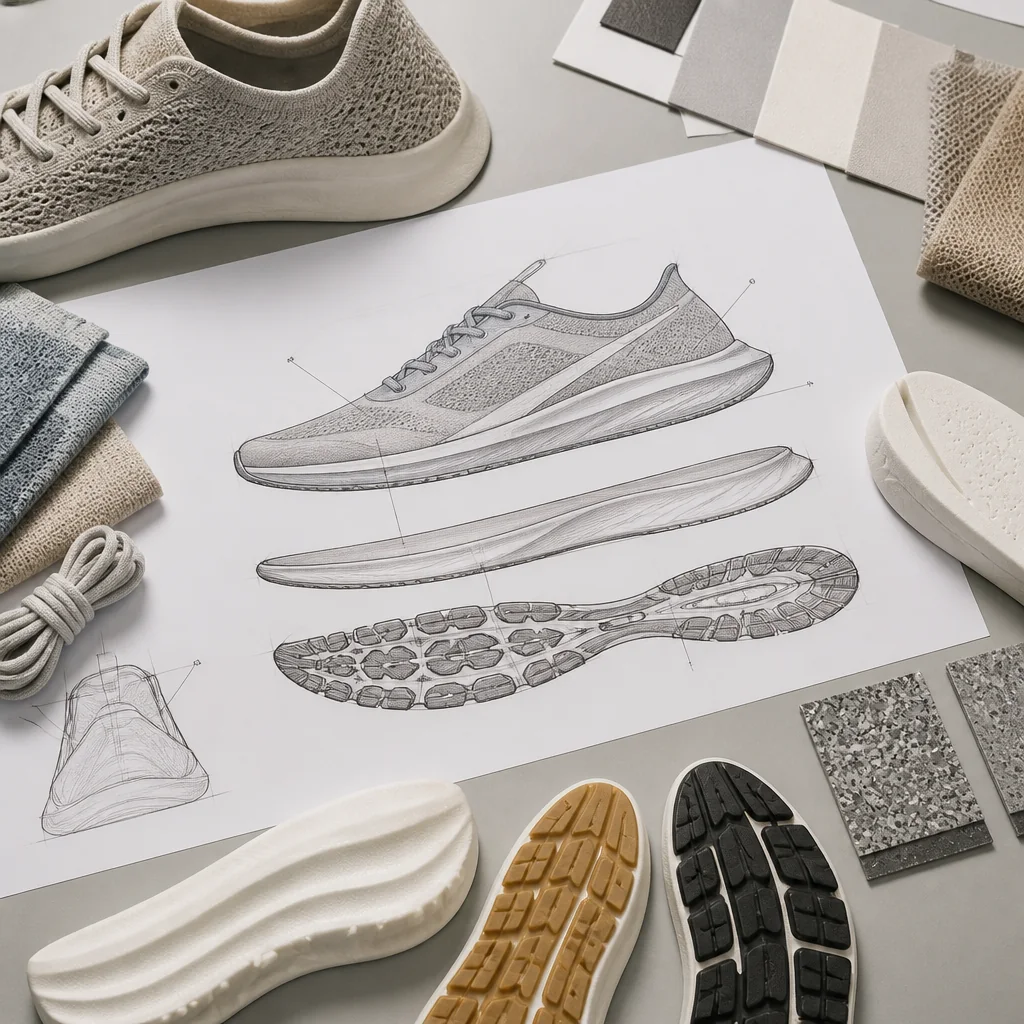
Buyers searching for a running shoe material specification for OEM quote are often working from a short product description, a visual reference, and a few material words. The practical task is to show what is already a component instruction, what is only a direction, and what has not been chosen. That makes the submission easier to read without treating a range description as a final construction.
This article offers an editorial recommendation for a buyer's own inquiry record. It does not describe a documented Custom Shoe Factory form, approval sequence, or material-selection service.
A Buyer Record, Not a Materials Slogan
A broad phrase such as "breathable upper" may be useful product language, yet it does not by itself state a selected material or a complete construction instruction. The same applies to a cushioning objective for the midsole. For an athletic footwear material specification, give upper, midsole, and outsole separate entries, then give each entry a visible status.
- Defined
- Use this status for a buyer decision intended as a current instruction. Identify the component and the material or construction detail that has been selected, along with the reference that represents the decision.
- Directional
- Use this for an intended appearance or product objective that should guide discussion but is not yet a fixed material instruction. A directional entry can preserve the buyer's intent without presenting it as a settled construction.
- Open
- Use this where the buyer needs information before choosing. State the affected component and write the unresolved question plainly, instead of leaving an unqualified note such as "material to be confirmed."
The labels are editorial tools for the buyer, not factory terminology. Their purpose is simple: a reader should be able to distinguish a present instruction from an item that still needs discussion. In practical terms, running shoe upper and outsole materials belong on separate lines because they are separate component decisions.
What Does the Published Range Identify?
The published running-shoe range describes performance-inspired daily-training builds. It describes breathable uppers and cushioned midsoles. Separately, the range names mesh, knit, and PU uppers. It names EVA and rubber outsoles.
Those statements identify language used for the displayed range. They do not identify a settled bill of materials for a buyer's new concept. In the buyer record recommended here, treat the descriptors as prompts for component questions, then mark the current answer as defined, directional, or open.
| Component | Published range wording | Editorial record to prepare |
|---|---|---|
| Upper | Breathable uppers; mesh, knit, and PU uppers. | Record a selected upper material only when it is a current buyer instruction. Otherwise, record the visual or product direction and the question still to be discussed. |
| Midsole | Cushioned midsoles. | Record cushioning as an intended objective. Keep any known construction decision in its own field, or mark that field open when no decision has been made. |
| Outsole | EVA and rubber outsoles. | State whether the material note is defined, directional, or open. Keep any applicable sole reference separate from an unresolved material question. |
The table is not a material catalog or a promise that a listed material applies to every project. It is a way for a buyer to turn published vocabulary into a readable starting record.
Intent Is Not a Construction Choice
Breathability and cushioning can be useful buyer-defined objectives, but they should sit beside the physical material entry. The published running-shoe description uses those terms for its range; an inquiry still needs to state whether the buyer has made a construction choice for the project.
- Write the intended attribute. Place breathability or cushioning in an intent field tied to the relevant component.
- Record the current physical decision. Enter the selected material or construction only when the buyer has selected it. Otherwise, retain a directional or open status.
- Ask the remaining component question. Connect the question to the upper, midsole, or outsole so the scope of the discussion is clear.
As an editorial recommendation, this arrangement keeps an intended attribute from being read as a performance promise or as an implied material choice.
The OEM Boundary
The OEM and ODM page states that Custom Shoe Factory manufactures to the buyer's tech pack and design. It states that manufacturability issues are flagged during DFM. The same OEM statement says the buyer's bill of materials is held across reorders. It separately says the buyer's tooling is held across reorders.
| Documented OEM statement | Buyer-record implication |
|---|---|
| Manufacture is to the buyer's tech pack and design. | Identify the current buyer design and tech-pack inputs when they exist, and make unresolved material fields visible. |
| Manufacturability issues are flagged during DFM. | Keep a focused question attached to any component decision that remains open. |
The cited excerpt does not establish that the company independently selects materials, creates the buyer's tech pack, redesigns the product, validates a material choice, or approves the buyer's specification. A buyer should therefore present open fields as questions about applicable options, not as instructions that assume those roles.
Product-Family Context
The company profile describes Custom Shoe Factory as focused on sport footwear. It names running, training, walking, and casual sneakers as its product family. A buyer developing a running-shoe concept can use that statement as category context, while keeping material availability, construction suitability, and project-specific decisions open for discussion where they have not been established.
A Buyer-Prepared Quote Record
The following is an editorial checklist for a buyer preparing an inquiry. It is not a required Custom Shoe Factory workflow or a statement of guaranteed quotation, development, or sampling services. Its role is to clarify OEM shoe quotation requirements while showing which decisions are still in progress.
- Current product definition: Identify the running-shoe concept and include the current design references, drawings, or tech-pack inputs available to the buyer.
- Separate component entries: List upper, midsole, and outsole independently. Give each material-related line a defined, directional, or open status.
- Intent beside construction: Record intended attributes separately from material choices, so a product objective is not mistaken for a final instruction.
- Controlling references: Identify the buyer file or visual reference that represents each defined decision, and make conflicting references visible.
- Open questions: Ask which development, manufacturability, sampling, or quotation options may apply to the affected component and current product definition.
Share the current product definition through the quote request page. A clear inquiry distinguishes settled component instructions from questions that still need discussion.
Sources and verification
- Athletic Shoe Manufacturer | Custom Product Range First-party site source
- OEM / ODM Shoe Development | Custom Footwear Manufacturing First-party site source
- About Custom Shoe Factory | OEM/ODM Athletic Shoes First-party site source
Share the current product definition and ask which development, manufacturability, sampling or quotation options may apply to the project.
Send your project brief