OEM Footwear Sourcing
OEM Running Shoe Material Options in Early Product Briefs
Published running-shoe material terms can help frame an early brief. They do not define a project-specific upper, midsole, or outsole construction. Use the terms as range context, then ask focused questions.
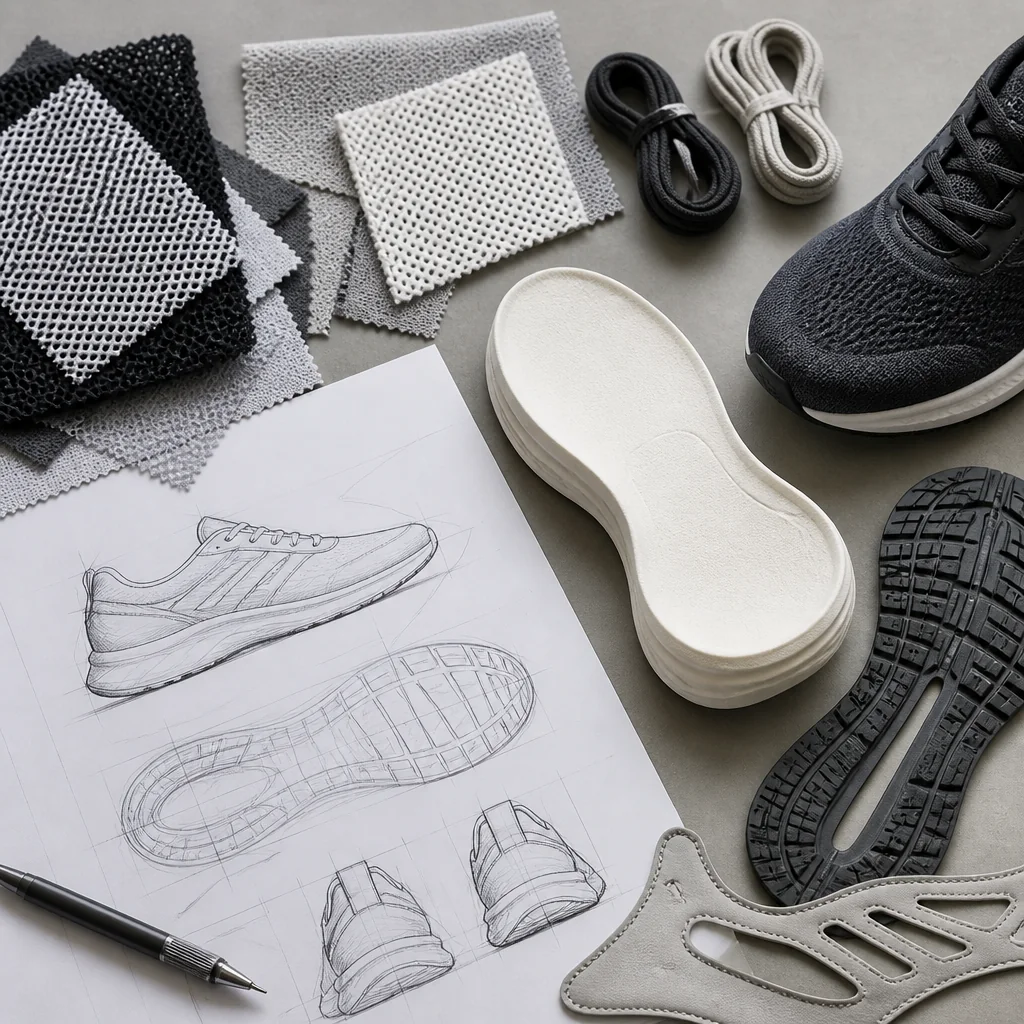
When reviewing oem running shoe material options, a buyer can use the published range to decide whether a concept belongs in the right product conversation. The available evidence supports a limited reading: Custom Shoe Factory publishes running-shoe category language and component terms. It does not provide a project-specific material specification.
Editorial recommendation: begin with a concise product brief that separates the direction already chosen from the points that need to be discussed. That keeps a broad material label from becoming an assumed upper construction or sole formula before the buyer has supplied a design, a tech pack, or a clear question.
The running-shoe product range describes performance-inspired daily-training builds. It also describes breathable uppers. Separately, it refers to cushioned midsoles. Those statements provide useful category context, but the buyer should keep the current project definition in its own document.
A Four-Field Material Note
A material note can be short. Its purpose is to make the current decision visible while marking the gaps that remain open. This is an editorial format for the buyer's own inquiry, not a documented factory form or process.
- Product direction
- State the intended running-shoe direction in broad terms. Where relevant, a buyer may use daily training as the working category language drawn from the published range.
- Upper direction
- Name the current requested upper category, such as mesh, knit, or PU, only when that is the level of definition available.
- Sole direction
- Record midsole language and outsole language separately. Do not turn several published component terms into one defined sole construction.
- Open question
- Identify what still needs review, such as an undefined zone in the design or a manufacturability point in the supplied technical package.
This note gives an inquiry a clear boundary. The buyer can show what is currently intended without presenting incomplete details as final material selections.
The Published Terms, Read Separately
The product-range wording is most useful when each term keeps its original scope. The table below separates the statements that are documented from the wording a buyer may use in an early brief.
| Published range statement | Editorial use in a buyer brief | Keep as an open project question |
|---|---|---|
| Performance-inspired daily-training builds | Describe daily training as the current product direction when it matches the concept. | How the proposed project will be defined beyond that broad direction. |
| Breathable uppers | Retain this as product-range context. | Any project-specific upper requirement or outcome. |
| Cushioned midsoles | Retain this as product-range context for the midsole. | The material and construction details for the proposed midsole. |
| Mesh uppers | Write mesh as the requested upper direction when applicable. | The final mesh specification and its location in the design. |
| Knit uppers | Write knit as the requested upper direction when applicable. | The final knit specification and its location in the design. |
| PU uppers | Write PU as the requested upper direction when applicable. | The final PU specification and its location in the design. |
| EVA outsoles | Use EVA as an outsole term from the published range where relevant. | Its role in the proposed outsole construction. |
| Rubber outsoles | Use rubber as an outsole term from the published range where relevant. | Its role in the proposed outsole construction. |
The table is not a selection list. It is a way to preserve the difference between documented category language and a buyer's unconfirmed project requirements.
The Upper Question Is a Definition Question
For a running shoe upper material inquiry, the useful starting point is the category the buyer wants to discuss. The published range names mesh uppers. It also names knit uppers. It also names PU uppers. It does not provide a construction drawing or a project-specific placement plan for those categories.
Editorial recommendation: state the preferred category, then record the information the current design does and does not define. This gives the manufacturer a more precise question than a broad request for all available upper options.
Identify the supplied design, reference, or tech pack that represents the current concept.
Name the requested upper category as a direction, not as a final construction.
List the upper zones that the buyer has already defined.
List any zones, overlays, reinforcements, or assembly details that remain undecided.
Ask whether the supplied design raises manufacturability questions during DFM.
Words such as breathable, supportive, durable, or premium should not stand in for missing technical information. The published running-shoe range uses breathable to describe its uppers. A buyer with a separate project requirement can include that requirement in the brief and ask what information is needed to discuss it.
Why Sole Language Needs Two Entries
Midsole wording and outsole wording should remain separate in the buyer's notes. The product range describes cushioned midsoles. It separately names EVA outsoles. It also separately names rubber outsoles.
The phrase EVA rubber outsole running shoe may be convenient shorthand, but an editorial brief should expand it before it is sent. The supplied product-range excerpt does not define an EVA-and-rubber arrangement for a particular shoe. It also does not place EVA in the midsole.
Write the current midsole direction in one entry, without assigning unverified material details or performance outcomes.
Write the current outsole direction in another entry, using EVA or rubber only as terms drawn from the published range when applicable.
Identify which sole details are already specified by the design or tech pack.
Ask which details must be clarified before the supplied design can be considered for manufacturability review.
Keeping these entries apart prevents an outsole term from being read as a complete sole specification. It also makes it easier for the buyer to revise one part of the brief without overstating another.
DFM Is Tied to a Supplied Design
The OEM/ODM service description says that Custom Shoe Factory manufactures to a buyer's tech pack and design. It separately says that manufacturability issues are flagged during DFM. These are the stated points that support a buyer's manufacturability question.
Editorial recommendation: connect a DFM request to the actual design or technical package being supplied. For example, the buyer can ask whether the stated material direction and current design raise manufacturability issues during DFM.
Keep other topics in their own questions. The supplied OEM/ODM excerpt does not state that DFM approves material combinations, confirms availability, validates performance, establishes compliance, determines cost, or produces a quotation. A buyer may need to ask about those topics, but they should remain questions rather than conclusions drawn from the DFM statement.
The Inquiry Should Show What Is Settled
A focused inquiry does not need to present an unfinished brief as a completed bill of materials. It should identify the current product definition and make the unanswered points easy to locate.
State that the project is a running-shoe concept and identify the buyer's intended product direction.
Attach the current tech pack or design when one is available, and identify any incomplete sections.
State the requested upper category separately from the unconfirmed construction details.
State the midsole direction and outsole direction in separate lines.
Identify the exact point to be considered for manufacturability issues during DFM.
Ask which development, manufacturability, sampling, and quotation information may apply to the project.
This structure keeps OEM running shoe development questions attached to the buyer's current design instead of treating the published range as a complete project answer. It also allows the buyer to update the note as the product definition becomes more specific.
A Final Scope Check
The About page describes Custom Shoe Factory as a sport-footwear specialist. Its stated product family includes running. It also includes training. It also includes walking. It also includes casual sneakers. The same description says it is not a catch-all factory.
Editorial recommendation: before sending the inquiry, check that the buyer has separated product-range context from project questions, upper direction from sole direction, and supplied design information from unresolved details. The current definition can then be shared through the quotation request path with a direct request for the project-specific information that may apply.
Sources and verification
- Athletic Shoe Manufacturer | Custom Product Range First-party site source
- OEM / ODM Shoe Development | Custom Footwear Manufacturing First-party site source
- About Custom Shoe Factory | OEM/ODM Athletic Shoes First-party site source
Share the current product definition and ask which development, manufacturability, sampling or quotation options may apply to the project.
Send your project brief