Footwear Product Development
Approval Ledger for Running Shoe Supplier Sample Review Checklist
Turn sample feedback into a clear buyer record: published references, current-project choices, and questions that still need a project-specific response.
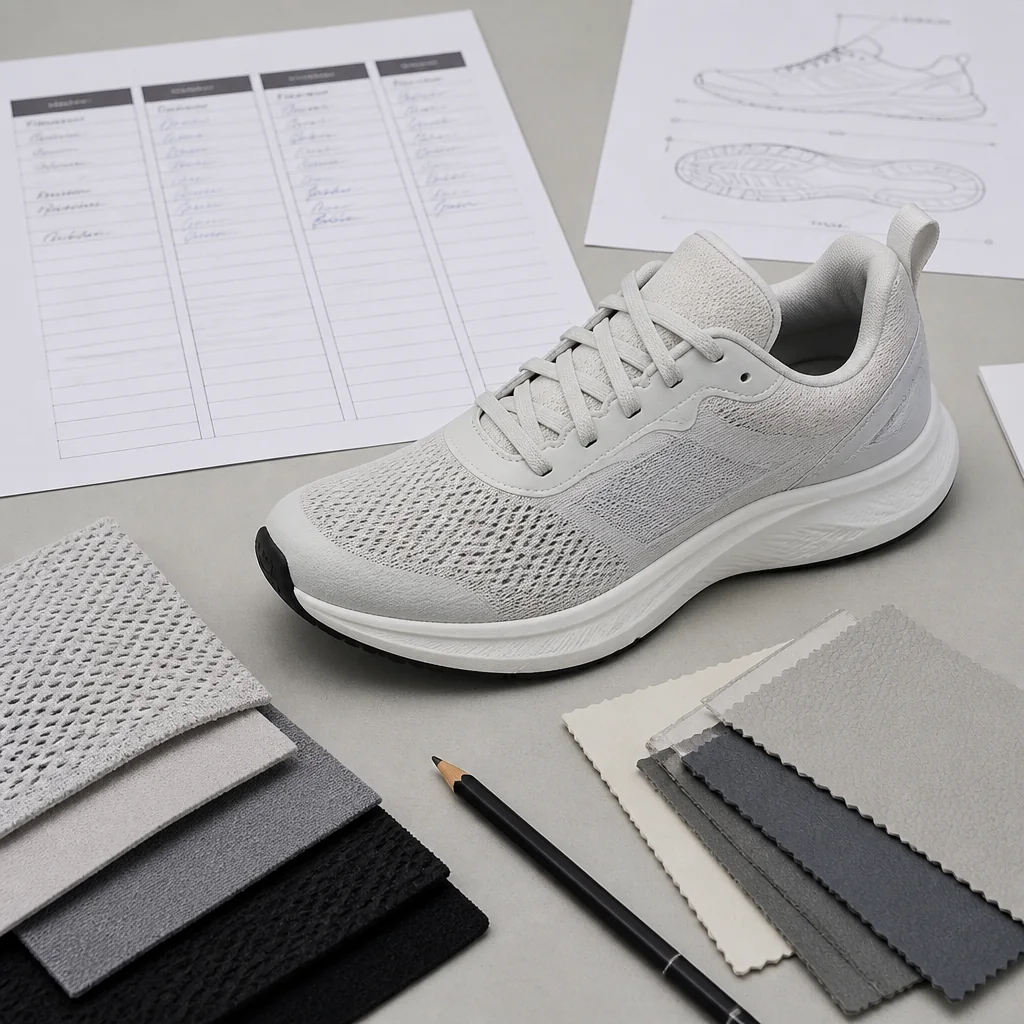
At sample review, the useful question is not whether a pair looks finished. It is which details are actual requirements for the current project, which belong only to a reference item, and which still need a response. A running shoe supplier sample review checklist gives those entries separate statuses before comments move forward.
This is an editorial recommendation for the buyer, not a documented Custom Shoe Factory approval procedure. The method is simple: keep published information apart from buyer decisions and supplier questions. That separation makes an athletic footwear sample review easier to read later, when a visual comment could otherwise be mistaken for an instruction.
The Pair Has a Limited Role
The case-studies page describes one example: a first running-shoe order structured from a reference pair to inspected first production. It establishes the format of that example, not a standard sequence for every project. It does not make a reference pair a technical specification or an approved production sample.
For the buyer, a reference pair is still useful. It gives feedback a common object: a panel shape, a visible texture, a sole profile, or the location of a treatment can be noted against the same pair. The next step is to assign a status rather than relying on a broad instruction such as "match the sample."
- Reference observation
- A feature noticed on the pair. Record it without treating it as a current-project requirement.
- Buyer decision
- A feature the buyer intends to carry into the project definition. Name the component or area affected.
- Open supplier question
- A point that remains unresolved and needs a project-specific response before the buyer records a decision.
Those labels can sit beside photographs and dated comments. They are an editorial recordkeeping choice, but they prevent an unmarked observation from silently becoming part of a running shoe production handoff.
An Approval Ledger
Use a four-column ledger for the review. The first column identifies the item. The second captures only the published source. The remaining columns are owned by the buyer: one records the present choice and one holds the open question. A row can remain undecided; the point is to show that it is undecided.
| Review item | Published reference | Buyer record | Open inquiry |
|---|---|---|---|
| Upper category | The products page names mesh, knit, and PU uppers for its running-shoe entry. | Selected, under consideration, or not selected. | Which details are needed to discuss the intended upper direction for this project? |
| Engineered mesh | The materials page contains a separate engineered-mesh description. | Reference only, being considered, or selected by the buyer. | What project information should accompany this material direction? |
| Midsole and outsole wording | The products page describes cushioned midsoles and identifies EVA and rubber outsoles. | Observation, buyer choice, or unresolved component direction. | What information would be needed to discuss the intended midsole and outsole direction? |
| Reference pair | The case-study excerpt uses a reference pair in one example project format. | List the individual features that are wanted, rejected, or still open. | Which named reference-pair features should be considered for the current definition? |
The source column should not absorb project assumptions. For example, a buyer may enter "upper visual effect retained" in the choice column while leaving the material category open. That is more precise than assigning a material merely because a sample resembles one.
Upper Entries Need Two Separate Lines
The running-shoe entry on the products page names mesh, knit, and PU as upper options. Record that wording as a range reference. It does not identify the upper in the pair under review or select an upper for a new project.
Engineered mesh deserves its own ledger line because its details come from a different source. The materials page describes it as a knitted or warp-knit synthetic with zoned density for ventilation, light stretch, and support. It also says engineered mesh takes screen print, heat-transfer film, and welded TPU overlays. Those are attributes of the published engineered-mesh description, not instructions for every running shoe.
The same source states a typical 90-250 GSM range depending on the zone, with denser knit at the eyestay and toe. Keep that number attached to engineered mesh only. It is not a default upper weight, a confirmation of a sample's construction, or a project requirement.
Useful upper notes
- Record a visible texture or pattern as an observation until the buyer chooses the upper direction.
- Write an intended graphic or overlay location as a buyer decision, not as proof that a particular material or application has been selected.
- When engineered mesh is under consideration, keep ventilation, light stretch, support, print, film, overlay, and GSM references on its separate material line.
- Ask for the information relevant to the current definition instead of filling an open construction detail with a range-level option.
That distinction matters when the visual character of an upper is acceptable but its material direction is not yet chosen. The ledger can show both facts without pretending that the choice has already been made.
Sole Language Is Not a Performance Result
The products page describes running shoes with cushioned midsoles. In a separate phrase, it identifies EVA and rubber outsoles. The buyer can preserve both entries as published references, but neither phrase documents a defined current-project midsole or outsole.
Editorial recommendation: keep sample feel and appearance in an observation field. Do not recast either as evidence of traction, durability, comfort, testing, or another performance outcome. A sole row can remain open while the buyer identifies the visual profile that matters and asks what component information should be considered next.
| What the buyer notes | How to record it |
|---|---|
| "Cushioned midsole" | Published running-range wording; add a separate buyer decision only when one exists. |
| "EVA and rubber outsoles" | Published range-level materials; do not convert the phrase into a confirmed component combination. |
| A feature seen or felt on the pair | Buyer observation; leave any technical outcome outside the entry unless project-specific information later supports it. |
Inquiry Contents
Once the ledger has clear statuses, the buyer can send the unresolved rows as questions instead of presenting them as settled specifications. The About page describes the company's product family as running, training, walking, and casual sneakers. For this inquiry, identify the project as a running shoe and keep the component choices specific to that project.
A concise project inquiry can include the following:
- A reference-pair identifier, images, and the observations tied to that item.
- Confirmed buyer choices, separated from material directions or components still under consideration.
- Each unresolved upper, midsole, outsole, visual, or construction entry as a direct question.
- A conditional request asking which development, manufacturability, sampling, MOQ, packing, and quotation information may apply to the current definition.
- A request for the next details needed to discuss the open entries.
This wording does not present those topics as documented services or promises. It asks what may apply. The buyer can use the project inquiry page to send the record and retain any response beside the related ledger row.
The Published Boundary
The products page establishes range-level running-shoe wording for breathable uppers, cushioned midsoles, mesh, knit, PU, EVA, and rubber. The materials page provides a separate description of engineered mesh. The case-study excerpt gives one reference-pair-to-inspected-first-production example. The About page identifies the stated athletic-footwear product family.
These excerpts do not document a universal sampling sequence, timeline, test method, fit-validation process, compliance outcome, price, minimum, packing term, inspection responsibility, or guaranteed production result. The practical buyer action is to keep the evidence at that scope, record present choices as choices, and leave every unresolved production-critical point as a question until a project-specific response is available.
Sources and verification
- Athletic Shoe Manufacturer | Custom Product Range First-party site source
- Footwear Manufacturing Case Studies | Example Project Formats First-party site source
- Shoe Soles, Uppers & Insole Materials | Footwear Specs First-party site source
- About Custom Shoe Factory | OEM/ODM Athletic Shoes First-party site source
Share the current product definition and ask which development, manufacturability, sampling or quotation options may apply to the project.
Send your project brief