Product Development
Wholesale Sports Shoes Sample Revision Checklist
A buyer-side framework for recording sample observations, requested changes, decision status and unresolved questions at component level.
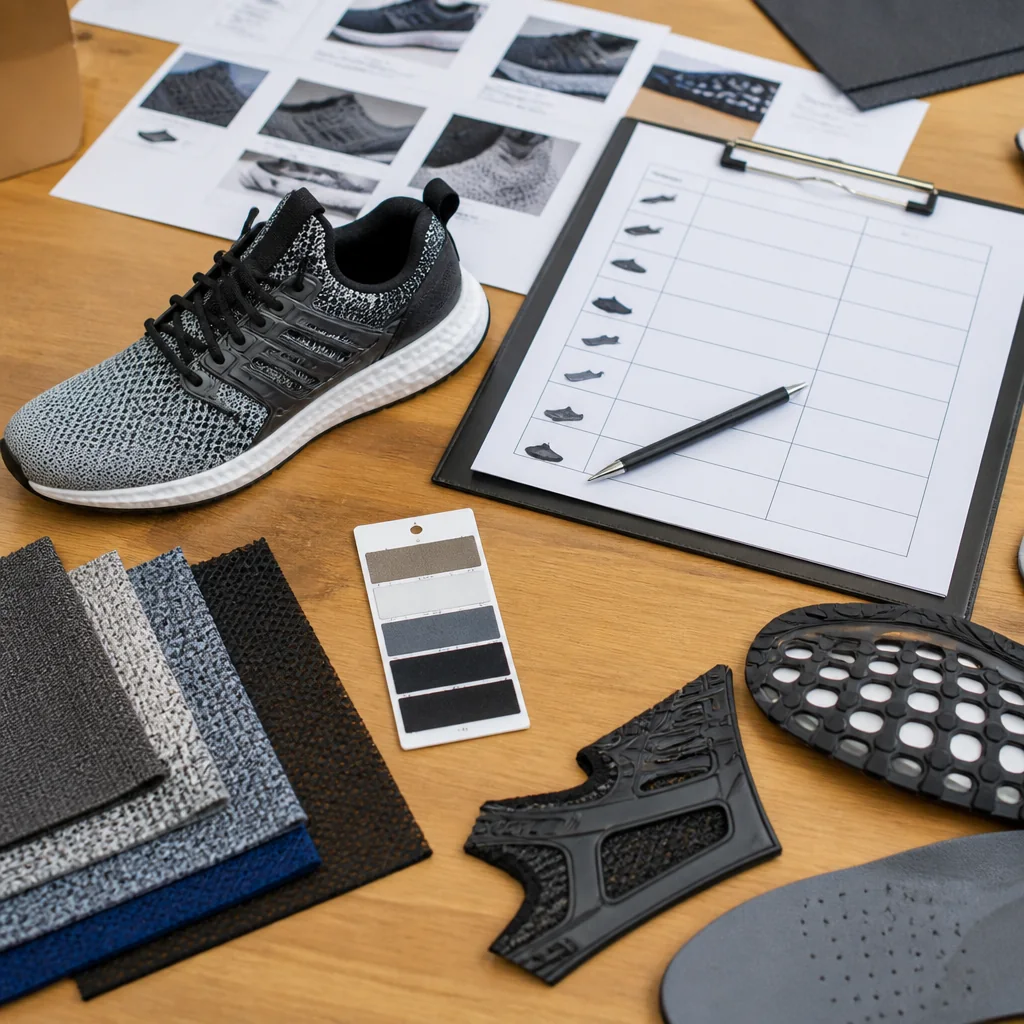
Sample review notes often ask one line to do several jobs: describe the reviewed item, request a change, record a decision and raise a question. A wholesale sports shoes sample revision checklist should give each job its own field. This article recommends a buyer-controlled ledger that records the current revision state without assuming how a manufacturer handles sampling, approval, pricing or change control.
The ledger begins with an identified sample or reference. Each row then connects one component-level observation to a requested direction, supporting reference, current status and unresolved question. This structure keeps buyer instructions separate from points that still require evaluation.
Separate evidence, direction and uncertainty
An observation describes the condition recorded during the buyer's review. A requested direction states what the buyer wants retained, changed or evaluated. An open question identifies information the buyer still needs before treating that direction as settled. Combining these functions in one comment leaves its current status unclear.
For an athletic shoe sample review checklist, this article recommends identifying the supporting material for each point. A marked photograph can locate the affected area. An artwork file, specification section or reference identifier can define the intended result. The written row should state which reference applies and whether the buyer is issuing a direction or requesting clarification.
Build a row that can stand alone
The following fields are editorial recommendations for buyer-side revision control. They are not presented as Custom Shoe Factory's sampling or approval procedure.
Recommended buyer-side revision ledger fields
| Field | Recommended buyer entry |
|---|---|
| Record ID | Assign a stable identifier to the issue. |
| Reviewed item | Name the exact sample, reference pair, file or other project record under review. |
| Component or zone | Identify the affected part and mark its location when the concern is limited to one area. |
| Observation | Describe the condition recorded in the reviewed item without embedding the requested solution. |
| Requested direction | State what the buyer wants retained, revised or evaluated. |
| Visual or specification reference | Identify the relevant filename, version, drawing, marked image or specification section. |
| Decision status | Assign one current buyer-side disposition to the row. |
| Open question | Record the information needed before the issue can be settled. |
| Response owner | Name the person or party from whom the buyer expects the next answer or decision. |
This article recommends starting a new row whenever the component, requested direction, reference, status or response owner changes. Unrelated upper, outsole and artwork points should not share a row merely because they were noticed during the same review.
The ledger should accompany the current product definition rather than replace it. For a separate framework covering the initial definition, see the quote-ready product brief guide.
Address the component before the change
Custom Shoe Factory's running-shoe listing describes performance-inspired daily-training builds with breathable uppers and cushioned midsoles. It lists mesh, knit and PU uppers. It also lists EVA and rubber outsoles. These are first-party product descriptions; the page does not establish that every listed option is interchangeable or available in every combination.
For a buyer-owned ledger, use a listed material name only when it matches the reviewed item or its project record. Add a panel or zone when the observation is localized. Descriptive words such as soft, dense, bright or heavy can remain in the observation field, but the row should also identify what part those words describe and which reference expresses the buyer's intent.
A running shoe sample revision log can therefore move from the broad product category to the component and then to the affected zone. The requested direction belongs after that identification, not in place of it.
Keep engineered-mesh details in scope
The company's materials page describes engineered mesh as a knitted or warp-knit synthetic construction with zoned density. It says engineered mesh typically runs from 90-250 GSM depending on the zone, with denser knit at the eyestay and toe. In the same engineered-mesh entry, the page says the material takes screen print, heat-transfer film and welded TPU overlays cleanly.
Those statements can supply vocabulary for an engineered-mesh row. The published GSM figure is a typical, zone-dependent description, not a project-specific tolerance or buyer acceptance band. This article recommends keeping the range and listed treatments within the engineered-mesh context rather than extending them to other upper categories.
Recommended fields for an engineered-mesh revision
| Field | Buyer entry | Scope boundary |
|---|---|---|
| Construction | Identify the construction named in the current product record or place the construction in the open-question field. | Do not assume that every item called mesh uses the same construction. |
| Affected zone | Name and mark the precise panel or area under review. | Keep a zone-specific direction from becoming an unmarked full-upper request. |
| Density direction | State a relative direction or cite an existing project specification. | Do not create a GSM value when the project record does not provide one. |
| GSM reference | Identify the governing project specification, or record a question if no project value has been established. | Do not use the published 90-250 GSM description as an approval criterion. |
| Treatment and artwork | Name the proposed treatment, artwork version and location that require review. | Keep screen print, heat-transfer film and welded TPU overlay references within the sourced engineered-mesh context. |
Artwork files and placement instructions should have their own references. The private-label artwork handoff guide addresses how buyers can organize that separate material.
Set one buyer-side disposition
This article recommends assigning one current disposition to every row and defining the terms in the ledger itself.
- Retain
- The buyer wants the identified feature kept as represented in the named sample or governing reference.
- Revise
- The buyer is submitting a defined change direction with its component, zone and supporting reference.
- Clarify
- The buyer is leaving the decision open until the recorded question receives an answer.
- Remove from the current request
- The buyer is taking the proposed change out of the active revision set without treating it as an approved feature.
A revise row should contain the requested direction and its reference. A clarify row should contain the unresolved question and expected response owner. These statuses express the buyer's current position; they do not establish the manufacturer's approval route or commercial treatment of a change.
Anchor feedback to identified project material
The case-studies page presents an example titled “Running Shoe Launch for a New Brand.” Its excerpt describes a first running-shoe order as spanning a reference pair through inspected first production. That stated span provides context for identifying which project material is currently under review.
The excerpt supplies no customer result, revision-round count, universal sequence, assignment of approval responsibility, inspection protocol or guarantee for another project. For buyer-side documentation, use it only as context. Name the actual sample, reference pair or other project record in the ledger instead of inferring an undocumented stage.
Move missing facts into questions
The sourced pages provide company and product vocabulary. Project-specific development and commercial details remain questions until the company evaluates the inquiry.
Documented context and corresponding inquiry topics
| Documented first-party context | Question for the current project |
|---|---|
| The about page identifies running, training, walking and casual sneakers as the company's sport-footwear family. | Does the current product definition fall within the scope the company is prepared to evaluate? |
| The running-shoe listing names mesh, knit and PU uppers. | Which upper material, if any, may apply to the identified design? |
| The running-shoe listing names EVA and rubber outsoles. | Which outsole construction may apply to the current product definition? |
| The materials page gives a zone-dependent description of engineered mesh. | Which construction, density reference and treatment may apply to the identified zones? |
| The case-studies excerpt states the span of one example format. | Which sample stages, revision handling and approval responsibilities may apply to this inquiry? |
This article recommends placing timing, revision limits, costs, tooling implications, testing expectations, tolerances, change handling and approval ownership in the inquiry column. The supplied evidence does not define those terms for a current project.
Describe the current revision state
Before submitting OEM footwear sample feedback, this article recommends organizing the following information:
- the current product definition and its identifier or version;
- the exact sample, reference pair or other project record under review;
- separate component-level rows for each observation and requested direction;
- the filenames or versions of relevant photographs, artwork and specifications;
- one current buyer-side disposition for every row;
- unresolved questions that remain distinct from confirmed instructions; and
- the expected response owner for each open point.
Use the project inquiry form to describe the current product definition and revision state. Ask which development, manufacturability, sampling or quotation options may apply to the project without assuming that a particular material, revision route or commercial arrangement is available.
Sources and verification
- Athletic Shoe Manufacturer | Custom Product Range First-party site source
- About Custom Shoe Factory | OEM/ODM Athletic Shoes First-party site source
- Footwear Manufacturing Case Studies | Example Project Formats First-party site source
- Shoe Soles, Uppers & Insole Materials | Footwear Specs First-party site source
Share the current product definition and ask which development, manufacturability, sampling or quotation options may apply to the project.
Send your project brief