Sourcing Guides
Which Records Give a Wholesale Sneaker Reorder Checklist Authority?
A buyer-side method for naming the records and authorized changes that define a repeat sneaker order before requesting project-specific next steps.
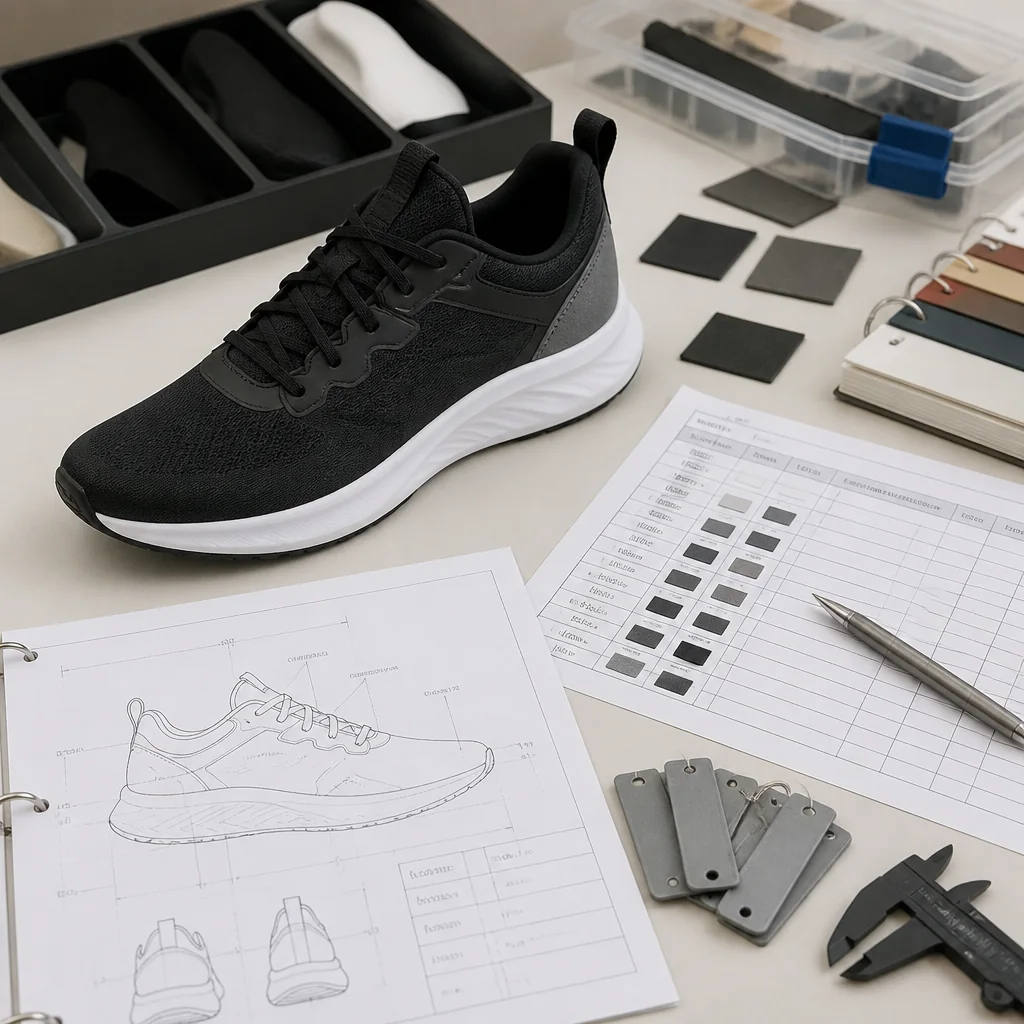
“Same style” does not identify which tech-pack revision, bill of materials, tooling reference or authorized change should govern the next build. This wholesale sneaker reorder checklist treats the request as a document-authority decision: the buyer names the applicable records, separates proposed changes from the intended baseline and asks which next step may apply.
The focus is repeat-order definition. Initial supplier screening, size grading, logo approval and a full pre-quotation manufacturability review are separate buying tasks. The editorial recommendation here is to replace shorthand about a previous order with references that the supplier can identify and discuss.
Establish what the published OEM statement covers
Custom Shoe Factory describes build-to-spec OEM work on its OEM and ODM service page as manufacturing to the customer’s tech pack and design. The company says it flags manufacturability issues during DFM.
The same published statement says the company holds the customer’s bill of materials across reorders. It also says the company holds the customer’s tooling across reorders.
Those statements provide the company-specific basis for this article, but their scope is narrow. The supplied excerpt gives no retention period and provides no details about tooling ownership or condition, automatic BOM version control, material-substitution decisions or repeat-order uniformity. It also does not state that every reorder automatically receives another DFM review.
The buyer should therefore distinguish the records known to exist from the project questions that remain open. A held BOM, for example, can be named as a reference without assuming which revision is current or whether a previously specified input remains available.
Build the request around governing references
The following is an editorial template for the buyer. It is not a description of a Custom Shoe Factory document system, approval workflow or version-control service.
| Buyer-side field | What to identify | Purpose in the request |
|---|---|---|
| Tech pack and design | Name the file and revision that the buyer intends to govern the reorder. | Replaces a general reference to the previous build with an identifiable product definition. |
| BOM reference | State the applicable identifier or revision from the buyer’s records. | Connects the material and component instructions to a named record. |
| Tooling reference | Provide the project’s tooling identifier if the buyer has one; otherwise ask which reference applies. | Frames the tooling inquiry without assuming ownership, condition, suitability or retention period. |
| Change record | List proposed changes separately and identify the named baseline for elements intended to remain unchanged. | Keeps a revised instruction visible instead of burying it inside a “same style” request. |
For OEM sneaker reorder documentation, the editorial recommendation is to state which record takes precedence whenever the buyer’s own files disagree. The conflict should be presented for a decision rather than left for the supplier to resolve by inference. Describing an element as unchanged still requires a named reference; the word itself does not define the earlier input.
Separate published facts from project questions
This table keeps the supplied OEM statement in one column and buyer inquiry topics in the other. Every item on the right is a question to raise, not a documented company service or promise.
| Published company statement | Question for the defined reorder |
|---|---|
| Build-to-spec OEM manufacturing follows the customer’s tech pack and design. | Question: Which file names and revisions should be identified as current for this request? |
| The company says it flags manufacturability issues during DFM. | Question: Do the proposed changes call for development work or a manufacturability review? |
| The company says it holds the customer’s BOM across reorders. | Question: Which BOM reference applies, what should the buyer resend, and how should a proposed material change be presented for a decision? |
| The company says it holds the customer’s tooling across reorders. | Question: Which tooling reference corresponds to the project, and does the requested build call for a tooling-status review? |
| No sampling or quotation process is described in the supplied reorder statement. | Question: Which development, sampling or quotation options may apply to the current product definition? |
Version logs, substitution reviews, tooling checks and resampling remain inquiry topics unless the supplier confirms their relevance to the project. This separation lets the buyer ask detailed questions without presenting those activities as an established factory workflow.
Test the reference with engineered mesh
The materials page shows why a broad material label may be insufficient. Its engineered-mesh entry names air mesh and sandwich mesh. It separately describes knitted or warp-knit synthetic construction with zoned density for ventilation, light stretch and support.
The entry says engineered mesh typically runs at 90-250 GSM depending on the zone, with denser knit at the eyestay and toe. That range describes the published material entry. It is not a universal target for every shoe or zone, and it provides no evidence that a material from an earlier build remains available.
The comparison below is an editorial specification test for the buyer. It does not prescribe a particular mesh or construction.
| Reorder wording | Recommended buyer-side reference |
|---|---|
| Mesh identified only by a generic material name | Cite the governing BOM line and the recorded material specification, including construction or zone information where those details already exist in the project records. |
| Upper described only as unchanged | Name the governing tech-pack revision and identify any upper changes as separate entries. |
| New density or construction requested | Mark the instruction as a proposed change and ask which development, manufacturability, sampling or quotation option may apply. |
For buyer-side footwear BOM change control, the practical recommendation is to avoid creating a replacement specification inside a reorder email. Point to the authorized record first, then make each proposed departure visible for discussion.
Keep category labels separate from build assumptions
Custom Shoe Factory identifies its product family on the company page as running, training, walking and casual sneakers. A buyer can use one of those category names to label the project without treating the label as a construction specification.
The separate running-shoe listing describes running builds with breathable uppers and cushioned midsoles. It lists mesh, knit or PU as upper options. It separately lists EVA and rubber outsoles.
Those details belong to the published running-shoe listing. They do not define every running shoe, extend automatically to training, walking or casual sneakers, or identify the materials used in a particular earlier order. The editorial recommendation is to let the named tech pack and BOM govern the build while using the category only to identify the product family.
Prepare the versioned handoff
The buyer can assemble the final request with the following editorial checklist:
- Product family: Identify the project as a running, training, walking or casual sneaker.
- Style or project identifier: Use the identifier recognized in the buyer’s current records.
- Request revision: Give the reorder request a revision or date so subsequent edits can be distinguished.
- Governing tech pack and design: Name the files and revisions intended to define the next build.
- Applicable BOM: State the buyer’s BOM identifier or revision rather than referring only to the previous order.
- Tooling reference: Include the relevant project reference when known, without making assumptions about ownership, condition or retention.
- Elements intended to remain unchanged: Tie each continuity instruction to the named governing record.
- Proposed changes: List each requested departure separately from the baseline.
- Decision requested: Ask which development, manufacturability, sampling or quotation options may apply to the current definition.
When a construction change raises manufacturability questions, the pre-quote DFM checklist can be consulted as a separate editorial resource. It does not replace the references governing the reorder.
Use the quotation inquiry page to share the current product definition and identify the applicable tech pack, BOM and tooling references. Include the proposed change record, then ask which development, manufacturability, sampling or quotation options may apply to the version being requested.
Sources and verification
- OEM / ODM Shoe Development | Custom Footwear Manufacturing First-party site source
- Shoe Soles, Uppers & Insole Materials | Footwear Specs First-party site source
- About Custom Shoe Factory | OEM/ODM Athletic Shoes First-party site source
- Athletic Shoe Manufacturer | Custom Product Range First-party site source
Share the current product definition and ask which development, manufacturability, sampling or quotation options may apply to the project.
Send your project brief