Materials & Specifications
Private Label Sneakers Mesh Upper Specification: Zone Mapping
A buyer-side framework for mapping upper areas, functional priorities, GSM status and decoration dependencies before a running-shoe inquiry.
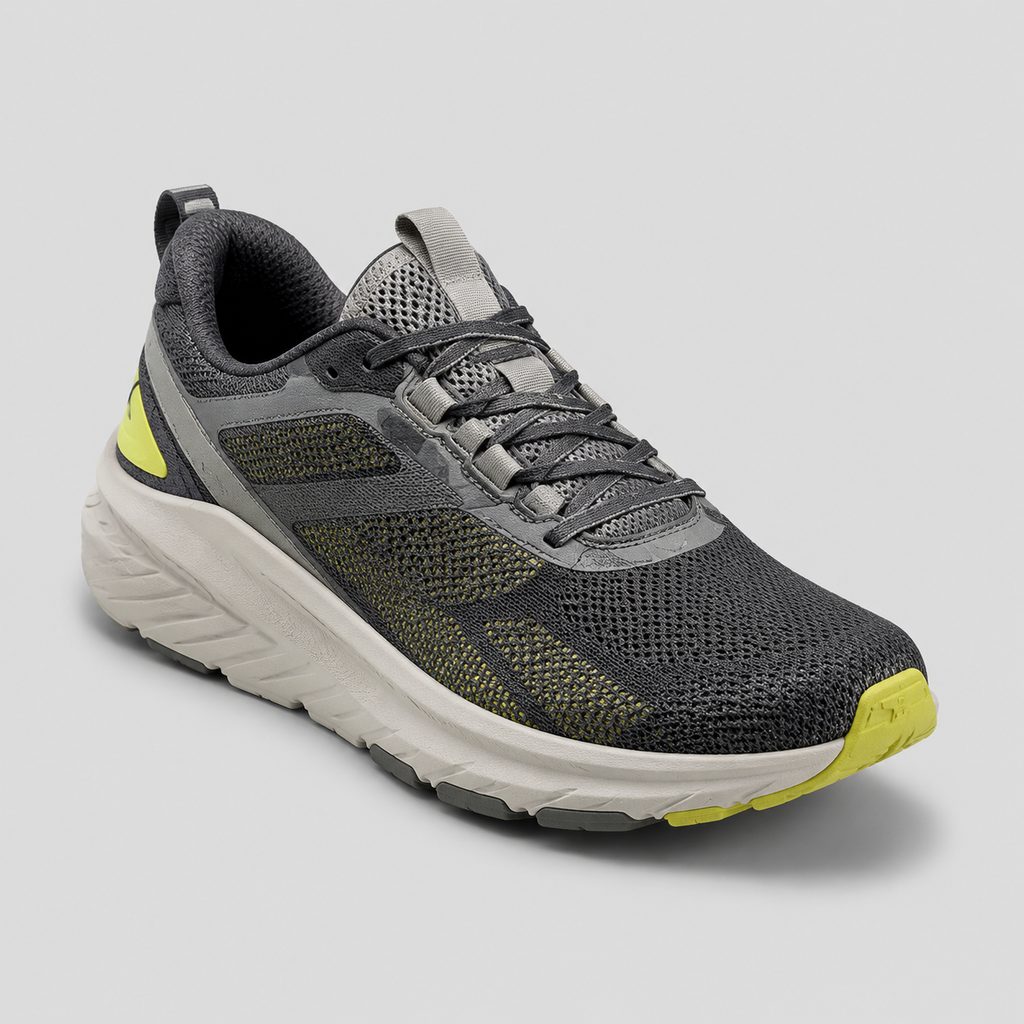
A private label sneakers mesh upper specification becomes practical once each upper area has a named job. Engineered mesh can carry ventilation, light stretch and support in one upper, but the material label never ranks those jobs for the buyer. Editorial recommendation for the buyer: name the relevant areas first, assign a primary emphasis where one is known, and mark whether each choice is fixed or still open.
Use three status labels for the rest of this article. Published fact means a source states it. Buyer decision means the product team owns it. Open question means manufacturer input is still required. That boundary applies to every section below.
Which jobs does the upper still need to assign?
The materials resource describes engineered mesh as a knitted or warp-knit synthetic material with zoned density for ventilation, light stretch and support. Those three functions are useful map categories. They do not place themselves on the upper.
Record functional intent separately from material and construction answers. A note such as “ventilation is the primary emphasis in this buyer-defined area” is a product decision. It is not a measured result, a mesh selection, or proof that the drawn area can be built as shown.
Reference images can support the brief when boundaries are marked and the intended reading is stated—openness of appearance, visual density, or the position of a support feature. Keep unverified construction assumptions out of fixed requirements.
Published running-shoe frame
Within the published product range, running shoes are described as performance-inspired daily-training builds with breathable uppers and cushioned midsoles. The page separately lists mesh, knit or PU uppers, together with EVA and rubber outsoles. Those lines are range descriptions for the catalog family.
The about page states a product family of running, training, walking and casual sneakers. That family statement does not add construction options to the running-shoe description.
For this exercise, identify the current product as a running shoe and record intended use in the buyer’s own terms. The zone map can then focus on the upper without treating product-family language as a bill of materials or performance claim.
Density notes and buyer-drawn areas
One narrow construction observation appears in the material description. Everything beyond it needs a visible owner.
- Published fact
- Engineered mesh density varies by zone, with denser knit at the eyestay and toe.
- Buyer decision
- The team names the areas relevant to the design, draws their boundaries, and ranks desired emphasis among ventilation, light stretch and support.
- Open question
- Material selection, construction representation, zone transitions and manufacturability of the proposed boundaries remain unresolved unless the buyer already holds verified project requirements.
The eyestay and toe note can shape questions. It is not a mandatory pattern for every running shoe. Area names stay buyer-defined as well. If the team uses terms such as quarter, vamp or collar, the annotation should show exactly what those terms cover in this design.
Leave 90-250 GSM unselected
The same material resource qualifies its GSM statement: engineered mesh typically runs at 90-250 GSM depending on the zone. The wording links the range to zoned use. It does not set a universal project range, a required minimum or maximum, or a recommended value for any named part of the buyer’s upper.
Copying 90-250 GSM into the specification as a selected tolerance would replace an open material question with a number that looks approved. It would also hide whether the team cares primarily about ventilation, light stretch, support, visual character or another project-specific constraint.
If a verified material requirement already exists, identify its source and the area it covers. Otherwise mark GSM as open and ask which material specifications may apply to the proposed use and zone map. Keep the published range in its proper role: contextual material information rather than a promise of availability or suitability.
Running shoe upper zone map matrix
Using only the three functions named in the material description, create one record for every area the buyer considers meaningful. The matrix defines the fields without supplying technical answers that still require project input.
| Field | What to record | Decision boundary |
|---|---|---|
| Buyer-named area | The area name and a matching boundary on an annotated upper view. | The name does not imply that the proposed boundary is manufacturable. |
| Functional emphasis | Rank ventilation, light stretch and support as primary, secondary, not required or open. | Treat these entries as design intent, not verified performance. |
| Reference input | A marked image, sketch, material reference or visual note, plus what should be read from it. | Do not assume the reference construction will be reproduced. |
| Decision status | State whether the requirement is fixed, constrained or open. | A fixed buyer decision can still require a manufacturability response. |
| GSM and construction | Enter a value or method only when it is already a verified project requirement; otherwise write “open.” | Do not derive a selection from the published contextual range. |
| Decoration dependency | Show whether artwork or an overlay reaches, crosses or borders the area. | Keep the detailed decoration specification in its own workstream. |
| Manufacturer question | Ask what material specification or construction approach may suit the stated priority and boundary. | A question records an unresolved issue rather than an assumed capability. |
Use the same status language throughout. “Fixed” means the buyer has made a decision. “Open” identifies where project input is still needed. Mark a preference “constrained” when the intent matters but the technical implementation remains negotiable.
In one hypothetical entry, a buyer could mark a lateral upper area, make ventilation the primary emphasis, show artwork touching its rear boundary, and leave GSM and construction open. The corresponding inquiry would ask which mesh specification may apply, whether the boundary can be represented in the proposed build, and how the artwork could affect that area.
Decoration as a separate dependency
The materials page describes engineered mesh as taking screen print, heat-transfer film and welded TPU overlays cleanly. That is a material-compatibility statement. It is not confirmation that every application is offered for every project, or that any one method suits the buyer’s design.
Carry only the dependency into the zone map: the proposed location, the area it intersects, and any priority that should not be obscured. Keep artwork dimensions, colors, placement references and candidate application methods in a separate branding record. For a focused treatment of those decisions, see specifying branding for private label sneakers.
The upper map explains what the area is intended to do. The branding record explains what should appear there. The inquiry can then ask how the two requirements may interact without treating published compatibility as a service promise.
What the excerpts leave open
The supplied excerpts do not resolve project-specific availability, zone-transition methods, tolerances, testing protocols, quantities, prices or timing. They also do not establish a predetermined development or sampling route. Keep those topics visibly open.
- Material question: Which engineered mesh specifications may apply to the intended use and mapped priorities?
- Zoning question: How could zoned density, if applicable, be represented across the proposed buyer-defined areas?
- Boundary question: Are the marked boundaries manufacturable as drawn, and which details need revision or clarification?
- Decoration question: How might the relevant artwork or overlay candidate interact with the functional emphasis in that location?
- Development and commercial question: Which development, manufacturability, sampling, MOQ, packing or quotation information may apply to the current project definition?
These remain inquiry topics. Decide internally what the team would need before changing an open field to fixed, and ask what supporting material information can be shared for the proposed selection.
Handoff package for the inquiry
Share a compact package in which every field shows its owner and status. Editorial recommendation for the buyer: fill the placeholders below before sending the inquiry.
- Product frame
- Running shoe — intended use: [buyer description]
- Annotated upper areas
- [area names + boundary notes on top/lateral views]
- Functional priorities
- For each area: ventilation / light stretch / support ranked as primary, secondary, not required or open
- References
- [image, sketch or material reference] — communicates: [what to read from it]
- Decision status
- Fixed: [list] · Constrained: [list] · Open: [list]
- Decoration dependency
- [location, intersecting area, priority that should remain visible]
- Unresolved questions
- Material · zoning · boundary manufacturability · decoration interaction · development / sampling / quotation path
Submit that current definition through the project inquiry and ask which development, manufacturability, sampling or quotation options may apply. The map does not guarantee a construction or service path. Its value is that buyer decisions stay visible, the contextual 90-250 GSM statement remains unselected, and the remaining questions can be submitted against a defined upper rather than the single label “mesh.”
Sources and verification
- Athletic Shoe Manufacturer | Custom Product Range First-party site source
- About Custom Shoe Factory | OEM/ODM Athletic Shoes First-party site source
- Shoe Soles, Uppers & Insole Materials | Footwear Specs First-party site source
Share the current product definition and ask which development, manufacturability, sampling or quotation options may apply to the project.
Send your project brief