Product Development
Private Label Sneakers: Define the Branded Upper
Build a focused upper-branding definition by connecting the sneaker category, mesh direction, artwork, placement and preferred application.
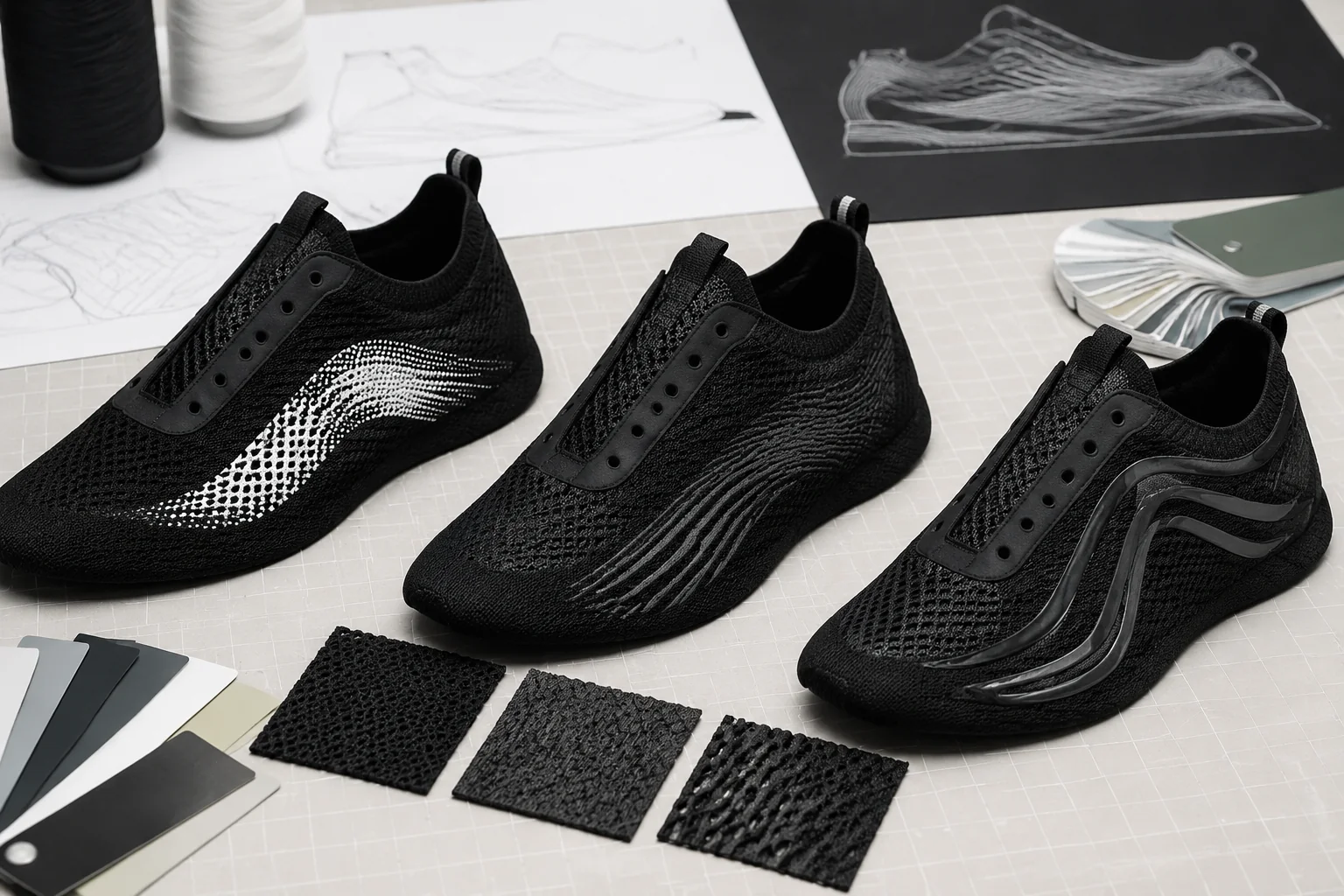
Supplying logo artwork is not the same as defining a branded sneaker upper. The artwork shows the graphic, but it does not specify the material beneath it, its exact position or the intended application. A useful inquiry for private label sneakers connects those decisions in one upper-branding definition.
This definition does not need to cover the entire shoe. It should identify the sneaker category, upper-material direction, branded areas, artwork files and preferred application for each area. Unresolved construction points can then be presented as questions instead of being mistaken for approved specifications.
The company pages cited below document the athletic footwear categories, mesh terminology and three applications discussed in this article. The steps for organizing artwork and preparing the inquiry are editorial recommendations for the buyer.
Define the shoe before the decoration
Custom Shoe Factory describes its product-family scope as running, training, walking and casual sneakers. A buyer should select the relevant category before mapping the branding because the broader term “sneaker” does not establish the intended product context. The stated categories appear in the company overview, while the product range provides additional running-shoe terminology.
The running-shoe description refers to performance-inspired daily-training builds with breathable uppers and cushioned midsoles. It separately names mesh, knit and PU as upper terms. EVA and rubber are listed as outsole terms.
These terms are useful vocabulary, but they should not be merged into an assumed construction. The buyer's product statement can instead name the category, intended use and visual direction, followed by reference images annotated to show which details matter. For training, walking or casual sneakers, use the applicable category rather than borrowing features from the running-shoe description.
Replace “mesh upper” with a material direction
The word “mesh” leaves important questions open. The materials page presents engineered mesh and also uses the terms air mesh and sandwich mesh. Buyers developing custom mesh sneakers should identify which term reflects the current concept, or mark the material direction as unresolved if no selection has been made.
Engineered mesh is described on that page as a knitted or warp-knit synthetic material with zoned density for ventilation, light stretch and support. The page gives 90-250 GSM as a typical range depending on the zone and refers to denser knit at the eyestay and toe.
The published range is material information, not a required target for an individual project. Likewise, the references to zoned density and denser knit do not mean that every upper includes the same zoning arrangement. In the buyer's definition, each branded area should therefore be associated with the proposed surface: an open mesh area, a denser area or a transition between zones. If that information is not yet known, flag it for discussion.
Map the artwork by location
As an editorial recommendation, give every branded area a short location code and connect that code to a marked shoe view. Labels such as lateral quarter, medial quarter, tongue, heel and eyestay are examples, not a required or exhaustive set. Use the names that make the proposed placement unambiguous.
Record the following information for each location:
- The location code and a clear placement name.
- The assigned logo, wordmark or graphic file.
- The intended width, height and orientation.
- A reference point for positioning the artwork on the upper.
- Color references and the intended tonal or contrasting appearance.
- The preferred application, if the buyer has selected one.
- Any nearby pattern line, support area or mesh-density transition.
Mark provisional dimensions and positions as provisional. That distinction allows the document to express the intended visual result without presenting an unresolved placement as a confirmed construction detail.
Compare the three documented applications
The engineered-mesh description names screen print, heat-transfer film and welded TPU overlays as applications. These are the three relevant sneaker branding options supported by the supplied material source. Their appearance on the page does not establish suitability for every mesh structure, artwork, location or upper pattern, so the inquiry should describe the proposal and ask what may apply.
| Application | Define in the branding map | Ask about |
|---|---|---|
| Screen print | Artwork version, location, finished dimensions, colors and intended coverage. | Whether the proposed artwork and placement may suit the selected mesh area, and what artwork information is needed. |
| Heat-transfer film | Graphic shape, scale, orientation, color treatment and boundary of the applied area. | Whether the application may suit the proposed mesh construction, particularly where the graphic approaches a density or stretch transition. |
| Welded TPU overlay | Overlay geometry, dimensions, location and color direction. State whether the concept uses it for branding, support or both. | Whether the geometry may be integrated with the proposed upper pattern and which construction details need further definition. |
The supplied evidence does not support ranking these applications by price, durability, flexibility, weight, lead time or minimum order quantity. The buyer can compare them by the desired appearance, proposed surface and questions that remain open for the project.
Assign one route to each branded area
A shoe may contain more than one branded area, and the same artwork may appear at different scales or orientations. Treat every placement as a separate entry rather than issuing one general instruction for the entire upper.
- Code the area. Link the code to a side, top or rear view of the shoe.
- Name the artwork. Reference a specific vector file or version so that primary logos, wordmarks and secondary graphics remain distinct.
- State the preferred application. Choose screen print, heat-transfer film or welded TPU overlay where there is a preference. Otherwise, label the route as open for discussion.
- Define the intended appearance. Record color references and note whether the mark should be tonal, contrasting or coordinated with another visible component.
- Add dimensions and positioning. Locate the artwork relative to pattern lines or recognizable upper features.
- Flag construction conflicts. Identify graphics that approach the eyestay, toe, support area, pattern line or a change in mesh density.
Questions about manufacturability, tolerances, color handling and what can be considered during sampling belong in the inquiry. They should not be written as guaranteed services or outcomes.
Keep buyer decisions and factory questions separate
The upper-branding definition is easier to assess when it distinguishes settled inputs from matters that still need an answer.
Buyer inputs
- Running, training, walking or casual sneaker category.
- Intended use and visual direction.
- Annotated reference images or an existing product definition.
- Proposed upper-material direction, if known.
- Branding locations and their assigned artwork files.
- Dimensions, orientation and color references.
- Preferred application for each location, where selected.
Questions for the manufacturer
- Which of the documented applications may suit the proposed upper, artwork and placement?
- Does any placement need revision because of the upper pattern, support areas or density transitions?
- What artwork, dimensional or material information is needed to discuss development?
- Which appearance or construction points may be considered during sampling?
- What project information is required to discuss sampling or quotation options?
This division prevents an open question from appearing as a fixed requirement. It also gives a private label sneaker manufacturer a clearer view of the current product definition and the decisions that remain unresolved.
Prepare a compact upper-branding inquiry
Use consistent file names and location codes across the shoe views, artwork files and written notes. The submission should include:
- A short product statement naming the sneaker category and intended use.
- Reference images with annotations identifying the relevant features.
- The proposed mesh or upper-material direction.
- A branding map showing every logo and graphic location.
- Artwork files named to match the codes on the map.
- Color references, dimensions and preferred applications.
- Open questions about material, placement and construction.
- The requested next discussion, such as development inputs, sampling considerations or quotation requirements.
The site also presents a running-shoe project example described as progressing from a reference pair to inspected first production. It can be read as an example of how project information may be structured, but the source does not identify it as a verified customer result or a mandatory workflow for other orders.
Ask which path may apply
A focused inquiry connects the artwork to a sneaker category, material direction, named upper location and preferred application. It also keeps unanswered construction points visible.
Share the current definition through the project inquiry page and ask which development, manufacturability, sampling or quotation options may apply to the proposed upper.
Sources and verification
- About Custom Shoe Factory | OEM/ODM Athletic Shoes First-party site source
- Athletic Shoe Manufacturer | Custom Product Range First-party site source
- Shoe Soles, Uppers & Insole Materials | Footwear Specs First-party site source
- Footwear Manufacturing Case Studies | Example Project Formats First-party site source
Share the current product definition and ask which development, manufacturability, sampling or quotation options may apply to the project.
Send your project brief