Footwear Specifications
Custom Running Shoe Sole Specification Questions
A procurement method that keeps published sole language, buyer-defined requirements and unresolved construction questions distinct before sampling or quotation.
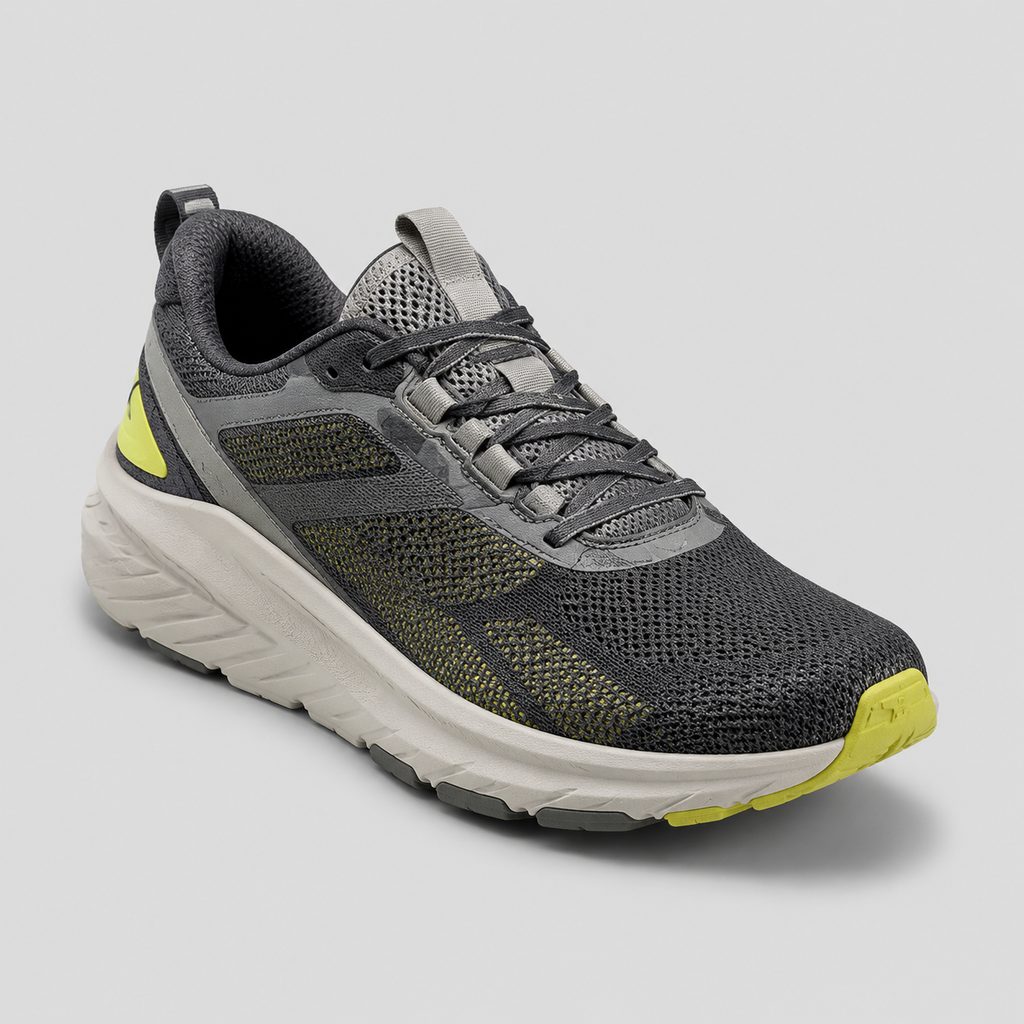
The published running-shoe range describes cushioned midsoles and uses the phrase EVA & rubber outsoles. Those two statements are the actual sole language available from the product page. They name broad components; they do not assign each material to a layer, define geometry or document construction. For buyers working through custom running shoe sole specification questions, that limited wording is the starting boundary of any running shoe sole construction inquiry, not a finished technical brief.
Treat the excerpt as fixed source language. Add only what the project has already decided. Leave everything else as open questions for the manufacturer. That discipline stops a category phrase from becoming an invented sole architecture, process claim or performance promise.
Published wording sets the boundary
The running-shoe product range describes performance-inspired daily-training builds with breathable uppers and cushioned midsoles. It also lists EVA & rubber outsoles. Together, those lines identify a product family and broad component language.
Read them conservatively. The excerpt does not say EVA is the midsole, rubber is a separate ground-contact layer or how the named materials sit relative to each other in a finished shoe. It does not state layer count, dimensions, compounds, attachment method or tooling. An EVA and rubber outsole specification cannot be derived from that phrase alone.
A stated-and-open map
The table below keeps published information separate from buyer inputs and unresolved questions. The right-hand column is an inquiry agenda, not a catalogue of documented supplier options.
| Topic | State supported by the product excerpt | Buyer input or open inquiry |
|---|---|---|
| Product context | Performance-inspired daily-training running-shoe builds are described. | State the intended use, wearer and operating conditions for the proposed product. |
| Upper context | The running-shoe description refers broadly to breathable uppers. | Keep the upper specification in a separate block so it does not become evidence for the sole. |
| Cushioning | The excerpt describes cushioned midsoles without defining the cushioning system. | Explain the desired feel or outcome and identify any buyer-selected benchmark or evaluation criterion. |
| Outsole wording | The exact broad phrase is EVA & rubber outsoles. | Ask how material placement and component naming would apply to the proposed construction. |
| Sole architecture | No layer count, geometry, coverage pattern or attachment method is stated. | Mark required geometry separately from dimensions and relationships that remain open. |
| Appearance and performance criteria | No sole colors, finishes, branding positions, compounds, tests or acceptance limits are documented in the excerpt. | Supply buyer requirements where they exist and ask what information is needed for the remaining decisions. |
Label a buyer-defined requirement as a requested outcome, retain source-derived facts at their documented scope, and leave unanswered items as questions. During quotation as well as development, do not present an open item as if either party has already approved it.
What should a reference pair be allowed to say?
The case-study teaser describes an example running-shoe project format spanning a reference pair through inspected first production. That limited statement does not define how the reference pair is handled or what technical information is extracted from it. Editorial recommendation: give the pair an explicit buyer-assigned role instead of treating it as an instruction to reproduce every detail.
- Visual direction
- Identify the specific cues the pair is meant to communicate, such as overall proportion, sidewall character, ground-contact appearance or color blocking.
- Product intent
- Describe any feel or use impression that matters, while labeling it as an intended outcome rather than a measured property of the reference.
- Deliberate departures
- List features that should differ from the pair so the reference is not read as an unqualified copy request.
What remains unproven
The teaser does not say that a submitted pair will be copied, measured, dismantled, reverse-engineered or matched. It also does not establish that the pair will determine sole construction. Ask which reference-handling and development process may apply, then record the confirmed process separately from the design cues the buyer supplies.
Upper evidence belongs in its own block
The engineered-mesh materials entry concerns an athletic upper. It names air mesh and sandwich mesh and describes knitted or warp-knit synthetic with zoned density. The entry gives a typical range of 90-250 GSM depending on the zone and names screen print, heat-transfer film and welded TPU overlays in connection with that mesh.
Those details do not establish sole materials, sole construction or sole customization choices. Keep them out of the sole block. When an inquiry covers both components, open a separate upper workstream using the relevant athletic-shoe mesh upper questions. Component discipline makes it easier to see which source supports each statement.
Questions grouped by the decision they unlock
The matrix below organizes custom footwear sampling questions around decisions. It does not prove that any construction, material, tooling, branding or testing option is available. Remove rows that do not apply; keep unresolved ones as explicit questions.
| Decision | Input to provide | Question to resolve |
|---|---|---|
| Intended cushioning | Describe the intended use and desired cushioning outcome in buyer terms. Identify any reference cue that informs the description. | Which aspects can be evaluated during development, and what additional definition would be needed? |
| Midsole and outsole relationship | Show which component relationships are fixed by the design and which remain open. | How would the applicable construction assign materials and functions to the named components? |
| Material placement | Label any buyer-required placement. Do not derive placement from EVA & rubber outsoles. | Where, if anywhere, could each named material apply to the proposed build? |
| Dimensions and geometry | Provide drawings or clearly labeled target dimensions when these have already been selected. | Which geometry is manufacturable, and which dimensions or tolerances require further agreement? |
| Ground-contact design | Mark intended coverage zones, visual segmentation, traction direction or flex locations when they are part of the concept. | Which details can be represented in the proposed sole, and how should they be documented for review? |
| Color and branding | Identify required colors, finish boundaries and proposed logo locations without presuming a decoration method. | Which locations and methods, if any, may apply without conflicting with the construction? |
| Reference departures | Annotate every intentional change from the reference pair that affects sole appearance, proportion or intended feel. | What development implications follow from those departures? |
| Construction and tooling | Separate mandatory design outcomes from areas where the manufacturer may propose an applicable route. | Which construction or tooling path may apply, and what commercial or ownership terms would need confirmation? |
| Evaluation and acceptance | Supply any buyer-required criteria, methods or standards as project inputs. | Which attributes can be assessed, by what method, at what stage and against which agreed limits? |
Use the returned answers to revise the brief. Do not silently convert a proposed route into an approved specification. Record who must confirm each open item and which document will carry the final decision.
Inspected first production is not a sole protocol
The case-study teaser ends its example project description with inspected first production. Within the supplied excerpt, that phrase names an endpoint only. It does not supply a sole-specific inspection method, test protocol, sampling rule, acceptance limit or allocation of responsibility.
Where inspection detail matters to the project, ask for clarification on:
- which sole attributes would be reviewed;
- which drawings, samples or specifications would govern the review;
- which methods or instruments would be applicable;
- which acceptance limits would need to be agreed; and
- how findings, approvals and required corrections would be recorded.
Keep each item open until the applicable procedure and responsibility are confirmed. The teaser alone should not be cited as evidence of a particular sole inspection control.
A handoff with visible unknowns
A usable inquiry can stay concise while preserving uncertainty. Assemble the current definition in this order:
- Intended product: state the running-shoe use, target wearer and commercial context in the buyer's own words.
- Published starting point: retain cushioned midsoles and EVA & rubber outsoles as separate, source-scoped statements.
- Buyer decisions: attach selected geometry, appearance, branding and performance requirements without attributing them to the manufacturer.
- Reference role: identify the cues the pair is intended to communicate and list deliberate departures.
- Open sole questions: include unresolved placement, construction, tooling, evaluation and acceptance topics from the matrix.
- Requested response: ask which development, manufacturability, sampling and quotation options may apply. The buyer may also ask which MOQ and packing information is relevant to the project.
Share that current definition through the quotation inquiry. A bounded brief lets the manufacturer respond to the actual concept while keeping unsupported sole architecture, process and inspection assumptions out of the request.
Sources and verification
- Athletic Shoe Manufacturer | Custom Product Range First-party site source
- Footwear Manufacturing Case Studies | Example Project Formats First-party site source
- Shoe Soles, Uppers & Insole Materials | Footwear Specs First-party site source
Share the current product definition and ask which development, manufacturability, sampling or quotation options may apply to the project.
Send your project brief