Sourcing Guides
A wholesale running shoe product definition for quote requests
A buyer worksheet for separating running-shoe source language from confirmed project choices and concrete questions before a quote request.
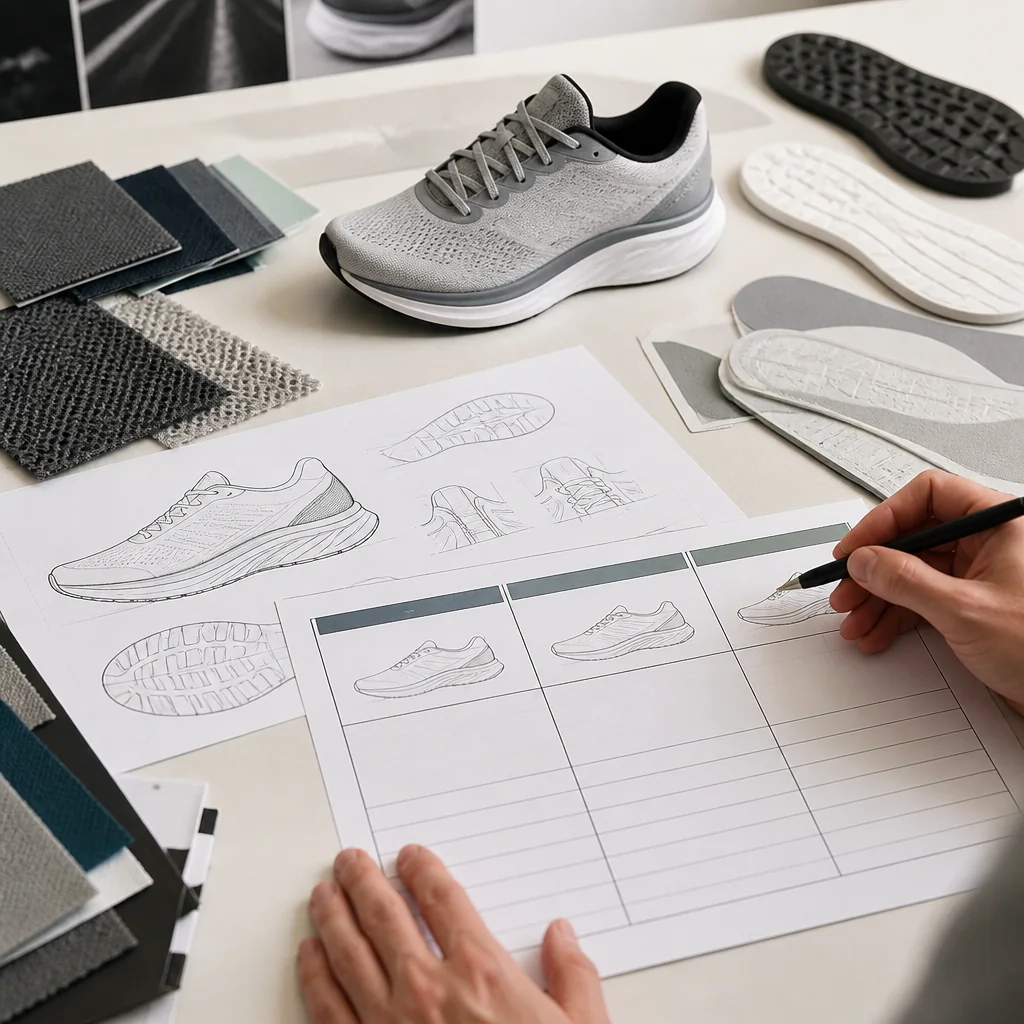
A product-range page can help name a direction, yet its wording can look more settled once it is pasted into a buying document. A wholesale running shoe product definition has a narrower job: show which range details are being considered, which project choices the buyer has confirmed, and which points are still unanswered. That keeps a category description from becoming an accidental specification.
The product and material details below come from the linked site excerpts. The decision method, worksheet prompts and inquiry format are editorial recommendations for buyers. They do not describe a documented factory workflow or promise that a particular option applies to a project.
For this worksheet, use three labels and apply each label only once to a given entry.
- Published fact
Text quoted or closely paraphrased from a cited excerpt.
- Buyer decision
A project requirement or preference the buyer has confirmed.
- Open question
An unresolved point that should be raised without an assumed answer.
What is actually defined?
The running-shoe range describes performance-inspired daily-training builds with breathable uppers and cushioned midsoles. It then provides separate lists of upper terms, outsole terms and sales or program terms.
| Source detail | Use in the working definition | Buyer entry still needed |
|---|---|---|
| Performance-inspired daily-training builds | Keep this as a range-level description. | State the proposed activity, wearer and product position. |
| Breathable uppers and cushioned midsoles | Record these as separate qualitative descriptions without adding performance targets. | Mark whether either characteristic is required, preferred or open. |
| Mesh, knit and PU uppers | Retain only the upper terms relevant to the proposed direction. | Identify the intended material, layer or upper area when known. |
| EVA and rubber outsoles | Keep these terms with the outsole discussion. | Mark the outsole material as selected, preferred or open, then add any buyer-defined structure or appearance. |
| Retail, ecommerce and private label | Record them simply as three terms named by the source. | State the buyer's actual channel and whether private label is relevant. |
The upper and outsole materials appear in separate source lists. The editorial recommendation is to record relevant terms individually rather than combine them into an assumed standard construction. The same treatment applies to breathability and cushioning: each can remain a broad direction until the buyer defines what it means for the proposed shoe.
Pick the lead input
Lead with the input that contains the most confirmed detail. This gives the running shoe quote request a clear center while allowing other references to remain supporting material.
| Lead input | When it is useful | How the buyer should frame it |
|---|---|---|
| Running-shoe range description | The broad category is clearer than the construction details. | Quote only the relevant wording, then add the buyer's intended use and product position. |
| Upper-material direction | The buyer has a more developed material idea than the range description provides. | Mark the material as selected or preferred and identify its proposed zones. Leave layers, reinforcements or treatments open when they have not been decided. |
| Reference pair | Selected features of a pair express the direction more clearly than a short description. | Annotate the features to retain and those to exclude. Do not treat every visible feature as a requirement. |
If the inputs disagree, the editorial recommendation is to state which one has precedence. A written material choice, an image and a reference pair should not silently compete for control of the same feature. Record the conflict and identify the buyer's current priority.
Engineered mesh at zone level
The materials page describes engineered mesh as a knitted or warp-knit synthetic with zoned density for ventilation, light stretch and support. It also names air mesh and sandwich mesh. Those names identify material directions in the source; they are not automatic selections for a proposed running shoe.
The page states that engineered mesh takes screen print, heat-transfer film and welded TPU overlays cleanly. This is a material-level statement. It does not confirm that a proposed decoration, location or construction is applicable to the buyer's project.
The same source gives engineered mesh a typical range of 90-250 GSM depending on the zone and notes denser knit at the eyestay and toe. Its "Best for" line names running, training and summer styles needing maximum airflow at what the source calls a sensible cost. Neither statement sets a GSM value, airflow result, cost finding or suitability decision for a particular shoe.
As an editorial worksheet, an engineered mesh zone map can turn the material name into more useful buyer input:
- Identify each upper area being considered rather than assigning one description to the whole upper.
- State whether ventilation, light stretch or support is intended in each area.
- Mark every zone as confirmed, preferred or open.
- Show the proposed location of any screen print, heat-transfer film or welded TPU overlay, then keep project applicability as a question.
- Enter a GSM target only if the buyer has selected one. Otherwise, leave density open instead of adopting the published 90-250 GSM range as a specification.
This record distinguishes a buyer's desired placement from the general material characteristics on the source page.
The working ledger
This table has a different job from the source inventory. It turns the available language into project entries and concrete questions without supplying missing answers.
| Topic | Published starting point | Buyer entry | Concrete open prompt |
|---|---|---|---|
| Intended use | Performance-inspired daily-training builds | Proposed activity, wearer and product position | Which of these points are fixed, and which remain open? |
| Upper characteristic | Breathable uppers | Required, preferred or open; intended upper area if known | Which upper areas, if any, carry this direction? |
| Upper material | Mesh, knit and PU are listed | Candidate material by layer or zone | Which material choice is fixed, and where is it intended to appear? |
| Midsole | Cushioned midsoles | Buyer-defined cushioning direction and any fixed visual features | Is cushioning a general direction, a confirmed requirement or still open? |
| Outsole | EVA and rubber are listed | Selected, preferred or open material; buyer-defined geometry and appearance | Is the material fixed, and which visible sole features must be retained? |
| Engineered mesh | Zoned density and a typical 90-250 GSM range | Zone status and any buyer-selected density or decoration location | Which zones, density choices and decoration locations remain unresolved? |
| Channel or program | Retail, ecommerce and private label are named | Actual selling channel and private-label relevance | Which of the named terms, if any, belongs in this request? |
As an editorial rule for the buyer, leave an unresolved field visibly open. A provisional value without a status label can be read as a confirmed instruction.
What can a reference pair show?
The case-study teaser describes a first running-shoe order as structured from a reference pair to inspected first production. Those are the stated endpoints. The excerpt does not provide an intervening sampling sequence, approval protocol, inspection method, quality criterion or production result.
The editorial recommendation is to annotate the pair with questions that identify its intended role:
- Which silhouette or proportion should inform the proposed design?
- Which upper sections or material characteristics are relevant?
- Which sole appearance or other visible elements should be considered?
- Which visible features are expressly outside the request?
- If the pair conflicts with a written requirement or another reference, which input has precedence?
Keep questions about interpretation in the open-question column. The brief case-study wording should not be expanded into a promised reference-pair process.
A shorter quote request
The inquiry does not need to repeat every source phrase. As an editorial recommendation, send the smallest set of fields that preserves confirmed choices, exclusions and unresolved points.
- Source starting point
Quote or closely paraphrase only the relevant product or material wording.
- Intended use and position
Enter the buyer's confirmed direction or mark it open.
- Upper direction
List selected or preferred materials, proposed zones and any open layer or decoration decisions.
- Midsole direction
State the buyer's expectation without turning "cushioned" into an unstated measurable target.
- Outsole direction
Record material status, structure and appearance separately from the midsole.
- Visual and reference scope
Identify the features to consider, the features to exclude and the reference that takes precedence.
- Open items
List unresolved product and commercial details without inserting assumed values.
- Request
Ask which options may apply to the definition as submitted.
When requesting a quote for wholesale running shoes, share the current definition through the project inquiry and end with a direct question: Which development, manufacturability, sampling or quotation options may apply to this product definition? This asks the recipient to identify applicable options without presenting any of them as a documented service or commitment.
Sources and verification
- Athletic Shoe Manufacturer | Custom Product Range First-party site source
- Shoe Soles, Uppers & Insole Materials | Footwear Specs First-party site source
- Footwear Manufacturing Case Studies | Example Project Formats First-party site source
Share the current product definition and ask which development, manufacturability, sampling or quotation options may apply to the project.
Send your project brief