Footwear Sourcing
White Label Shoe Branding Options for Mesh Uppers
A practical framework for defining branding on a mesh shoe upper without confusing published material compatibility with project-specific availability or approval.
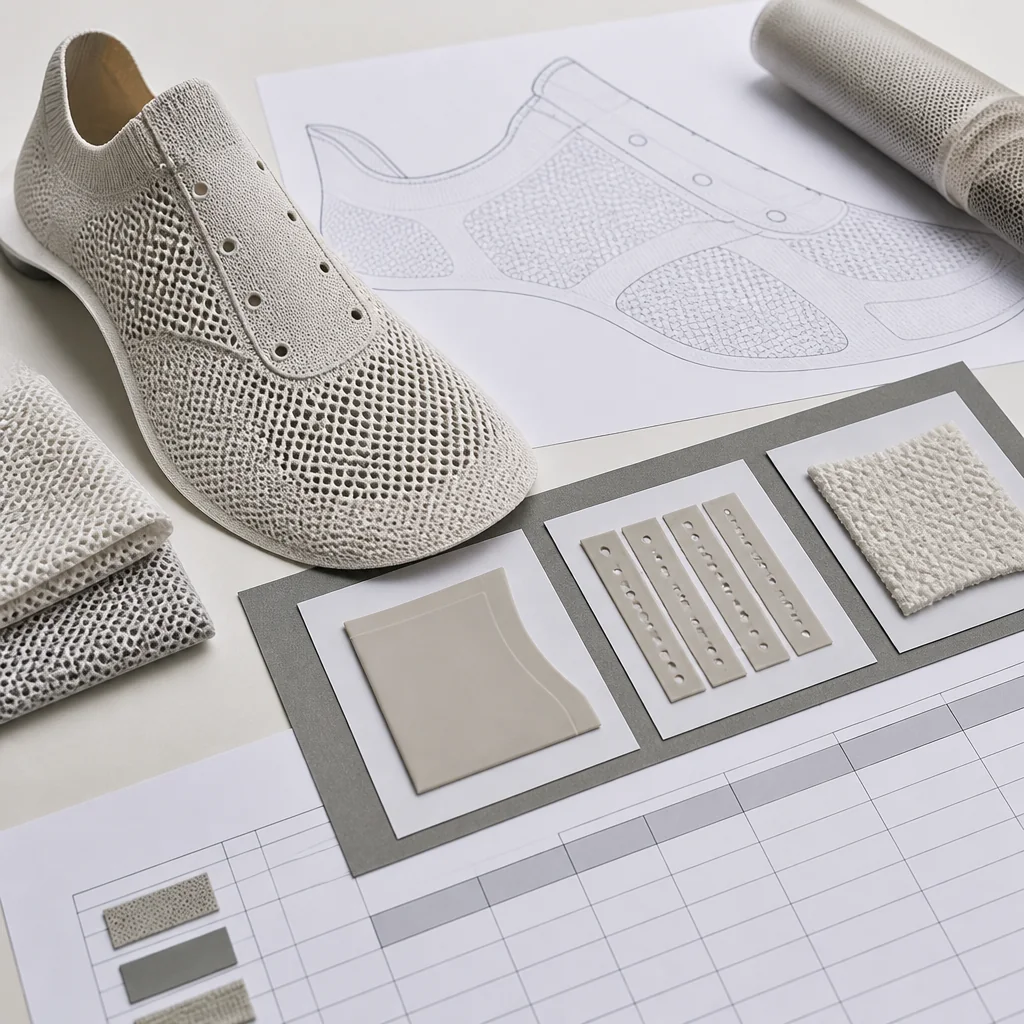
A marked upper drawing can identify a logo and the panel where it should appear while leaving the application method unresolved. Is the proposed mark a screen print, a heat-transfer film or a welded TPU overlay? For buyers reviewing white label shoe branding options for mesh uppers, that missing field belongs in the product definition rather than in a general note that says "logo on mesh."
Without a named method, the buyer's record does not show which branding construction should be discussed during development or quotation. This article recommends treating the method as a separate buyer-controlled variable alongside artwork, location and mesh details.
Published compatibility sets the boundary
Custom Shoe Factory's published engineered-mesh description says the material takes screen print, heat-transfer film and welded TPU overlays cleanly. That statement supplies three candidate mesh upper logo application methods for a buyer's worksheet.
| Published information | Buyer can record | Still requires a project response |
|---|---|---|
| Engineered mesh takes screen print cleanly. | Screen print as a candidate application. | Whether it is available and appropriate for the selected mesh, location and project. |
| Engineered mesh takes heat-transfer film cleanly. | Heat-transfer film as a candidate application. | Whether it is available and appropriate for the selected mesh, location and project. |
| Engineered mesh takes welded TPU overlays cleanly. | Welded TPU overlay as a candidate application. | Whether it is available and appropriate for the selected mesh, location and project. |
The source establishes category-level compatibility only. It does not document project-specific availability, approval, performance, pricing or lead time, and it provides no basis for ranking the three methods by durability, cost, weight, appearance or production speed.
The matrix records one decision per row
This article recommends giving each proposed combination of location, mesh assumption and application method its own row. That structure keeps the buyer's current selection distinct from information still awaiting a response. It also creates a direct reference for artwork revisions and written project correspondence.
| Row | Intended location | Mesh definition | Candidate method | Buyer status | Question or response reference |
|---|---|---|---|---|---|
| MB-01 | Name the panel or zone and cite the marked drawing. | Enter the material reference and known GSM, or mark the details unresolved. | Screen print | Enter one of the worksheet statuses below. | Ask whether this method may apply to the specified mesh and location. |
| MB-02 | Record the location even when it matches another candidate row. | Use the exact current mesh assumption rather than a broad description. | Heat-transfer film | Enter one of the worksheet statuses below. | Record the related question or applicable written response. |
| MB-03 | Show the proposed boundary and orientation on the upper drawing. | Enter the selected construction or leave the field visibly unresolved. | Welded TPU overlay | Enter one of the worksheet statuses below. | Ask for the mesh, location and application to be considered together. |
For this buyer worksheet, use four editorial status terms:
- Candidate
The method remains under consideration and is included in the inquiry.
- Buyer-selected
The method is the buyer's preferred submission. The status does not imply a manufacturer response.
- Unresolved
A material detail, decision or project answer is still missing.
- Response recorded
The row points to a written response that applies to the stated product revision and construction assumption.
These labels are an editorial recommendation for organizing the shoe upper branding specification. They are not presented as a factory workflow or approval system.
Mesh data needs its own fields
The materials page describes engineered mesh as typically running at 90-250 GSM depending on the zone. This is category context, not a fixed specification for every mesh. The buyer should record the project's actual GSM only when it is known and leave the field unresolved when it is not.
The same source says denser knit is typical at the eyestay and toe. That statement does not make denser knit mandatory in either zone, nor does it establish that the eyestay or toe is suitable for a particular logo. The matrix should therefore keep location, knit density and application method in separate fields.
Copying the full published GSM range into a project-specific material field would not identify the mesh being proposed. This article instead recommends retaining the range as source context while reserving the project field for the current material definition.
The base shoe remains a separate record
The running-shoe product entry describes performance-inspired daily-training builds with breathable uppers and cushioned midsoles. It separately lists mesh, knit or PU uppers. It also lists EVA and rubber outsoles.
Those statements provide product-category vocabulary, but the excerpt is not a configuration matrix. It does not establish that every listed upper and outsole can be combined in one white-label product. A buyer can avoid that inference by recording the current shoe platform separately from the branding alternatives.
| Buyer record | Recommended fields | Purpose in the inquiry |
|---|---|---|
| Base shoe definition | Footwear category, intended use, upper family, known material reference, midsole definition, outsole definition, drawing reference and revision. | State the current product assumption without treating the product-page lists as selectable combinations. |
| Branding definition | Matrix row, artwork revision, dimensions, color expectation, upper location, mesh detail, candidate method and status. | Show which branding construction the buyer wants discussed. |
This separation is a buyer-side record-keeping recommendation. A change to a branding row does not, by itself, represent a change to the base shoe definition.
OEM responsibilities have a narrow scope
Custom Shoe Factory's published OEM build-to-spec description says it manufactures to the buyer's tech pack and design. Under that OEM scope, the company says it flags manufacturability issues during DFM. It also says it holds the buyer's bill of materials and tooling across reorders.
These statements apply to the published OEM path. They should not be extended to every white-label, private-label or ODM inquiry. The DFM statement concerns flagging manufacturability issues; it does not say that DFM automatically approves a proposed branding method.
| Area | Recorded responsibility | Evidence boundary |
|---|---|---|
| Branding intent | The buyer records the artwork, location and candidate or selected application. | This is an editorial recommendation for communicating the buyer's definition. |
| OEM production input | The applicable branding row can be connected to the buyer's tech pack and design revision. | The company states that it manufactures to the buyer's tech pack and design under its OEM build-to-spec scope. |
| DFM | Any applicable manufacturability issue can be referenced against the affected row. | The company states that it flags manufacturability issues during DFM; method approval is not stated. |
| Reorders | The OEM record can identify the applicable bill of materials and tooling references. | The published statement is limited to holding those two items across reorders. |
Open questions complete the handoff
The supplied sources leave several project details unanswered. The following points are buyer inquiry topics, not documented company capabilities, procedures or promises:
- Method availability: Which candidate applications, if any, may apply to the current project?
- Construction compatibility: Can the proposed mesh, known or proposed GSM, location and application be considered as one construction assumption?
- Artwork inputs: What file format, dimensions, line details or other inputs would be requested for the proposed method?
- Color control: What color references and acceptance expectations should accompany the artwork?
- Sampling: Which sampling options or proposed steps, if any, may apply to this definition?
- Evaluation and testing: What evaluation or testing may be proposed, and what criteria and responsibilities would apply?
- Quotation treatment: How would the selected branding row be represented in a quotation, including any applicable setup, material or tooling considerations?
- Commercial scope: What MOQ, packing, lead-time or other commercial constraints would apply?
The buyer can then package the inquiry in this order:
- State the current base shoe definition and product revision.
- Attach a marked drawing for each proposed branding location.
- Include a separate matrix row for every candidate combination of location, mesh assumption and application method.
- Provide known material and artwork details while marking missing information unresolved.
- Place availability, manufacturability, sampling, evaluation, quotation and commercial questions beside the rows they concern.
Share that definition through the project inquiry form and ask which development, manufacturability, sampling or quotation options may apply. The resulting request identifies the proposed branding construction while keeping unanswered project questions visible.
Sources and verification
- Shoe Soles, Uppers & Insole Materials | Footwear Specs First-party site source
- Athletic Shoe Manufacturer | Custom Product Range First-party site source
- OEM / ODM Shoe Development | Custom Footwear Manufacturing First-party site source
Share the current product definition and ask which development, manufacturability, sampling or quotation options may apply to the project.
Send your project brief