Footwear Sourcing
Transfer Map: Wholesale Training Shoes vs Running Shoe Specifications
A claim-by-claim transfer map of which published running-shoe and material details can inform a training-shoe inquiry, and which specifications must remain open.
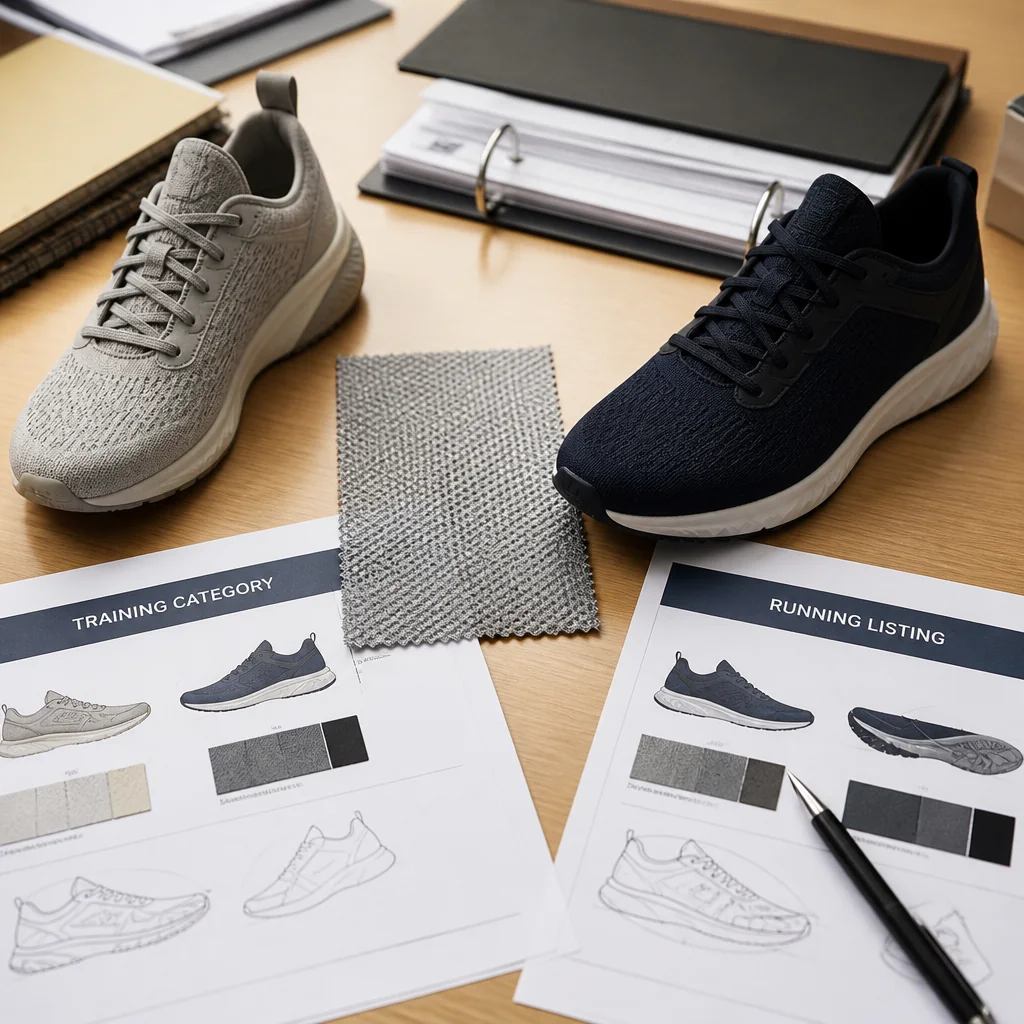
The company profile names training shoes inside one sport-footwear family. A separate product listing uses “daily-training” only while describing running shoes. That shared word is the procurement hazard. Buyers reviewing wholesale training shoes vs running shoe specifications often treat the two records as interchangeable, yet the published excerpts do not authorize that merge. Training is a named category; construction language, sales contexts and the example launch format remain attached to running. Engineered mesh is the single material record that explicitly spans both categories. Everything else stays conditional or running-only until a buyer places it in a project definition.
One word, two product records
The company profile groups running, training, walking and casual sneakers within one sport-footwear family. That is direct evidence that training is a named product category. It does not supply a training-specific bill of materials, construction path, performance standard or development route.
On the product listing, “daily-training” modifies a running-shoe build. It is not a technical record for the separately named training-shoe category. The overlap creates a scope collision, not a license to combine the two records into one OEM training shoe specification.
In running vs training shoe sourcing, that distinction matters because the available excerpts do not document technical differences in fit, support, cushioning, outsole geometry, intended movement or testing. A buyer may still need answers in those areas; the published text cannot provide them.
Which claims keep transfer rights?
The four first-party records fall into three evidence classes. The table below keeps each claim on its original scope and shows what must still be settled before a statement can enter a confirmed training-shoe brief.
| Evidence status | What the record supports | What remains unresolved | How to treat it in the RFQ |
|---|---|---|---|
| Direct training-category evidence | The company profile names training alongside running, walking and casual sneakers in its sport-footwear family. | No training-specific upper, sole, cushioning, branding or validation specification appears in that excerpt. | Identify the product as a training shoe, then supply the actual requirements separately. |
| Conditionally relevant material evidence | The materials record presents engineered mesh as suitable for running, training and summer styles. It also describes construction, zoned density, a typical weight range and three decoration methods. | The record does not confirm that engineered mesh is selected for a given training shoe, which zone construction applies, or which decoration method is manufacturable for that project. | Cite engineered mesh only as a preference or discussion point when it matches the product definition. Keep zone mapping, weight and decoration execution open. |
| Restricted to running records | The running listing describes breathable, cushioned, performance-inspired daily-training builds. It names mesh, knit and PU uppers. It names EVA and rubber outsoles. It associates the entry with retail, ecommerce and private-label contexts. The example-project page describes how a first running-shoe order is structured from a reference pair to inspected first production. | Neither record establishes that the running construction or example-project format applies to training shoes. Neither describes activity beyond the stated first-production endpoint. | Treat these pages as adjacent references that generate questions. Do not paste their content into the confirmed training-shoe specification. |
Carry a statement into the inquiry as fact only at the scope in which it was published. Mark everything else as a buyer requirement, a preference or an unresolved question. That sorting step is the operational outcome of the table above.
Engineered mesh as a conditional bridge
The materials page is the narrow documented link between the categories. It describes engineered mesh as a knitted or warp-knit synthetic with zoned density intended for ventilation, light stretch and support. The same record presents the material as suitable for running, training and summer styles that need airflow.
The page gives a typical range of 90 to 250 GSM depending on the zone and notes denser knit at the eyestay and toe. That range is descriptive of the material, not a prescribed target for a training-shoe project. As an editorial recommendation for the buyer, define the desired upper behavior first, then ask which weight and density arrangement may suit the proposed zones.
Decoration language is equally bounded. The material record identifies screen print, heat-transfer film and welded TPU overlays. That supports a material-level discussion of those three methods. It does not confirm that every method will suit the artwork, panel geometry, reinforcement plan or manufacturing route of a particular shoe.
- State whether engineered mesh is a confirmed requirement, an acceptable option or only a reference preference.
- Identify upper zones that need ventilation, structure, stretch or an overlay, without assigning an unsupported GSM value.
- Provide intended artwork and mark screen print, heat-transfer film or welded TPU as methods to evaluate, not as approved executions.
Running construction that does not travel
The running listing combines several kinds of information in one product entry: breathable and cushioned positioning, performance-inspired daily-training language, upper choices of mesh, knit and PU, EVA and rubber outsoles, and retail, ecommerce and private-label contexts. All of those details belong to the running-shoe record.
“Performance-inspired” should stay positioning language. It is not evidence of performance testing or a measured result. Cushioning language and named outsole materials likewise do not establish a training-shoe cushioning system or sole specification.
Buyers can still cite the listing as adjacent evidence if they keep source and status separate. “EVA and rubber outsoles appear in the running listing” is a source note. “Confirm the proposed sole construction for this training shoe” is the matching inquiry topic. The first records what is known; the second avoids treating it as a transferred specification.
The same handling applies to upper materials. Mesh, knit and PU can be mentioned as running-listing references. The intended training-shoe upper remains open unless the buyer has already selected and defined it independently.
How far does the example project go?
The example-project page describes a running-shoe launch format for a first order, beginning with a reference pair and ending with inspected first production. Its useful scope is that sequence and that running-product context.
It should not be presented as a verified training-shoe customer result or a standard process for every project. The excerpt also does not establish what happens after first production. A buyer can use the format to identify questions, not to predict an undocumented workflow.
The role of a reference pair therefore stays open in a training-shoe inquiry. As an editorial recommendation, state whether a physical pair, photographs, drawings or a written definition is currently available, then ask how that input may be used for the proposed project. That wording supplies context without assuming that the running example governs training-shoe development.
What belongs in the training-shoe manufacturer inquiry
A useful inquiry makes evidence status visible. It gives the recipient enough product definition to assess the request while avoiding false certainty about construction, sampling or commercial terms. Keep the following items separated rather than merged into one borrowed specification block.
- Product identity. Describe the requested product as a training shoe. Add intended use, target market and any design priorities that are already settled.
- Source-backed category context. Note that training is named in the company profile. If relevant, point to the engineered-mesh record as material context while preserving its conditional status.
- Confirmed requirements versus preferences. Separate required features from options under consideration. Include available drawings, artwork, reference materials and upper-zone intentions without presenting adjacent running details as approved training specifications.
- Open construction decisions. Ask what sole construction, cushioning approach, upper execution and branding method may be manufacturable for the current definition. These are inquiry topics, not capabilities established by the cited excerpts.
- Development and commercial questions. Ask which development, manufacturability, sampling and quotation options may apply. Where relevant to the buying decision, also ask which MOQ and packing information applies to this project rather than assuming published or standard terms.
- Reference-pair status. Say whether a reference pair exists and what the buyer expects it to communicate. Ask what role, if any, that reference may play in evaluating the training-shoe request.
This structure turns missing evidence into usable questions. It also lets the buyer revise the specification cleanly when a material, sole, cushioning system or branding execution moves from preference to confirmed requirement.
Share that current product definition through the quotation inquiry and ask which options may apply. The objective is not to make the training brief look complete by borrowing running-shoe details. It is to show exactly what is known, what is preferred and what still needs a project-specific answer.
Sources and verification
- About Custom Shoe Factory | OEM/ODM Athletic Shoes First-party site source
- Athletic Shoe Manufacturer | Custom Product Range First-party site source
- Shoe Soles, Uppers & Insole Materials | Footwear Specs First-party site source
- Footwear Manufacturing Case Studies | Example Project Formats First-party site source
Share the current product definition and ask which development, manufacturability, sampling or quotation options may apply to the project.
Send your project brief