Sourcing Process
Sports Shoes Supplier First Production Structure
Extract the documented path from reference pair to inspected first production without assuming unstated steps or multi-category maps.
Buyers preparing a first athletic footwear order often seek a sports shoes supplier first production structure that can be checked against published site material rather than assumed industry norms. The sole documented format here describes a running-shoe launch for a new brand. It moves from reference pair to inspected first production and stays limited to that actor, category and first-order setting. Extending it as a universal map for every sports-shoe program would go beyond the stated scope. The practical path is to fix the exact wording, confirm family fit, capture listed constructions, and turn remaining gaps into open questions that leave responsibility and timing undecided. This keeps later discussion inside the published excerpts and stops an unstated process map from taking root.
What does the published first-order example cover?
On the case-studies page the heading Running Shoe Launch for a New Brand is followed by a short description of how a first running-shoe order is structured, from reference pair to inspected first production. The actor is a new brand placing its first order in the running category. The modality is a structure description, not a sequence guarantee or assignment of ownership for any step. The time frame is that first order alone. No other categories, reorder sequences or multi-style programs appear in the excerpt. The phrase therefore functions as one data point for generating questions, not a ready-made template that transfers to other programs. See the full wording on the case studies page.
Anything beyond that narrow frame belongs on the buyer’s own checklist. The excerpt does not claim the structure holds for training, walking or casual sneakers. It does not name who prepares the reference pair, who inspects the first production, or when handoffs occur. Starting from the exact wording reduces later arguments about implied duties. Two poles are given and nothing between them; the rest stays open until the supplier supplies project detail.
Does product-family fit come first?
Before discussing any production structure, confirm that the intended program sits inside the factory’s published product family. The about page calls the operation sport-footwear specialists working one consistent family—running, training, walking and casual sneakers—and not a catch-all factory. Treat the statement as a screening signal. Programs such as outdoor hiking boots or fashion dress shoes fall outside the list, so family fit fails and first-production discussion is premature.
When the category matches one of the four, note the alignment so both sides share the same language. Reference the wording on the about page. The step prevents misalignment without adding capability claims. A brief already limited to a listed category simply records the match; one outside the list can pause and reassess the shortlist. Family confirmation therefore acts as a gate rather than part of the process conversation itself.
Upper and sole constructions listed for running shoes
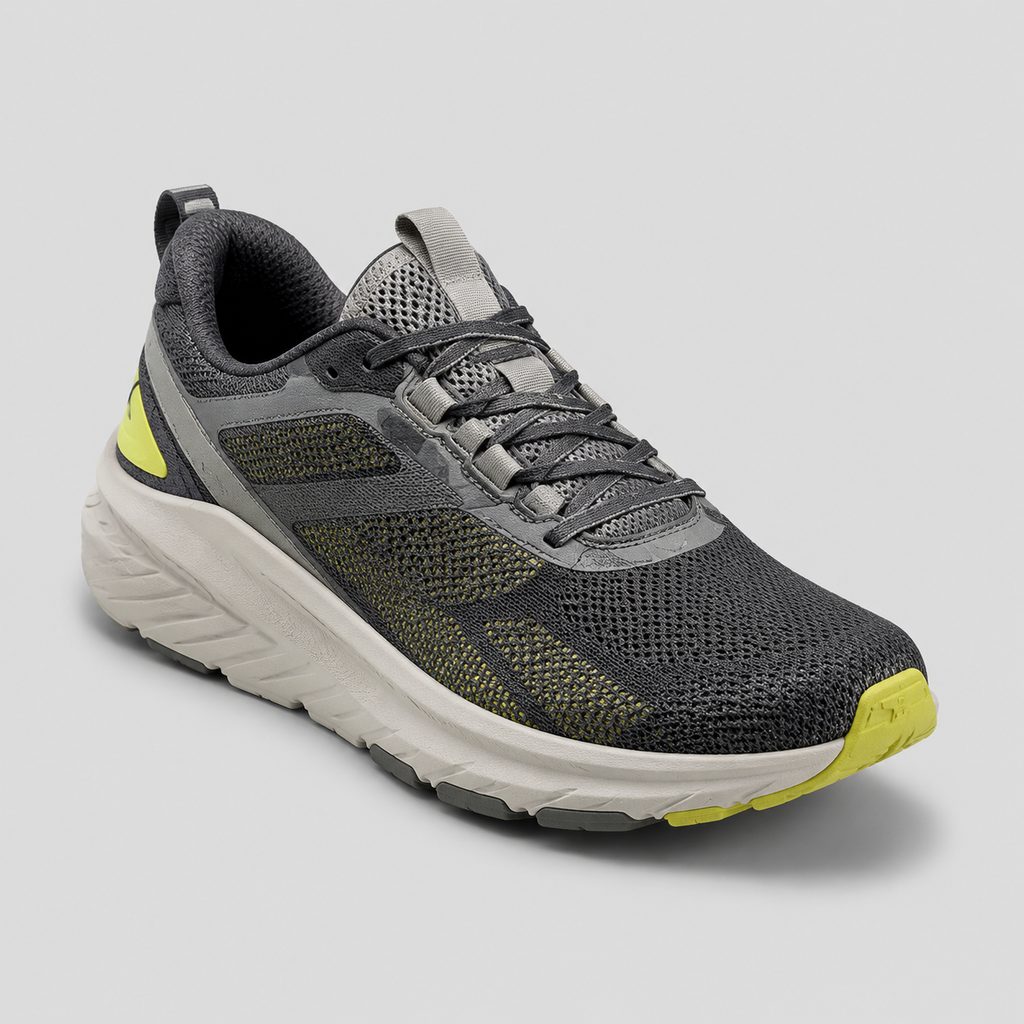
Material options appear in two places and must remain separate. The products page shows breathable and cushioned running shoes with mesh / knit / PU uppers and EVA & rubber outsoles. Those are the constructions listed for the running-shoe family. No performance numbers or process steps attach to the list.
| Component | Documented options for running shoes |
|---|---|
| Uppers | Mesh / knit / PU |
| Outsoles | EVA & rubber |
Separately, the materials overview describes engineered mesh as air mesh or sandwich mesh, knitted or warp-knit synthetic with zoned density. It notes that the construction takes screen print, heat-transfer film and welded TPU overlays cleanly for multi-colour branding, is typically run at 90-250 GSM depending on the zone, and is best for running, training and summer styles that need maximum airflow at a sensible cost. These details belong under material specification and do not enlarge the first-order structure in the case example. Record them only as available screening signals when preparing an athletic footwear reference pair handoff.
Check the running-shoe range on the products page and the mesh notes on the materials page. Keep the two lists distinct so a note about mesh GSM never turns into a claim about production order. Preference for denser knit at the eyestay can be listed; the listing does not mean the factory already owns or guarantees any particular sequence.
Open questions the example phrase generates
The phrase “from reference pair to inspected first production” gives two poles and nothing between them. Turning those poles into distinct OEM sports shoes first production questions leaves responsibility and timing open until the supplier answers. Practical questions include:
- What information must accompany the reference pair when it is handed over for a first running-shoe order?
- Which party prepares or approves any interim samples between the reference pair and first production?
- What does “inspected first production” mean in terms of who performs the inspection and what criteria are applied?
- How does the structure change, if at all, when the order is not a new-brand launch?
- Which development, manufacturability, sampling or quotation options may apply once the current product definition is shared?
Each question preserves the original actor and modality boundaries. None asserts that the factory already performs a particular step. The buyer simply asks which elements of an inspected first production sports shoes supplier path are relevant to the present program. Writing the questions in this form turns a short case-study line into a practical inquiry checklist without inventing missing stages.
Why material notes stay specification tests
Engineered-mesh GSM ranges and multi-colour branding methods serve only as specification-depth tests. They let the buyer check whether the upper can accept the intended artwork density or ventilation zones. They neither replace nor enlarge the limited process description in the case example. Noting “90-250 GSM with denser knit at eyestay and toe” records a material preference, not a production milestone. Clean acceptance of screen print, heat-transfer film and welded TPU overlays is a branding note, not a first-production inspection claim. Keeping the signals in their own lane stops partial lists from combining into an unstated broader capability. The materials page stays a specification resource; the case-studies page stays a structure description limited to one running-shoe first order.
Gaps the four excerpts leave unstated
The four source excerpts leave the following topics open:
- Order quantities, MOQs or commercial pricing of any kind
- Lead times, sample calendars or production timelines
- Specific inspection methods, AQL levels or export packing steps
- Adaptations of the first-order structure for training, walking or casual sneakers
- Ownership of design files, tooling or intellectual property
- Any multi-style or reorder process
These gaps must stay open. Treat them as questions rather than inventing answers. Sampling and export-ready quality control appear only as general business phrases elsewhere on the site and are not mapped to the case-study structure. Therefore they cannot be listed as guaranteed sequential services. Leaving the gaps explicit protects the integrity of every later claim and keeps the inquiry honest.
Buyer definition package for option mapping
The buyer controls a short set of fields that can be assembled into a definition package. Completing them does not create a service promise; it simply gives the supplier a clear basis for indicating which options may apply. As an editorial recommendation for the buyer:
- State the product category (running, training, walking or casual sneaker) and confirm it sits inside the one-family description.
- Define the role of the reference pair: physical sample to match, digital assets only, or combination.
- List preferred upper constructions from the documented mesh / knit / PU options and any engineered-mesh zone notes the team already holds.
- Note outsole preference as EVA & rubber if that matches the program, or flag an open question.
- Attach branding intent only at the level of multi-colour methods already listed for engineered mesh.
- Append the open questions generated from the reference-pair-to-inspected-first-production phrase.
This package stays inside the buyer’s control. Once submitted, the supplier can map development, manufacturability, sampling or quotation options against it. No quantity or timeline fields are required because none appear in the source material. The definition package therefore functions as a clean handoff of what the buyer already knows, not as a demand for unstated services.
How to submit the package and questions
Share the completed definition package together with the open questions. The conversion path is the request form at request a quote. In the message, restate that the package is limited to the current product definition and that the questions keep every responsibility and timing decision open until answered. Do not assert that any particular service is already documented. Ask only which development, manufacturability, sampling or quotation options may apply to the project as defined.
By fixing the case example at its stated limits, confirming family fit, recording only listed constructions, and converting gaps into questions, the buyer creates a clean athletic footwear reference pair handoff request. The sports shoes supplier first production structure remains a topic for dialogue rather than an assumed map. This approach protects both parties from scope creep and keeps the conversation inside verifiable published limits. A well-scoped inquiry of this kind gives the supplier a practical starting point without forcing either side to invent missing process detail.
Sources and verification
- Athletic Shoe Manufacturer | Custom Product Range First-party site source
- About Custom Shoe Factory | OEM/ODM Athletic Shoes First-party site source
- Footwear Manufacturing Case Studies | Example Project Formats First-party site source
- Shoe Soles, Uppers & Insole Materials | Footwear Specs First-party site source
Share the current product definition and ask which development, manufacturability, sampling or quotation options may apply to the project.
Send your project brief