Footwear Product Development
Zone Map for a Sports Shoes Supplier for Engineered Mesh Uppers
Turn a broad breathable-mesh request into a buyer-owned zone map that identifies functional priorities, density status, decoration placement and unresolved project questions.
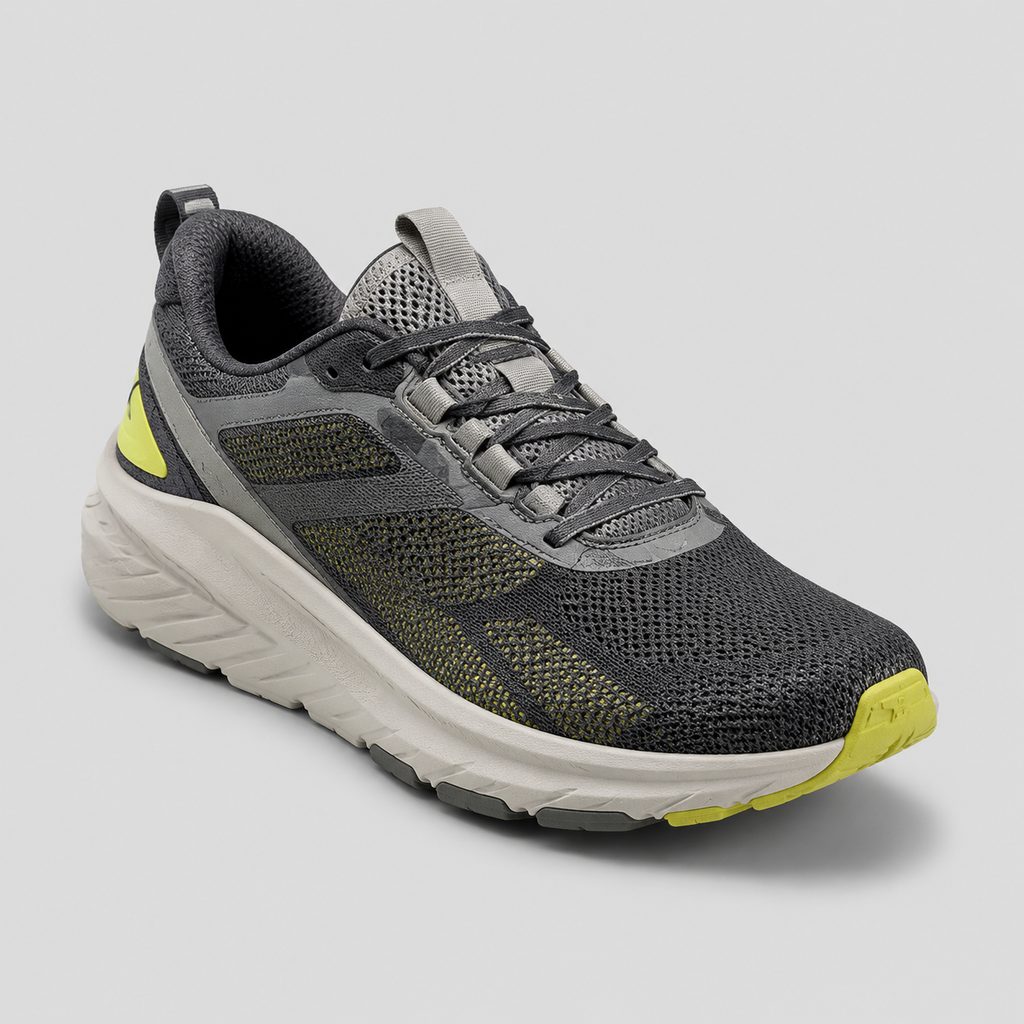
In a buyer's brief, "breathable mesh upper" does not specify whether the eyestay or toe has a different density, where ventilation, light stretch or support should be prioritized, whether decoration crosses a construction boundary, or whether GSM is fixed. For a buyer preparing to contact a sports shoes supplier for engineered mesh uppers, those points belong in separate specification fields.
The published materials reference describes engineered mesh as a knitted or warp-knit synthetic with zoned density for ventilation, light stretch and support. It also provides a typical zone-dependent GSM range, names two locations associated with denser knit, and lists compatible decoration methods. These details supply specification vocabulary. The buyer still owns the proposed zone layout, priorities, values and artwork, while project applicability remains an open inquiry.
Map the Upper by Location
As an editorial recommendation, begin with the physical upper rather than a general material label. Mark each relevant area on the latest drawing, pattern image or reference photograph. Give it a stable location name, an intended job and a current decision status.
Recommended buyer-owned upper zone map
| Location | Published or buyer-defined context | Buyer entry | Question field |
|---|---|---|---|
| Eyestay | The materials reference identifies the eyestay as a location with denser knit. | Record the intended function, current density decision, status and any artwork overlap. | State what remains unresolved for the proposed construction. |
| Toe | The materials reference also identifies the toe as a location with denser knit. | Record the buyer's intended function and whether density is fixed, preferred or undecided. | Ask which project-specific options may apply. |
| Any additional named zone | The location and priority come from the buyer's current product definition. | Mark its boundary and select the relevant vocabulary, such as ventilation, light stretch or support. | Identify any construction or material point that still requires discussion. |
| Decoration footprint | This is an artwork location that may sit within one zone or cross a boundary. | Record the artwork reference, placement, colors, target dimensions and proposed method. | Ask about applicability to the underlying mesh construction. |
Use the same zone names in the drawing, table and inquiry. Where one artwork element crosses two zones, show both relationships instead of assigning the entire graphic to a single substrate entry. For the buyer, this creates a traceable running shoe mesh upper specification without implying that the proposed arrangement has been reviewed or approved.
Assign a Status to Every Entry
The map becomes easier to discuss when every construction, density and decoration field carries a buyer-controlled status. Three labels are sufficient for this purpose.
- Requirement
- A fixed part of the current product definition. Record the exact location and decision, but leave out performance outcomes that have not been established.
- Preference
- A direction the buyer wants to retain if suitable options are available. Describe what may be adjusted rather than presenting it as mandatory.
- Open question
- An unresolved item. The buyer can ask which development, manufacturability, sampling or quotation options may apply without assuming that a particular service or process is available for every project.
Keep zoned mesh upper sampling questions in the open-question category until a project-specific answer is recorded. A blank field hides whether a decision was omitted or intentionally deferred. An explicit status preserves that distinction.
Read the GSM Reference by Zone
The materials page states that engineered mesh is typically run at 90-250 GSM depending on the zone. The published scope matters: this is a typical, zone-dependent range. It does not supply individual GSM figures for the eyestay, toe or any other part of a proposed upper.
For the buyer, the useful task is to record the status of each GSM field rather than deriving values from the endpoints of the published range.
Recommended classification for GSM entries
| Entry type | What belongs in the zone map | Meaning during inquiry |
|---|---|---|
| Published context | Typical 90-250 GSM, depending on the zone. | Material reference vocabulary rather than a whole-upper target. |
| Buyer requirement | A value already fixed by the buyer and attached to a named zone. | A stated requirement whose project applicability remains to be discussed. |
| Buyer preference | A proposed value identified as adjustable. | A current design direction, separate from mandatory requirements. |
| Undecided | No assumed number; record the field as an open question. | A visible gap that can be included in the project inquiry. |
Do not calculate zone values by dividing or interpolating the 90-250 GSM range. The source provides no tolerances, measured airflow, stretch results, weight effects or durability outcomes. Those results therefore do not belong in the zoning sheet unless supported by separate project evidence.
Give Artwork Its Own Layer
The materials reference says engineered mesh takes screen print, heat-transfer film and welded TPU overlays cleanly. It also describes multi-colour branding as easy. Those statements concern engineered mesh generally; the suitability of a particular mesh construction, artwork, color treatment or placement remains specific to the project.
As an editorial recommendation, keep the construction decision and artwork decision in separate fields:
- Identify the artwork. Record the file name or revision, target dimensions, placement and color references.
- Identify the substrate. Name the mesh zone beneath the artwork and record that zone's current construction and GSM status.
- Record the proposed method. Enter screen print, heat-transfer film, welded TPU overlay or "undecided" only when that is the buyer's current direction.
- Write the open question. Ask which options may apply to the proposed combination of artwork, location and substrate.
These are two decisions that should occupy separate fields: the visual result the buyer wants and the unresolved applicability of that treatment to the proposed upper. Listing a decoration method from the materials page does not establish a company service, a guaranteed result or approval for a particular design.
Use Category Information as Context
The company overview presents Custom Shoe Factory as a sport-footwear specialist focused on running, training, walking and casual sneakers. This gives the buyer a documented category reference.
Separately, the product range describes running shoes as performance-inspired daily-training builds with breathable uppers and cushioned midsoles. It lists mesh, knit or PU uppers. It also lists EVA and rubber outsoles.
Category information and its limited use in the brief
| Published information | Recommended buyer use |
|---|---|
| Running, training, walking and casual sneaker focus | Identify which published product family is closest to the proposed program. |
| Running-shoe description and listed materials | Provide category context alongside the component-level upper definition. |
Category presence does not settle the proposed zone map, GSM entries or artwork. Keep the intended footwear category in its own field so that product-range context is not mistaken for project acceptance, tested performance or approval of the upper specification.
Prepare the Current Definition for Inquiry
The inquiry package should show what the buyer has decided and what remains open. A recommended package includes:
- the intended footwear category and use position;
- the latest upper drawing, pattern image or marked reference;
- the zone map with consistent location names and boundaries;
- the intended function and status of each zone;
- known GSM entries and clearly labeled undecided fields;
- artwork files, placement details, color references and proposed decoration methods;
- a consolidated list of development, manufacturability, sampling and quotation questions.
Review the package for silent assumptions before sending it. An unresolved density, artwork-substrate relationship or construction choice should remain labeled as an open question. Completing the field with an invented value would make the definition appear more settled than it is.
Share the current upper definition through the project inquiry page and ask which options may apply. The purpose of the zone map is to present precise buyer decisions and precise unknowns, without promising a quotation, sample, timeline, manufacturing method or result.
Sources and verification
- Shoe Soles, Uppers & Insole Materials | Footwear Specs First-party site source
- Athletic Shoe Manufacturer | Custom Product Range First-party site source
- About Custom Shoe Factory | OEM/ODM Athletic Shoes First-party site source
Share the current product definition and ask which development, manufacturability, sampling or quotation options may apply to the project.
Send your project brief