Footwear Sourcing
What belongs in a sports shoes manufacturer reorder checklist?
Compare a named prior buyer baseline with the current product definition. The resulting matrix shows which records are unchanged, revised or unresolved before the buyer raises development, DFM, sampling or quotation questions.
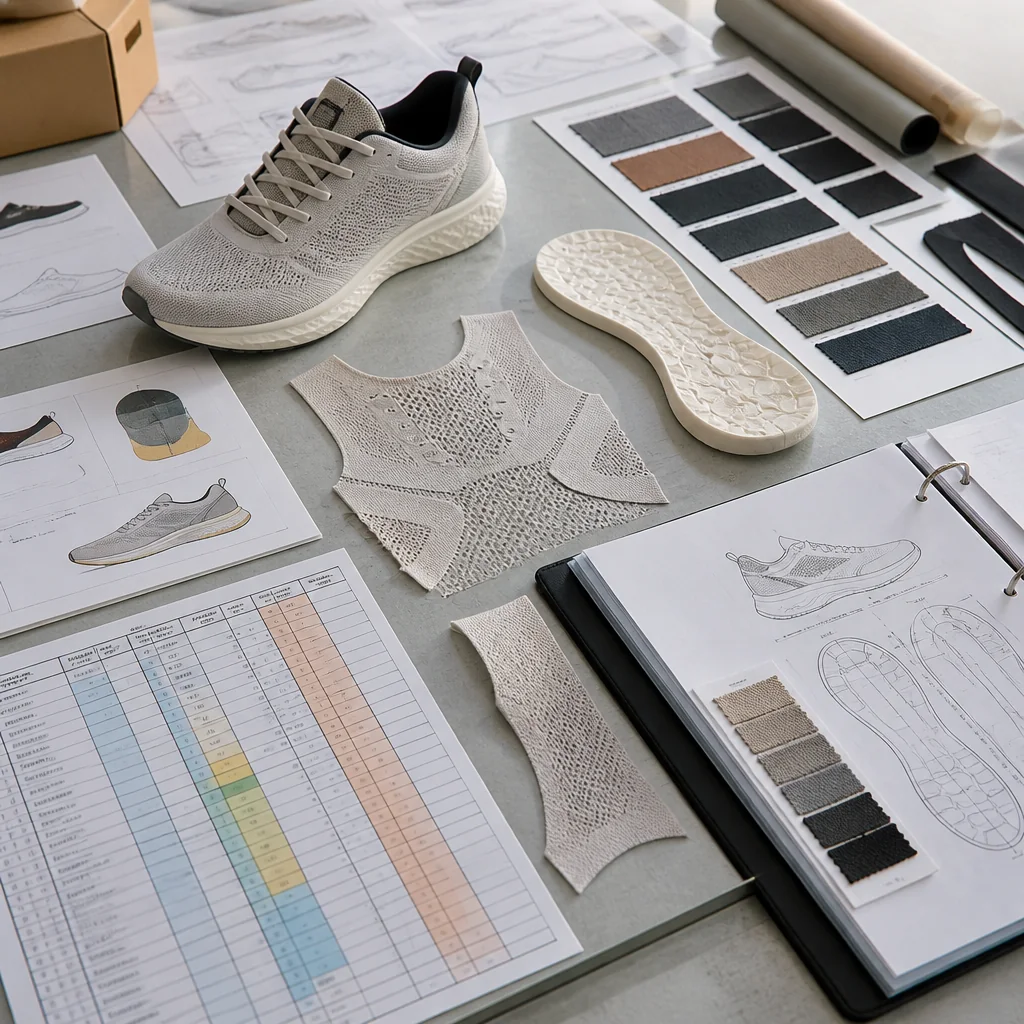
For buyer-side preparation, this article recommends a sports shoes manufacturer reorder checklist built as a comparison record. Place a named prior product definition beside the current request, then give each affected record one buyer-assigned status: unchanged, revised or unresolved. The result shows what the buyer intends to retain, what has changed and which items still need a project-specific answer.
This footwear reorder change matrix is an editorial tool for the buyer. It is not a description of a revision-control system operated by Custom Shoe Factory, and the available excerpts do not explain how the company classifies revised reorders. The documented company actions are addressed separately below so they are not confused with the recommended checklist structure.
One matrix, two product definitions
For an OEM athletic shoe reorder, the recommended starting point is a pair of identifiable product definitions: the prior buyer baseline and the current request. The word “reorder” can remain the commercial description, while the matrix records whether the underlying documents and references have changed.
Recommended fields for the buyer-owned matrix
| Field | Buyer entry | Purpose |
|---|---|---|
| Prior baseline | The exact earlier document or reference selected by the buyer | Identifies the comparison point without implying that the manufacturer has validated it |
| Current definition | The current file, instruction or open decision | Separates the present request from the earlier record |
| Affected record | Tech pack, design, bill of materials or tooling reference | Keeps different records in different rows |
| Change status | Unchanged, revised or unresolved | Records the buyer's comparison rather than a manufacturer approval |
| Question reference | A short identifier linked to one open inquiry | Prevents several unrelated questions from being bundled into one answer |
The buyer can add page numbers, drawing locations, component entries or other pointers from its own records. That recommendation is about making each comparison findable; it does not assign document checking or revision management to the manufacturer.
What do the published OEM statements cover?
Custom Shoe Factory describes its product-family focus as running, training, walking and casual sneakers. That statement supplies the category context for the checklist, but it contains no reorder-handling procedure.
The company's OEM description uses three relevant verbs: manufactures, flags and holds. Their scope is narrow enough to display in one place.
Published OEM wording and its evidence limits
| Documented company action | What the excerpt establishes | What the excerpt leaves open |
|---|---|---|
| Manufactures to the buyer's tech pack and design | The tech pack and design are named inputs to OEM manufacturing. | The excerpt does not assign authorship, completeness checking, redesign or change approval. |
| Flags manufacturability issues during DFM | Manufacturability issues may be flagged during the stated DFM stage. | The excerpt does not describe an earlier review, a required resolution or an approval process. |
| Holds the buyer's bill of materials and tooling across reorders | Holding those items across reorders is the documented action. | Holding does not establish ownership, revision accuracy, condition, availability, continued suitability or automatic reuse. |
These limits govern the rest of the matrix. A prior BOM or tooling reference can identify a comparison point, but the word “holds” cannot be converted into a conclusion about the current project.
The buyer-selected baseline
As an editorial recommendation, the buyer should select the exact earlier records it intends to use for comparison. The baseline may include a prior tech pack, a design reference and known BOM or tooling references. Selecting them for the matrix does not mean Custom Shoe Factory supplied them, confirmed that they are complete or maintained their revision history.
- Baseline identifier
- Enter the buyer's exact file name, revision label or other available reference. Avoid the unqualified phrase “same as before.”
- Current identifier
- Name the file or instruction that represents the current request. If no final record exists, mark that field unresolved.
- Comparison location
- Point to the relevant page, drawing area, component entry or tooling association in the buyer's records.
- Status source
- Identify the status as the buyer's assessment unless a separate record establishes another party's decision.
An incomplete baseline can still be recorded without filling gaps by assumption. The recommended treatment is to mark the missing comparison point unresolved and give it its own question reference.
A record-by-record change map
The following template keeps the records named in the OEM excerpt separate. The entries are prompts for buyer preparation, not statements about which factory response will apply.
Buyer-owned reorder change matrix template
| Affected record | Prior buyer baseline | Current definition | Buyer status | Question reference |
|---|---|---|---|---|
| Tech pack | Exact prior document identifier and relevant section | Current identifier and affected fields | Unchanged, revised or unresolved | For example, M-1 |
| Design | Named prior design file or reference | Named current file and location of the identified difference | Unchanged, revised or unresolved | For example, M-2 |
| Bill of materials | Known prior BOM reference and affected entry | Current entry, proposed revision or open buyer decision | Unchanged, revised or unresolved | For example, M-3 |
| Tooling | Known tooling reference and prior product association as understood by the buyer | Current design reference and the relationship the buyer wants assessed | Unchanged, revised or unresolved | For example, M-4 |
The example identifiers are only labels for the matrix. They do not represent factual orders or company tracking numbers.
- Unchanged
- The buyer has identified no intended difference between the selected prior record and the current definition. The label says nothing about current suitability or commercial terms.
- Revised
- The buyer has identified a difference. The label does not predict the development, DFM, sampling or quotation response.
- Unresolved
- A decision, document or comparison point remains open. The row should link that uncertainty to a specific buyer question.
Where separate records have separate issues, give them separate rows. A design change and an unresolved BOM entry should not share one status or question reference simply because they concern the same shoe.
Material names without technical shortcuts
The published running-shoe range offers limited terminology that can help identify the subject of a change. It describes running-shoe uppers as breathable. It separately describes midsoles as cushioned.
The material line names mesh, knit and PU for uppers. In a separate material category, it places EVA and rubber under outsoles.
For the buyer's matrix, these terms can identify where to look in the current records. The product excerpt does not establish material equivalence, compatibility with a particular design, construction details, grades, compounds, dimensions or test performance. A category name therefore belongs in the matrix only at the level supported by the buyer's own current definition.
Recommended treatment of material terminology
| Record area | Matrix entry | Open point |
|---|---|---|
| Upper | Use the exact upper-material term and location found in the buyer's selected records | Mark missing grade, construction or other project information unresolved rather than inferring it |
| Outsole | Use the exact outsole-material term and location found in the buyer's selected records | Ask about the current entry without treating listed material categories as interchangeable |
Which open question belongs with each row?
Once the buyer has assigned statuses, the editorial recommendation is to create one question for each relevant inquiry topic. Development, sampling and quotation remain inquiry subjects here, not documented automatic services or predetermined reorder requirements. The only review action stated in the supplied OEM excerpt is that Custom Shoe Factory flags manufacturability issues during DFM.
Scoped questions for revised or unresolved entries
| Inquiry topic | Buyer question | How to record the answer |
|---|---|---|
| Development | Which development options, if any, may apply to this identified change? | Link the response only to the referenced row. |
| Manufacturability | What information is needed to consider this identified change during DFM? | Keep any flagged issue distinct from its later response or decision. |
| Sampling | Which sampling options, if any, may apply to this identified change? | Do not mark sampling as required or unnecessary before a project-specific answer. |
| Quotation | Which quotation options, if any, may apply to this identified change? | Record the answer without assuming continuity from the prior product definition. |
This arrangement also prevents a response on one topic from silently closing another. A DFM question, for example, can retain its own reference while a separate sampling or quotation question remains open.
Final buyer review
Before sending the matrix, the buyer can use a short editorial review focused on traceability and scope.
- Confirm that every row names a prior baseline, a current definition or an explicit unresolved field.
- Make sure unchanged, revised and unresolved are presented as buyer-assigned comparison statuses.
- Check that BOM and tooling references are identifiers, not claims about revision control, availability, suitability or reuse.
- Keep material category names separate from unsupported claims about equivalence, construction or performance.
- Leave development, sampling and quotation outcomes as questions.
- Record a DFM flag separately from any response, resolution or approval.
The completed matrix should give the manufacturer a defined current request without answering open project questions on its behalf. The buyer can use the quotation request page to share the current product definition and ask which development, manufacturability, sampling or quotation options may apply.
Sources and verification
- OEM / ODM Shoe Development | Custom Footwear Manufacturing First-party site source
- Athletic Shoe Manufacturer | Custom Product Range First-party site source
- About Custom Shoe Factory | OEM/ODM Athletic Shoes First-party site source
Share the current product definition and ask which development, manufacturability, sampling or quotation options may apply to the project.
Send your project brief