Sneaker Sourcing
Sneakers Wholesale: Build a Comparable RFQ
A practical framework for defining one athletic sneaker baseline, separating approved alternatives and requesting quotations against consistent specifications.
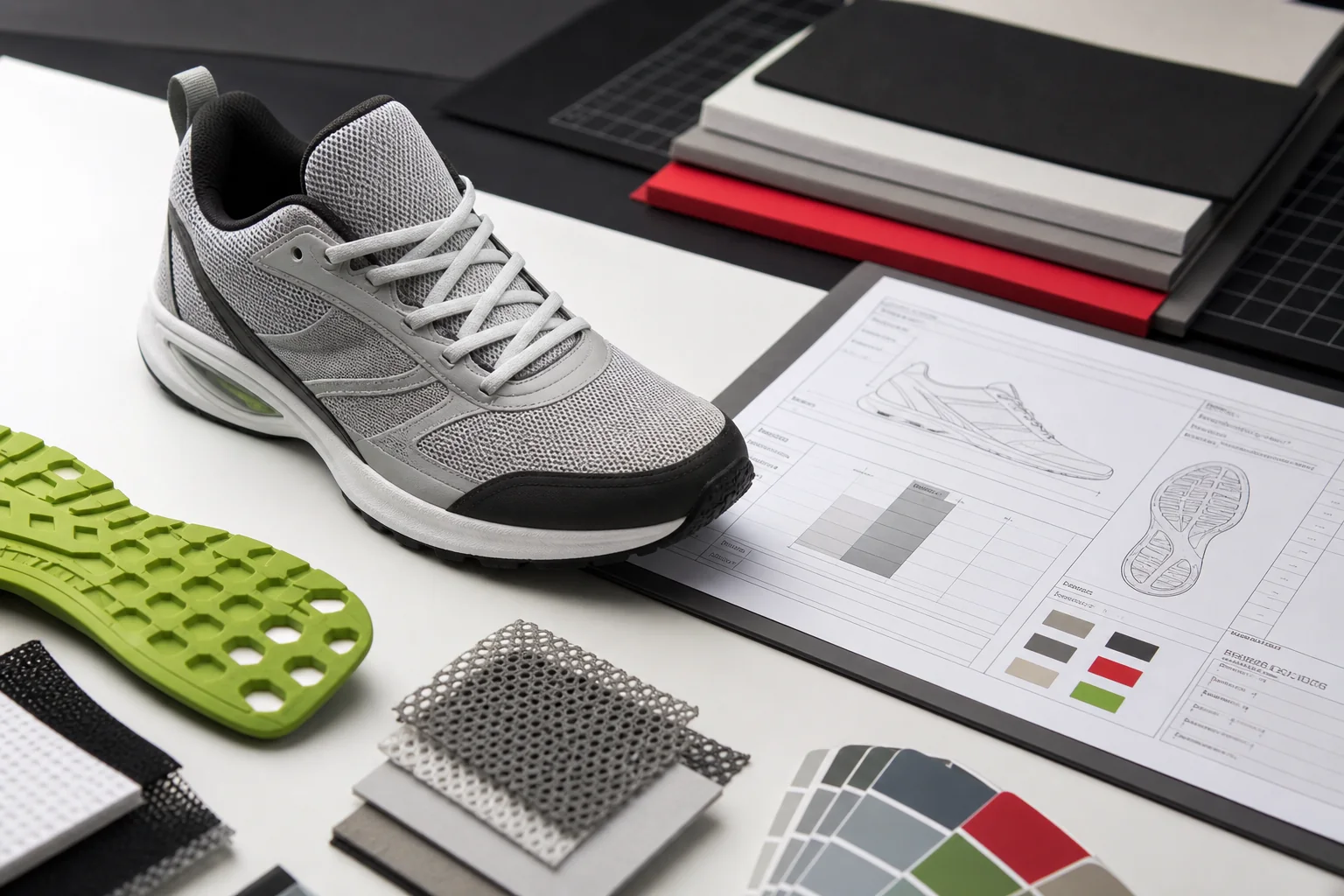
Consider a hypothetical quotation comparison. One response assumes a basic mesh upper with a printed logo. Another assumes zoned engineered mesh with welded overlays. Even if both responses are labeled “running sneakers,” their prices describe different products.
That is the central problem when sourcing sneakers wholesale: a price is difficult to interpret until the product behind it is defined. Intended use, upper construction, sole components, branding and design inputs need a common baseline. Any proposed departure from that baseline should remain visible.
The framework below is an editorial recommendation for buyers preparing an RFQ. It distinguishes buyer inputs from the company-specific materials and OEM statements cited in this article.
Make the product comparable before the price
A broad request may be useful for an initial conversation, but it is not a controlled comparison document. Terms such as “breathable,” “cushioned” and “custom logo” do not identify a complete construction. Each term can leave open questions about materials, component structure and application methods.
The buyer does not need to resolve every question before contacting a manufacturer. Instead, the RFQ should show which decisions are fixed, which may accept an alternative and which remain undecided. This gives each response a visible reference point without presenting early assumptions as approved specifications.
Custom Shoe Factory's product range describes running shoes as performance-inspired daily-training builds with breathable uppers and cushioned midsoles. For those running-shoe examples, the page lists mesh, knit and PU uppers. It separately lists EVA and rubber outsoles. These examples can help a buyer identify fields to clarify, but they do not replace a project-specific definition.
Category sets the first boundary
Custom Shoe Factory describes its sport-footwear specialization as running, training, walking and casual sneakers on its company page. A buyer should identify the relevant category before comparing component proposals.
As an editorial recommendation, add the intended activity and use setting in the buyer's own language. These details provide context for reviewing a proposal without implying that a particular construction, performance result or component is available for the project.
| RFQ field | Buyer input | Reason to include it |
|---|---|---|
| Footwear category | Running, training, walking or casual | Identifies the relevant product context. |
| Intended activity | The activity the buyer expects the shoe to address | Gives construction discussions a defined purpose. |
| Use setting | The expected environment and frequency of use | Adds context beyond styling references. |
| Buyer priorities | Project attributes that should remain visible during review | Provides criteria for evaluating proposed changes. |
The controlled sneaker definition
Use the same specification revision for every request for wholesale sneaker quotes. The baseline should be compact enough to circulate with an inquiry while detailed enough to expose meaningful differences.
- Intended use
Name the footwear category, activity and use setting. Separate confirmed requirements from background information.
- Upper construction
Record the material family, structure, panel arrangement, lining and reinforcement assumptions. Identify any zones with buyer-defined ventilation, stretch or support requirements.
- Midsole
Describe the midsole separately, including available material references, geometry files and buyer priorities.
- Outsole
State the outsole assumptions, drawings, material references and required visual details without merging them into a general “sole” description.
- Branding
Identify each logo location, artwork revision, color and preferred application method. Mark the method as fixed or open to a proposed alternative.
- Color plan
List base and accent colors and identify any construction differences between colorways.
- Size and packing inputs
State the requested size coverage and packing format as questions for the specific project. Confirm which options apply before treating them as part of the quotation baseline.
- Buyer-supplied documentation
List the current tech pack, drawings, artwork, color references, last information, sole files and reference samples. Mark obsolete revisions clearly.
What “mesh” leaves unresolved
The company's engineered-mesh description shows why a generic upper label may be insufficient. It lists air mesh and sandwich mesh. It also describes knitted or warp-knit synthetic structures.
For the engineered mesh described on that page, zoned density is used for ventilation, light stretch and support. Typical weights are stated as 90 to 250 GSM depending on the zone. The description also specifies denser knit at the eyestay and toe.
Those details apply to the engineered-mesh material description, not automatically to every mesh upper or every part of a shoe. When this construction is relevant, an editorially recommended RFQ entry would identify:
- The mesh structure or approved material reference.
- The zones associated with ventilation, stretch or support requirements.
- Any specified density differences at the eyestay, toe or other defined area.
- Whether weight is fixed, targeted by zone or open to review.
- The lining, reinforcement and edge treatment shown in the buyer's current tech pack.
A proposal using a different mesh structure can then be reviewed as an alternative rather than being treated as equivalent because both options use the word “mesh.”
Branding belongs in the specification
A quotation baseline should keep branding attached to the upper construction. Logo placement, artwork and application method can otherwise become hidden differences between responses.
For the engineered-mesh construction described by the company, screen printing is identified as a compatible branding method. Heat-transfer film is also identified as compatible. The same material description identifies welded TPU overlays as compatible. This does not establish that every mesh, artwork or completed shoe construction accepts each method.
- Method fixed: State the required application when the approved design depends on it.
- Alternative allowed: Keep the target artwork and appearance in the baseline, and require any proposed method change to be identified.
- Method undecided: Ask which option may be manufacturable for the submitted design without assuming that a listed method will apply.
Buyers evaluating private label athletic shoes should compare branded specifications with the same branding included. An unbranded base and a construction with transferred graphics or welded overlays are not the same quotation subject.
Three decision states for every variable
The following status system is an editorial tool for keeping the baseline readable while development questions remain open.
| Status | Instruction in the RFQ | Response review |
|---|---|---|
| Fixed | Request the stated specification. | Record any departure as an exception. |
| Alternative permitted | Allow a proposal while preserving the original requirement. | Identify the changed variable and the reason supplied for the proposal. |
| Undecided | State the question that remains open. | Do not add an unconfirmed response to the approved baseline. |
Keep proposed alternatives in separate comparison fields rather than overwriting the original request. MOQ, pricing, sample arrangements, packing and timing also need to be confirmed for the specific specification and project.
Revision control in an OEM program
In its OEM service description, Custom Shoe Factory states that it manufactures to the buyer's tech pack and design. It also states that it flags manufacturability issues during design for manufacturing. The company says it holds the buyer's bill of materials and tooling across reorders.
Holding a bill of materials and tooling does not establish permanent material availability, identical prices or unchanged production conditions. Buyers should maintain their own revision-controlled product record and confirm the current basis of each reorder.
As an editorial recommendation, that record should identify the document version, approved construction, artwork revision, accepted alternatives and unresolved exceptions. Once a change is approved, update the controlled definition so later requests do not depend on scattered comments or earlier quotation versions.
A quotation-ready snapshot
Before contacting an OEM sneaker manufacturer, assemble one current snapshot containing:
- The footwear category, intended activity and use setting.
- The fixed upper, midsole and outsole definitions.
- Known material structures, zones and reference specifications.
- Branding locations, artwork revisions and preferred application methods.
- The color plan and any construction differences between colorways.
- The requested size coverage and packing format as project questions.
- Current tech packs, drawings, artwork and other buyer-supplied files.
- Approved alternatives, prohibited substitutions and undecided fields.
- Questions about manufacturability, sampling, MOQ, quotation scope, packing and timing.
Submit the current definition through the quotation request and ask which development, manufacturability, sampling or quotation options may apply. The objective is not to eliminate every open question. It is to give each response the same product reference and make every proposed change easy to identify.
Sources and verification
- About Custom Shoe Factory | OEM/ODM Athletic Shoes First-party site source
- Athletic Shoe Manufacturer | Custom Product Range First-party site source
- OEM / ODM Shoe Development | Custom Footwear Manufacturing First-party site source
- Shoe Soles, Uppers & Insole Materials | Footwear Specs First-party site source
Share the current product definition and ask which development, manufacturability, sampling or quotation options may apply to the project.
Send your project brief