Sourcing and Procurement
Shoe Manufacturing Quote Comparison for Small Businesses
A buyer-side matrix for separating published statements, current quotation responses and unresolved questions before comparing athletic footwear manufacturing offers.
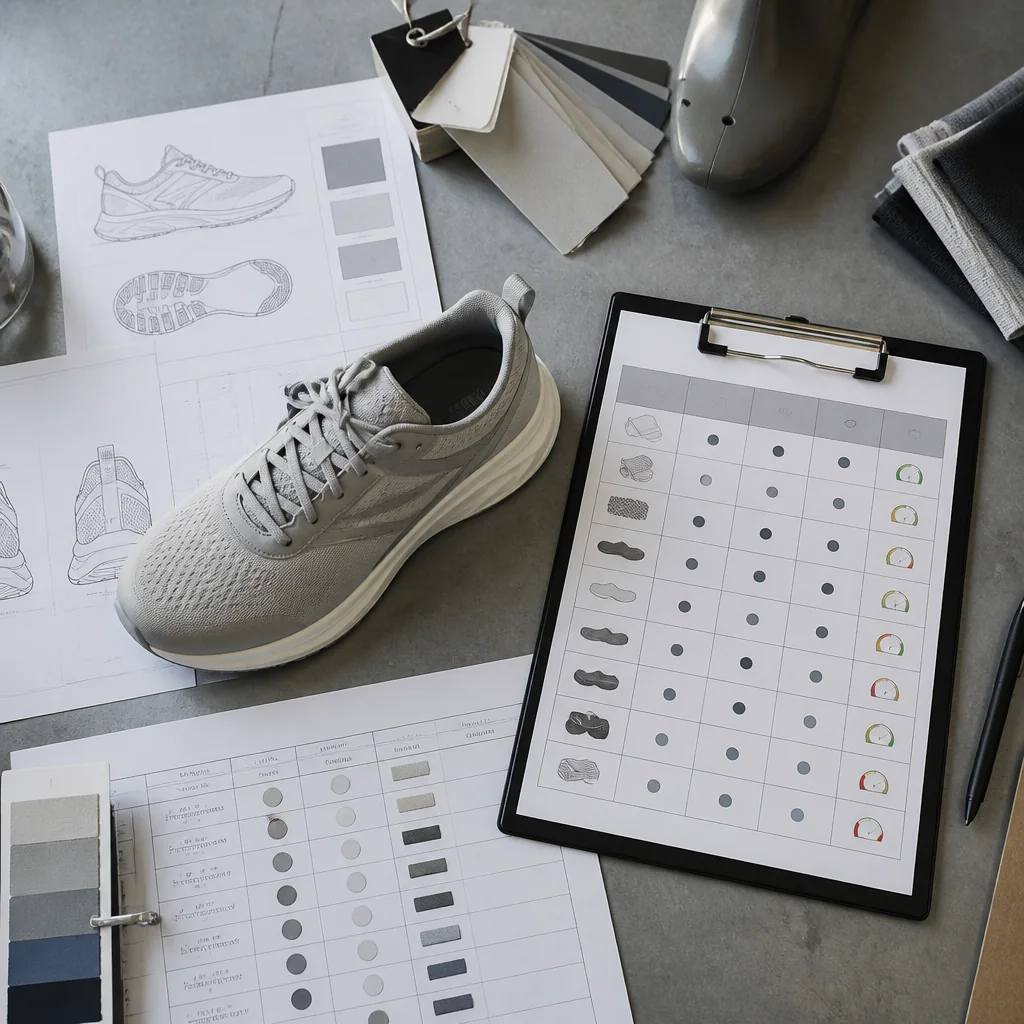
Create the working sheet for a shoe manufacturing quote comparison for small businesses with columns for the response reference, product-definition revision, category, construction direction, evidence state, DFM flags, reorder wording and unresolved questions. These fields give the buyer a direct test: can every response be traced to the same proposed shoe and the same specification revision?
This is an editorial comparison method, not a quotation format offered by Custom Shoe Factory. Use it to keep published company information separate from answers supplied for the current project. When a point remains unanswered, leave it visible as an inquiry instead of completing the matrix from an assumption.
Fix the comparison baseline
Our first recommendation is to choose one controlling product definition before interpreting the responses. Identify the footwear category, current tech pack or specification file, upper direction, outsole direction and revision reference. The matrix then has a stable baseline against which each response can be read.
Preserve earlier revisions in the record when the specification changes. A response tied to an earlier file may still contain useful information, but it should occupy a separate line from an answer addressing the current definition. This prevents a construction change from being mistaken for a difference between suppliers.
- Response reference: Record the quotation, email or other written answer being reviewed.
- Controlling definition: Name the product file and revision used for the comparison.
- Scope status: Mark the response as aligned with the baseline, proposing a variation or leaving the point open.
- Revision conflict: Note when an answer concerns a superseded specification.
For an OEM shoe quote comparison checklist, revision alignment is the first decision gate. Commercial comparisons remain difficult to interpret while the underlying builds differ or cannot be identified.
Assign one evidence state to each entry
The matrix uses three states. The state describes where an entry came from; it does not score the entry or indicate that a published statement applies automatically to the current shoe.
| Evidence state | Contents | Editorial treatment |
|---|---|---|
| Published first-party statement | A narrowly scoped statement from a named company page, with its product or process context. | Record the page and scope. Create a separate inquiry if project-specific confirmation is still needed. |
| Current quotation response | A written answer associated with the product definition and revision under review. | Attach the response reference and record any stated variation or open condition without merging it with website language. |
| Unresolved buyer inquiry | A question that has not been answered for the current project. | Return the question with the controlling revision. Its presence documents an information gap, not a service, inclusion or promise. |
A published statement that appears relevant should stay in the published state until its application to the current definition is confirmed. Our recommendation is to add a separate inquiry beside it rather than introducing an assumed state.
Place product statements in their exact scope
The company overview identifies Custom Shoe Factory's focus as running, training, walking and casual sneakers, described as one product family rather than a catch-all factory. This supports a published entry about the company's stated category focus. It provides no basis here for conclusions about capacity, order suitability, cost or compatibility with a particular design.
A separate running-shoe entry lists mesh, knit and PU uppers. The same running-shoe entry lists EVA and rubber outsoles. Keep those two attribute groups in separate matrix fields and retain the running-shoe scope.
The material wording should not be copied into rows for training, walking or casual footwear. Nor should the list be converted into a claim that every upper and outsole combination is available for every running-shoe project. The buyer-side task is narrower: compare each response with the upper and outsole directions in the controlling product definition.
- Category field: Enter the category stated in the buyer's current file.
- Upper field: Record the specified upper direction and any written alternative separately.
- Outsole field: Record the specified outsole direction and any written alternative separately.
- Confirmation field: Indicate whether the response addresses those requirements for the current revision.
When buyers compare custom shoe factory quotes, general product-page wording belongs in the published column. Project-specific applicability belongs in the current-response column.
Bind DFM flags to a revision
The OEM/ODM page says that, for OEM build-to-spec work, Custom Shoe Factory manufactures to the buyer's tech pack and design. It separately says that the company flags manufacturability issues during DFM. These statements support two bounded published entries: one about the build-to-spec basis and one about flags raised during the stated DFM stage.
Our editorial recommendation is to give each DFM flag its own matrix line. Record the affected component, issue wording, specification revision and current disposition. Then identify whether the quotation response addresses the affected revision or a later file.
- Copy the flag into the record without broadening its wording.
- Attach the product-definition revision affected by the flag.
- Record any buyer decision or design change as a separate disposition.
- Check which revision the response under comparison actually addresses.
An internal status such as resolved is useful only when the project record contains a clear disposition. It should not be used to imply guaranteed manufacturability, production performance or a broader engineering service beyond the supplied OEM statement.
Keep reorder wording narrow
In the same OEM context, Custom Shoe Factory states that it holds the buyer's bill of materials and tooling across reorders. Enter that statement in the published column with its context intact.
| Row | What to record |
|---|---|
| Published statement | The company says it holds the buyer's bill of materials and tooling across reorders in the described OEM build-to-spec context. |
| Current response | Only the written answer supplied for the current product definition and revision. |
| Buyer inquiries | Separate questions about ownership, exclusivity, retention period, storage cost, transfer rights or future availability when those points affect the decision. |
The published wording concerns holding the bill of materials and tooling across reorders. Ownership, free storage, perpetual retention, transferability and guaranteed future availability are outside its stated scope. Keep those cells open until the current project response addresses them.
Use the project example to form questions
The case-studies page introduces an example format for a new brand's first running-shoe order, described from a reference pair to inspected first production. Treat this as a description of that example format, not as a standard workflow or a documented result for every project.
For the comparison matrix, the excerpt can prompt narrowly framed inquiries: does the current response assume a reference pair, which revision controls the proposed work, and what does any inspection wording mean for this project? Until answered, those topics remain unresolved. The excerpt alone establishes neither a general inspection protocol nor a promise that another project will follow the same stages.
Read differences by cause
Once the rows have evidence states and revision references, read each mismatch according to its cause. The purpose is to identify equivalent scope, not to produce a generic supplier score.
| Comparison row | Question for the buyer | Recommended treatment |
|---|---|---|
| Product definition | Do the responses address the same category and intended build? | Separate responses that concern different definitions. |
| Upper direction | Does each response address the upper in the controlling file? | Record a proposed alternative independently from the original requirement. |
| Outsole direction | Does each response address the outsole in the controlling file? | Leave omitted or unconfirmed details open. |
| Specification revision | Can each answer be traced to a named revision? | Request confirmation before treating unmatched revisions as comparable. |
| DFM flags | Which revision is affected, and does the response reflect a later disposition? | Keep the original flag and subsequent decision as separate records. |
| Reorder wording | Is the entry published background or a project-specific answer? | Do not expand the published wording into unstated commercial or legal terms. |
| Other quotation questions | Has the point been answered for the controlling definition? | Classify a missing answer as an unresolved inquiry. |
The supplied evidence contains no prices or standard quotation terms. This article therefore supports a method for normalizing scope, not a conclusion about which response is cheaper, more complete or commercially preferable. Once the matrix distinguishes specification changes, published background and current answers, the buyer can evaluate commercial differences within the appropriate product context.
Return the open rows
Convert blank or conflicting cells into a focused request tied to the controlling product definition. Our recommendation is to make each question specific enough that its answer can be returned to one matrix row.
- Identify the current product-definition file and revision.
- Ask which revision each existing response addresses.
- List open DFM flags and ask whether the response reflects the affected definition or a later revision.
- Ask which development, manufacturability, sampling or quotation options may apply to the current project.
- Raise MOQ, packing and other commercial topics as buyer inquiries, without treating them as documented inclusions.
- Keep reorder-related commercial and legal questions separate from the published bill-of-materials and tooling statement.
The buyer can share the current product definition and ask which options may apply. A useful completed matrix has a source for each populated cell, a revision attached to each project answer and a visible question wherever the available information stops.
Sources and verification
- OEM / ODM Shoe Development | Custom Footwear Manufacturing First-party site source
- Footwear Manufacturing Case Studies | Example Project Formats First-party site source
- Athletic Shoe Manufacturer | Custom Product Range First-party site source
- About Custom Shoe Factory | OEM/ODM Athletic Shoes First-party site source
Share the current product definition and ask which development, manufacturability, sampling or quotation options may apply to the project.
Send your project brief