Product Development
Known vs. Open Fields: running shoe material brief for small brands
A procurement worksheet for recording published running-shoe material references, buyer instructions, and unresolved development questions.
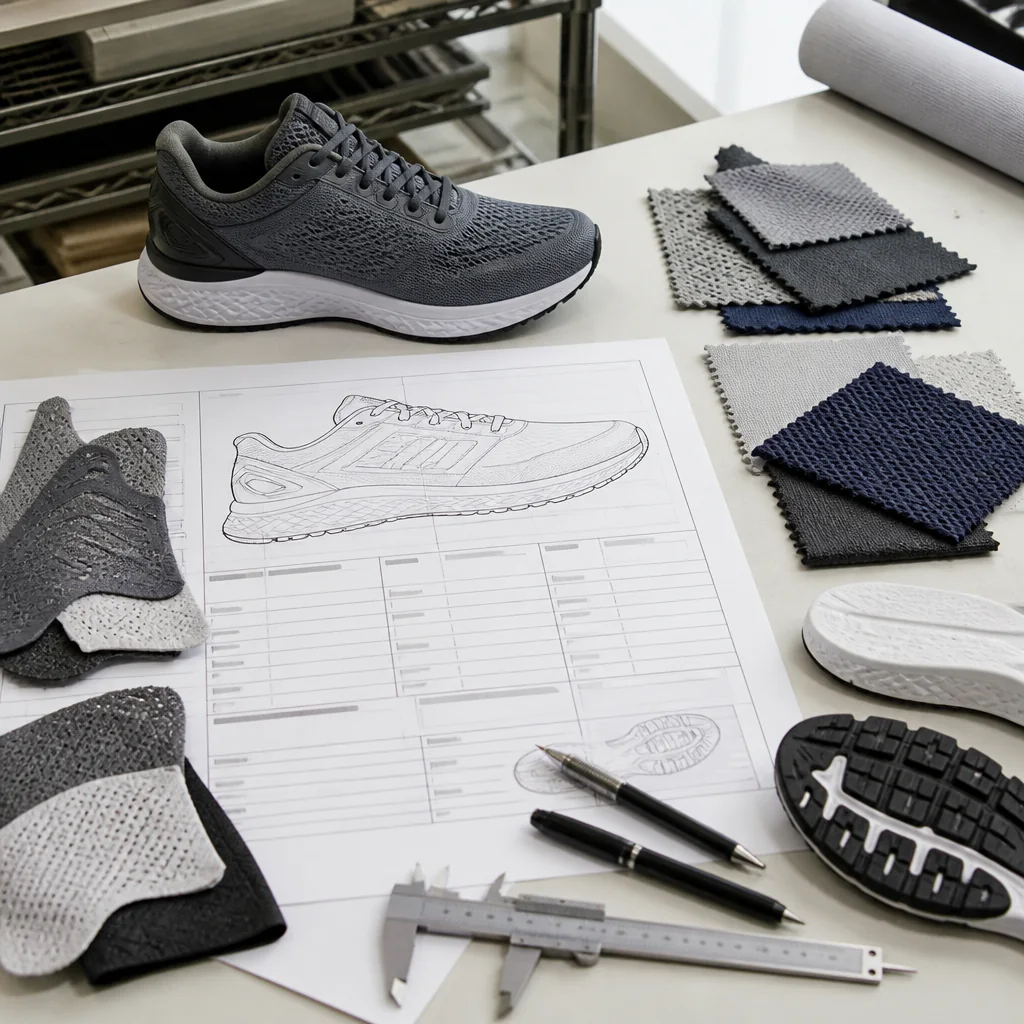
For a running shoe material brief for small brands, begin with a record that separates published references from project instructions. The record should show what the product page actually states, what the brand has decided, and which points need a project-specific response. That structure keeps an early inquiry usable when the team has a product direction but has not selected every component.
Custom Shoe Factory's running-shoe product page describes performance-inspired daily-training builds. The page also describes breathable uppers and cushioned midsoles. It names mesh, knit, and PU for uppers. It separately names EVA and rubber for outsoles.
Those statements establish a narrow category reference. They do not select an upper, outsole, construction, component pairing, or sample specification for a buyer's project. The guidance below is an editorial recommendation for buyers: treat every unconfirmed combination, requirement, commercial term, and expected outcome as an open field for discussion.
Start the record with product intent
Before listing materials, write the product role in terms the team can stand behind. A buyer can state that it is considering a performance-inspired daily-training running direction, provided that this is its own intended direction rather than a claim that a project has been accepted. It can also state whether the visual direction should read as more technical or more casual, and where the product is expected to sit in the brand's range.
Keep this first section short. Its job is to give the development conversation a boundary. A material name alone leaves too much undefined, while a detailed performance promise would go beyond the published product-range information.
Record the intended product category and the current design direction.
Identify the wearer or use context in the brand's own planning terms.
State the visual priorities, such as a layered appearance, a cleaner upper, or a more pronounced sole profile.
Mark any requirements that are still under internal review.
This section is a buyer instruction, not a statement of factory capability. It gives the supplier context for the questions that follow without enlarging a published category description into a confirmed program.
Use known and open fields side by side
Buyers reviewing running shoe material options for brands can use the following worksheet as a controlled starting point. The known column records the supplied product-page scope. The open column is for the buyer's current instruction or a question that needs a project-specific answer.
Known and open material-brief worksheet
| Brief area | Known reference | Open project field |
|---|---|---|
| Running-shoe direction | The product page describes performance-inspired daily-training running builds with breathable uppers and cushioned midsoles. | State whether that direction is the intended starting point and define the product's role in the brand range. |
| Upper reference | Mesh, knit, and PU are listed for uppers. | Identify whether the brand has a preferred upper direction. Mark visible zones, visual priorities, references, and any decision that remains open. |
| Outsole reference | EVA and rubber are listed for outsoles. | Describe the intended outsole direction, appearance, and unresolved questions about the component arrangement. |
| Construction | The published references do not select a construction for this inquiry. | Provide sketches, drawings, reference images, branding positions, color notes, and questions about details that have not been defined. |
| Decision status | A listed reference is not a selected component for the buyer's project. | Label each field as confirmed by the brand, preferred for discussion, or open. |
The worksheet does not rank mesh, knit, PU, EVA, or rubber. It does not assign breathability, cushioning, durability, flexibility, cost, fit, or another outcome to an individual material. A buyer can name the outcome it wants to explore and ask which options may apply after the project inputs have been reviewed.
Separate instructions from development questions
A clear brief makes uncertainty visible. The buyer should record its own decisions as instructions and preserve unresolved issues as questions. This prevents a preference from being read as a final bill-of-materials instruction.
- Buyer instruction
Record the product direction, design references, material preferences, component zones, color direction, branding placement, and non-negotiable visual requirements. Where the buyer has a tech pack or design, identify the current version and show which fields have been approved internally.
- Open development question
Ask what further definition is needed to consider the intended direction. Frame questions around an identified field, such as an upper zone, a visible material treatment, a sole appearance, or a construction relationship.
- Information still unavailable
State plainly when the brief lacks an input, reference, or decision. A visible gap is easier to resolve than an assumed instruction, especially when several people contribute to the product definition.
An athletic shoe sampling brief can use the same format. At this stage, it is a record of current inputs and unanswered questions. It does not describe a prescribed sample sequence or a result for the proposed shoe.
Bring the marked record into DFM
The OEM / ODM page states that Custom Shoe Factory manufactures to the buyer's tech pack and design. The page separately states that it flags manufacturability issues during DFM. For a buyer with a developing material brief, that is the documented point at which unresolved fields can be raised for discussion.
Attach the current tech pack or design where one is available. Separate confirmed instructions from reference images and open choices.
Include the known-and-open worksheet. Use a published material reference only as a reference unless the buyer has made a project selection.
Ask which open fields require additional definition for the proposed tech pack or design. Keep each question tied to a specific area of the record.
After the discussion, update the buyer's own brief with any revised instruction and leave unconfirmed points marked as open.
DFM should be treated as a manufacturability review point within the stated OEM scope. The supplied statement does not establish material approval, individual material performance, cost, availability, testing, or final production feasibility for a particular project.
Keep sampling and quotation questions bounded
An OEM running shoe material inquiry is easier to answer when each request is connected to the current brief. Avoid asking for an undefined running shoe and then assuming that a reply confirms a material package. Instead, send the product direction, available design inputs, listed references that are relevant, and the fields that require discussion.
Editorially, the inquiry can ask which development, manufacturability, sampling, and quotation options may apply to the project. It can also ask what additional project information is needed. These are questions for the project response; they are not documented promises that a particular sampling route, commercial term, component combination, or quotation outcome will be available.
Which current brief fields need further definition before the proposed design can be considered?
Which of the buyer's upper and outsole references are relevant to discuss for this project?
What design or tech-pack information should be clarified?
Which sampling and quotation questions can be addressed after the project inputs are reviewed?
Keeping questions in this form protects the evidence boundary. It also gives the buyer a practical way to collect project-specific information without presenting inquiry topics as settled services.
Record resolved choices for reorder discussions
The OEM / ODM page says that Custom Shoe Factory holds the buyer's bill of materials across reorders. The same statement says that it holds the buyer's tooling across reorders. That wording becomes relevant after the buyer has a defined bill of materials and identified tooling for its project.
It does not establish identical material availability, unchanged pricing, indefinite retention, or an unchanged result on a future order. Before relying on the statement in a reorder discussion, the buyer should ask what the project record identifies as the bill of materials, what tooling is recorded, and what needs confirmation for the proposed reorder.
Maintain a simple change log beside the chosen brief. Record the prior component instruction, the requested change, the date of the revision, and the question still awaiting a project-specific response. That log helps distinguish a past selection from a current request.
Send a concise, traceable inquiry
A useful inquiry does not need to present every field as final. It needs enough structure for the recipient to see the current definition and the open decisions. Before using the quote request page, check that the note includes the following:
The current running-shoe direction and the buyer's intended product role.
Mesh, knit, or PU only where an upper reference from the published range is relevant to the inquiry.
EVA or rubber only where an outsole reference from the published range is relevant to the inquiry.
Confirmed component choices and every field still open for discussion.
Available tech packs, designs, sketches, drawings, or reference images, with their current status.
Specific questions about development, manufacturability, sampling, or quotation options that may apply.
Send the current record with its open fields intact, then keep the resulting project decisions beside the same worksheet. This gives the buyer a traceable material brief without treating a published range as a confirmed specification.
Sources and verification
- Athletic Shoe Manufacturer | Custom Product Range First-party site source
- OEM / ODM Shoe Development | Custom Footwear Manufacturing First-party site source
Share the current product definition and ask which development, manufacturability, sampling or quotation options may apply to the project.
Send your project brief