Product Development
RFQ Decision Matrix for Wholesale Sneakers Mesh Upper Specification
An RFQ worksheet for recording mesh upper zones, construction terms, material-weight status, branding details and open manufacturability questions.
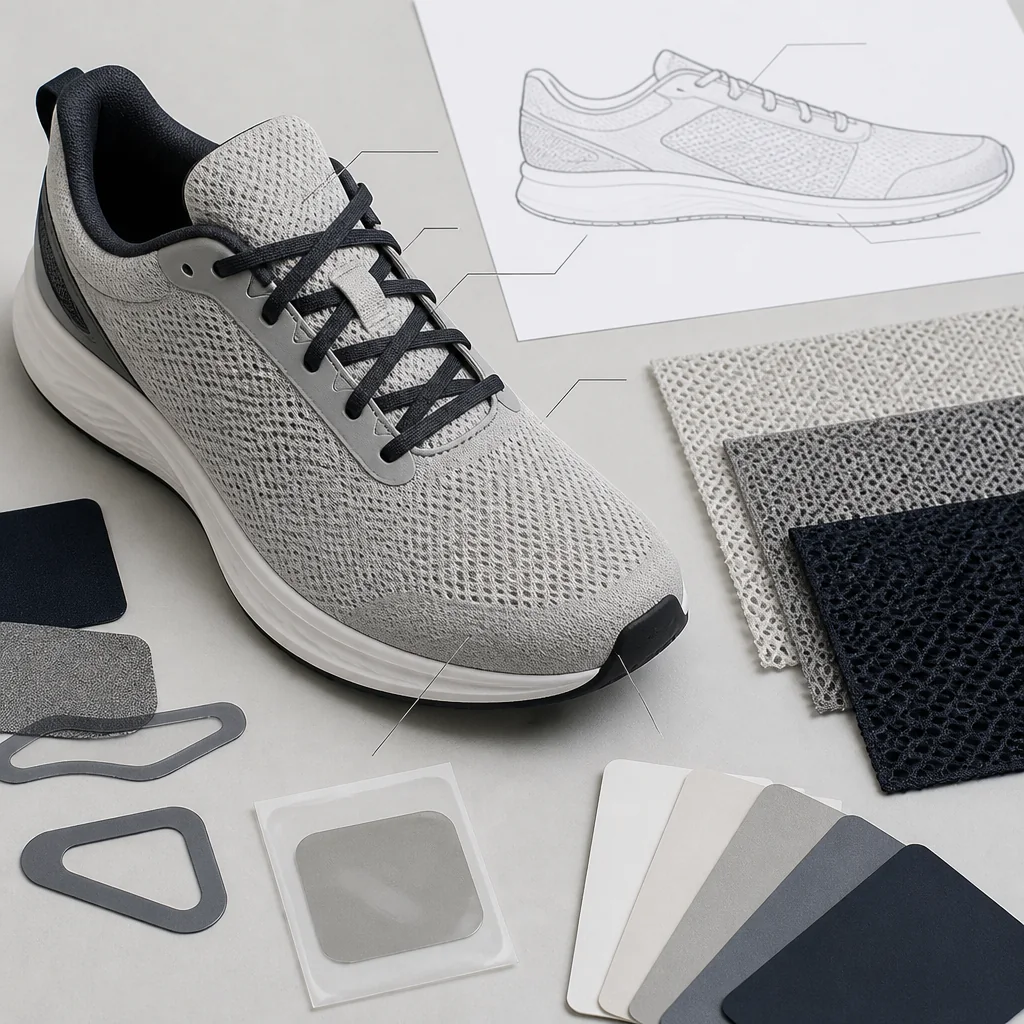
"Mesh upper" does not identify zone boundaries, construction, GSM status or branding treatment. For this editorial worksheet, a wholesale sneakers mesh upper specification should show which fields are fixed, preferred or open for review. That distinction lets a buyer submit the definition available today without presenting unanswered material questions as settled requirements.
The worksheet is an editorial recommendation for buyers, not a factory-prescribed form. It organizes the site's published material descriptions, product scope and OEM language into an RFQ record that can be read field by field.
Fixed, preferred or open?
Before adding more material detail, assign a decision status to each entry in the buyer's record. The following three labels are an editorial convention for making uncertainty visible:
- Fixed
- The buyer has selected the requirement and documented it in the current drawing, artwork file, material reference or written specification.
- Preferred
- The entry records the buyer's present direction, but it remains subject to a specific review question.
- Open
- No selection has been made. The record names the zone and the decision that still needs to be considered.
Apply the status beside each field rather than placing one general note at the top of the RFQ. The forefoot construction may be fixed while its GSM remains open, or the artwork position may be confirmed while the proposed treatment is still preferred. A broad "mesh to be confirmed" note does not preserve those distinctions.
Which product family fits the concept?
The company description identifies running, training, walking and casual sneakers as its product family and says it is not a catch-all factory. For the buyer's RFQ, select the published program type that matches the concept rather than relying only on a broad label such as "athletic shoe."
- Record running, training, walking or casual as the current program type.
- Mark the program field open if the buyer has not yet selected one of those categories.
- Keep market positioning and intended use notes separate from the program label.
The program type gives the upper a defined product context. It does not replace the zone, construction, GSM or branding fields that describe the upper itself.
The zone map as a working specification
The materials reference uses the terms engineered mesh, air mesh and sandwich mesh. Its engineered-mesh description refers to knitted or warp-knit synthetic construction with zoned density for ventilation, light stretch and support.
Those published terms support a zone-based discussion, but they do not prescribe a universal panel layout. For an engineered mesh sneaker upper, the table below is editorial buyer guidance for recording where each current requirement begins and ends.
| Upper zone | Intended role to record | Material fields | Decision status |
|---|---|---|---|
| Forefoot or vamp | Ventilation, light stretch, support or a buyer-defined combination | Construction term and separate GSM entry | Fixed, preferred or open |
| Quarter panels | The buyer's intended ventilation, light-stretch or support role | State whether the construction matches or differs from the forefoot | Fixed, preferred or open |
| Eyestay | The intended role around the lacing area | Density, mesh boundary and any proposed overlay | Fixed, preferred or open |
| Toe area | Required coverage and intended support role | Mesh boundary, density status and any separate treatment | Fixed, preferred or open |
| Tongue and collar | Whether these areas belong to the same material program | Record an independent construction when the design differs | Fixed, preferred or open |
| Branding area | The space reserved for the buyer's artwork | Position, dimensions, colors and proposed treatment | Fixed, preferred or open |
The materials reference also gives a typical context of denser knit at the eyestay and toe. That statement can inform a discussion, but it is not a required layout for every design. As an editorial practice, mark the buyer's actual zone boundaries on a technical drawing, rendering or reference image and use matching zone names in the material record.
Construction names and GSM answer different questions
The materials page describes engineered mesh as knitted or warp-knit synthetic. In a separate specification statement, it gives a typical range of 90-250 GSM depending on the zone. One describes construction; the other records material weight. The editorial worksheet therefore keeps them in separate fields.
| Field | What the buyer records |
|---|---|
| Construction terminology | The exact term already selected, or an explicit open status when no term has been chosen |
| GSM status | An intended value, an acceptable range or an open question tied to a named zone |
| Functional intention | Ventilation, light stretch, support or the buyer's required combination for that zone |
| Reference material | A buyer-held swatch reference, supplier code, close-up image or other record of the intended material |
In this editorial format, a sneaker upper GSM specification should name the zone to which the entry applies. The published 90-250 GSM range is zone-dependent context, not a mandatory target, exhaustive option list or quality scale. The source does not establish that a particular point within the range confirms ventilation, durability, stretch, support, comfort or cost.
Branding at the material boundary
The engineered-mesh entry mentions screen print, heat-transfer film and welded TPU overlays as treatments that the material takes cleanly. The statement belongs to the published engineered-mesh description. It does not confirm suitability for every mesh construction, artwork, shoe zone or production design.
For the buyer's branding record, include:
- the artwork file and revision;
- the named upper zone and orientation;
- finished dimensions and position;
- required colors;
- screen print, heat-transfer film, welded TPU overlay or an open treatment field;
- whether the artwork crosses a panel boundary, seam or density transition;
- which visual features are fixed and which may be adjusted.
Keep a proposed method marked as preferred until its suitability for the named construction and location has been considered. A hypothetical bounded question could read: "Can the preferred welded TPU treatment be reviewed for the marked eyestay zone and artwork dimensions?" The question identifies the treatment and location without presenting them as approved.
Upper definition and the sole package
The running-shoe description refers to breathable uppers and cushioned midsoles. It separately lists mesh, knit and PU uppers. EVA and rubber appear in its outsole language.
The source does not provide an exact midsole material, outsole layer arrangement or required pairing. The editorial worksheet therefore keeps the upper definition and the rest of the shoe in distinct rows:
| Product field | Buyer record |
|---|---|
| Upper | Zone boundaries, construction terms, intended roles and GSM status |
| Upper branding | Artwork, position, dimensions, colors and proposed treatment |
| Cushioning or midsole | The buyer's current requirement, reference or open question |
| Outsole | Current material language, design reference and unresolved construction fields |
| Whole-shoe context | Last, outsole drawing, side profile, colorway and other buyer-held references needed to interpret the upper |
This separation allows the buyer to define the mesh upper without filling gaps in the cushioning or outsole package with unsupported assumptions. It also shows which broader shoe details are available when the upper is considered within the complete design.
What can DFM flag?
The published OEM description states that the factory manufactures to the buyer's tech pack and design and flags manufacturability issues during DFM. In that description, the tech pack and design are the manufacturing inputs, while issue flagging is the stated DFM action.
The excerpt does not document automatic material selection, completion of missing specifications, artwork approval or guaranteed resolution of every issue. Buyers can preserve that boundary by separating confirmed inputs from bounded questions:
| Buyer-confirmed input | Question for review |
|---|---|
| Program type, upper drawing and zone boundaries | Does the current zone layout present manufacturability issues to flag during DFM? |
| Selected construction term for each confirmed zone | Which marked-open construction details need to be considered for the current design? |
| GSM value, range or open status for each zone | Can the proposed weight or density transition be reviewed for the named zone? |
| Artwork, dimensions, colors and preferred treatment | Are there manufacturability issues to flag for the proposed treatment and placement? |
| Current cushioning and outsole information | What additional context, if any, is needed to consider the upper within the design? |
A bounded question names the zone, construction field and decision under review. It gives the inquiry a defined subject without assuming that the factory has already selected a material or approved a treatment.
RFQ handoff record
As an editorial handoff recommendation, assemble the current information in one record rather than distributing related decisions across separate messages:
- Identify the program. Mark the concept as running, training, walking or casual.
- Attach the upper drawing. Show zone names and boundaries that match the worksheet.
- Record construction by zone. Mark each term fixed, preferred or open.
- Record GSM separately. Enter a value, range or open status for every relevant zone.
- Add the branding definition. Include artwork, revision, dimensions, colors, location and proposed treatment.
- Provide whole-shoe context. Keep cushioning, midsole and outsole fields distinct from the upper record.
- Separate decisions from questions. List confirmed buyer inputs first, followed by bounded development or manufacturability questions.
Share the current definition through the project inquiry form and ask which development, manufacturability, sampling or quotation options may apply to the project. Open fields can remain open when each one is attached to a named zone and a specific question.
Sources and verification
- Shoe Soles, Uppers & Insole Materials | Footwear Specs First-party site source
- Athletic Shoe Manufacturer | Custom Product Range First-party site source
- About Custom Shoe Factory | OEM/ODM Athletic Shoes First-party site source
- OEM / ODM Shoe Development | Custom Footwear Manufacturing First-party site source
Share the current product definition and ask which development, manufacturability, sampling or quotation options may apply to the project.
Send your project brief