Footwear Product Development
Private Label Running Shoes DFM Checklist: Resolve Each Flag
A buyer-side method for recording the requirement behind each running-shoe DFM issue, the permitted response and the questions that remain unresolved.
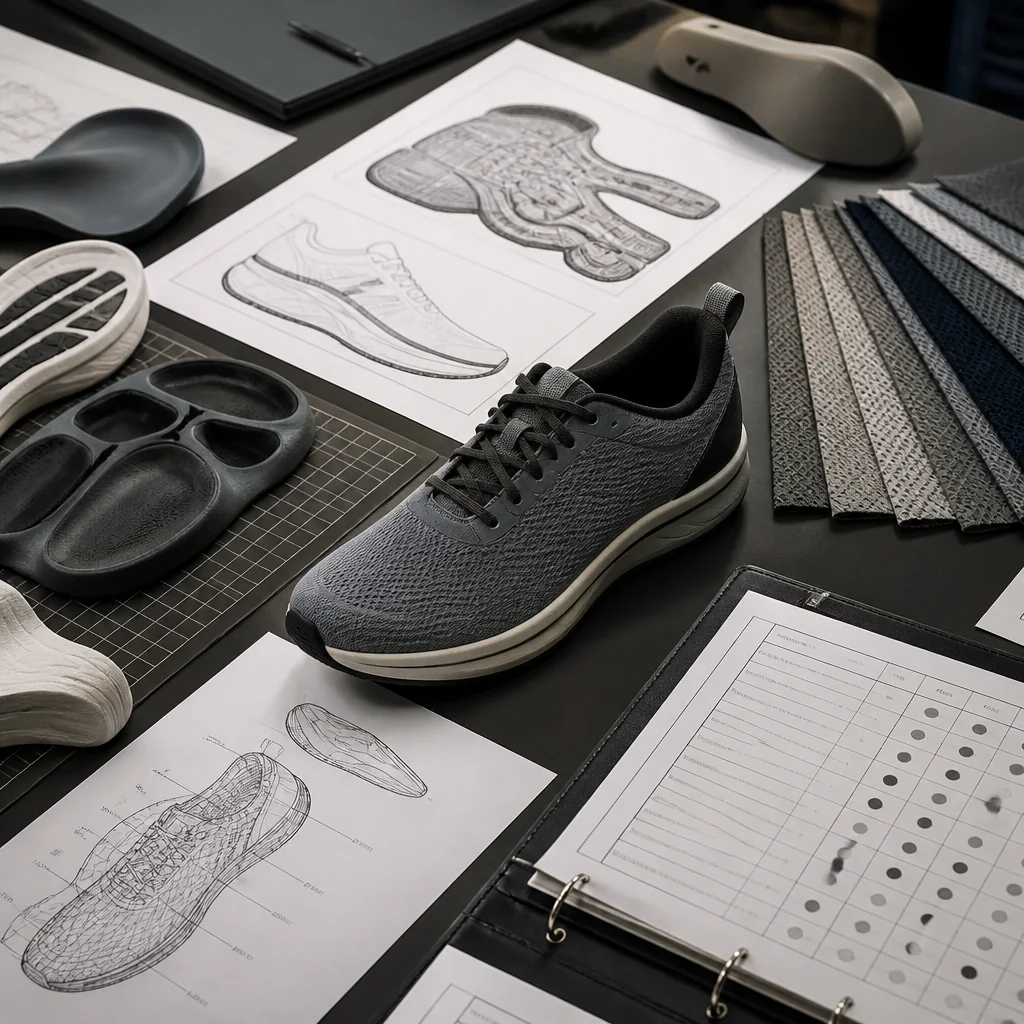
A manufacturability flag has been raised against the running-shoe tech pack. The buyer now needs to decide what may change, who can approve the response and which questions must remain open. This private label running shoes DFM checklist organizes that work around one issue at a time, beginning with the original requirement rather than the proposed correction.
Custom Shoe Factory's OEM and ODM page says the company manufactures to a buyer's tech pack and design. It also says the company flags manufacturability issues during DFM. The supplied source does not specify the format, timing, price or approval effect of those flags.
The register and workflow below are editorial recommendations for the buyer's internal control. They are not presented as a report, approval system or other documented deliverable from Custom Shoe Factory.
Build the issue packet around the requirement
For the buyer's review, the first record should preserve the requirement that existed before the DFM issue was raised. A proposed change cannot be assessed clearly if the team has reduced the original instruction to a general label such as “upper issue” or “material change.”
The running-shoe product page provides a published product frame, but it does not replace the project's own specification. The page describes performance-inspired daily-training builds with breathable uppers and cushioned midsoles. It separately lists mesh, knit and PU as upper options. It also refers to EVA and rubber outsoles. These are general product terms; they do not confirm a material combination or construction for a particular design.
As a buyer-side control, assemble the issue packet with the following references:
The requirement exactly as issued in the current tech pack, drawing, artwork file or material schedule.
The component and precise shoe zone affected by the flag.
The product intent the buyer wants to preserve, expressed in the buyer's own approved terms.
The DFM wording exactly as received, including any conditions or unanswered questions.
The internal role authorized to approve a change to that requirement.
The product page can help identify broad terminology, but the project documents should establish what is actually under review. If the current specification nominates mesh, for example, the decision record should not expand that requirement to include every upper option listed on the website.
Convert the flag into one decision row
Use a separate row for each issue as a buyer-side recommendation. The purpose is to keep the scope of each response visible: an accepted change to one zone should not read as approval to alter the complete upper or an adjoining component.
Recommended fields for a buyer-owned DFM decision register
| Field | Buyer-side record |
|---|---|
| Original requirement | Specification wording and the document, drawing or artwork reference where it appears. |
| Issue as received | The full wording of the DFM flag without an internal paraphrase replacing it. |
| Affected component or zone | The location covered by the issue and any connected construction that requires separate review. |
| Buyer priority | The approved functional, visual, commercial or schedule consideration guiding the response. |
| Permitted alternative | An alternative the buyer is authorized to consider, or an open field where approval is still required. |
| Decision owner | The internal role authorized to accept, reject or condition the response. |
| Status | A buyer-defined state such as open, under review, accepted, rejected, conditional or awaiting information. |
| Unresolved questions | The project-specific information required before the buyer closes the issue. |
In this article's only hypothetical example, an invented DFM flag reads, “The engineered-mesh callout does not define the forefoot zone or branding construction; please clarify the requirement.” The wording is invented for this example and did not come from Custom Shoe Factory.
Completed buyer record for the hypothetical flag
| Original requirement | “Engineered mesh upper” in the buyer's current upper-material callout. |
|---|---|
| Issue as received | The invented flag quoted above. |
| Affected component or zone | Forefoot upper and the area intended to carry branding. |
| Buyer priority | Preserve the buyer's approved ventilation intent and visual placement of the artwork. |
| Permitted alternative | No substitution approved; zone-specific mesh construction may be considered after project review. |
| Decision owner | Buyer product-development lead. |
| Status | Awaiting information. |
| Unresolved questions | Which mesh construction may apply to the forefoot, what project-specific material weight may apply and which branding method may suit the artwork and zone? |
In this hypothetical row, the ventilation intent and artwork placement are invented buyer priorities for the example; they are not project facts drawn from the engineered-mesh source. The row does not predict the manufacturer's answer. It shows how the buyer can separate the current requirement, the authority to change it and the information still being requested.
Use published mesh details as context
The materials page identifies air mesh and sandwich mesh under engineered mesh. It describes knitted or warp-knit synthetic construction with zoned density for ventilation, light stretch and support.
The same page says engineered mesh is typically run at 90-250 GSM depending on the zone. It mentions denser knit at the eyestay and toe. That published range is context rather than a confirmed project target.
The page also identifies screen print, heat-transfer film and welded TPU overlays as compatible with engineered mesh. This general compatibility statement does not approve a method for the hypothetical artwork, shoe zone or construction.
For the same hypothetical decision row, the buyer can use the published details to improve the questions without copying them into the specification:
Questions developed from the published engineered-mesh context
| Requirement field | Buyer question |
|---|---|
| Mesh definition | Which proposed construction corresponds to the appearance and function stated in the buyer's project documents? |
| Shoe zone | How should the forefoot zone be defined, and are other upper zones affected by the same issue? |
| Density intent | What zone-specific construction may address the buyer's stated ventilation and support priorities? |
| Material weight | What project-specific specification may apply instead of treating the published typical range as an approved target? |
| Branding relationship | Which, if any, of the published branding methods may suit the actual artwork, placement and mesh construction? |
The buyer's record should keep the material definition, shoe zone, intended function and branding question separate. A response to one field does not automatically resolve the others.
Keep documented scope separate from inquiries
The following comparison is the evidence boundary for this review. The left column reflects the supplied first-party pages. The right column contains questions that still require project-specific answers.
Published statements and unresolved project questions
| Documented on the supplied pages | Question for the project inquiry |
|---|---|
| The OEM page says the company manufactures to the buyer's tech pack and design. | Which current document references should accompany the project inquiry? |
| The OEM page says the company flags manufacturability issues during DFM. | How might issues be communicated for this project, and what response information may be required? |
| The product page describes performance-inspired daily-training running shoes with breathable uppers and cushioned midsoles. | Which construction may apply to the buyer's intended use and current design? |
| The product page lists mesh, knit and PU upper options. | Which, if any, may be considered for the specified upper? |
| The materials page publishes engineered-mesh construction, zoning, weight and branding details. | Which material and branding specifications may apply to the actual zones and artwork? |
For an OEM shoe development inquiry, the buyer may also ask about response timing, testing, cost effects, substitutions, sample implications and change approvals. Those topics remain questions. The supplied evidence does not establish a formal DFM report, costed alternatives, risk scoring or a standard change-control system.
Connect the decision to later references
The case-studies page describes an example first running-shoe project format extending from a reference pair to inspected first production. It is presented as an example format, not a universal order sequence or a reported customer result.
Separately, the OEM page says the company holds the buyer's bill of materials and tooling across reorders. That statement does not establish automatic revision control or guarantee unchanged materials, availability, prices or tolerances.
As a continuity control for the buyer:
Attach the accepted DFM decision to the current buyer-controlled document reference.
Keep the original requirement, received issue and final buyer response distinguishable.
Identify which approved decision a later sample, reference pair or production reference is expected to represent.
Ask how the project's approved changes may relate to bill-of-materials and tooling references held across reorders.
This record remains the buyer's tool. The project's actual document, approval and reorder procedures still need to be confirmed through the inquiry.
Send the open issues with the product definition
For the final handoff, send a compact issue list rather than presenting unresolved decisions as settled specifications. Include:
The current product definition and intended use.
The current tech pack, drawing, artwork and material references relevant to each flag.
Each DFM issue exactly as received and the component or zone it affects.
Changes the buyer has accepted, rejected or accepted conditionally.
Requirements that cannot change without further internal approval.
Questions about materials, construction, branding, testing, substitutions, samples, costs or reference continuity.
A request to clarify which development, manufacturability, sampling or quotation options may apply to the project.
Where relevant, questions about the MOQ, packing and other commercial information that may apply.
Share the defined product and unresolved running shoe DFM questions through the project inquiry page. The decision register should show what the buyer has approved, what remains protected and what information is still needed before an open flag is carried into another project reference.
Sources and verification
- OEM / ODM Shoe Development | Custom Footwear Manufacturing First-party site source
- Athletic Shoe Manufacturer | Custom Product Range First-party site source
- Shoe Soles, Uppers & Insole Materials | Footwear Specs First-party site source
- Footwear Manufacturing Case Studies | Example Project Formats First-party site source
Share the current product definition and ask which development, manufacturability, sampling or quotation options may apply to the project.
Send your project brief