Footwear Sourcing
How to run an OEM walking shoe manufacturer quote comparison
Use a buyer-created ledger to normalize walking-shoe manufacturer replies after they arrive. Separate documented OEM responsibilities, buyer inputs, response assumptions and unresolved questions before reviewing commercial terms.
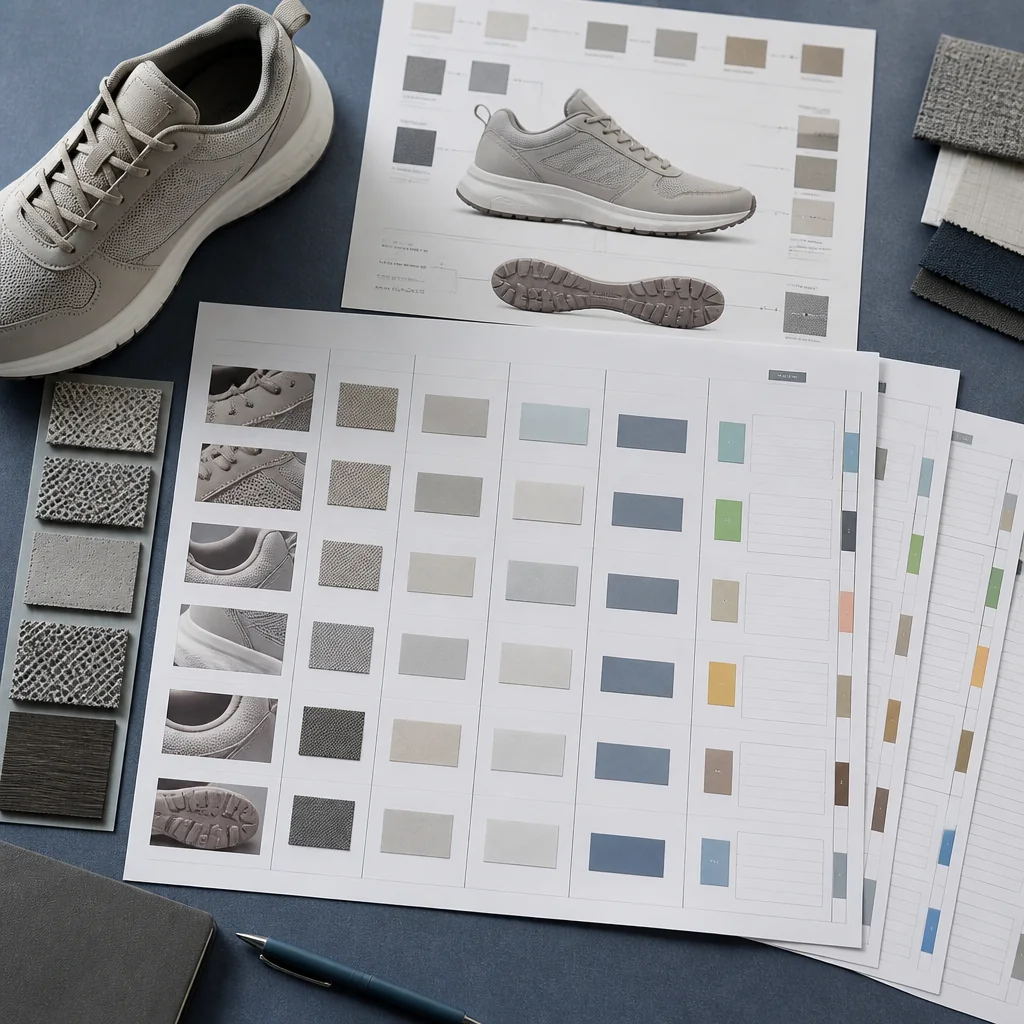
After manufacturer responses arrive, the buyer-side recommendation for an OEM walking shoe manufacturer quote comparison is to begin with one scope question: does every reply describe the same product definition and division of responsibility? Commercial figures are easier to interpret when the design revision, buyer inputs, manufacturer assumptions and quoted activities are visible in one record.
The framework below is an editorial method for procurement teams. In this article, it is a buyer-created tool rather than a documented Custom Shoe Factory service, approval stage or guarantee. Use it to compare replies row by row and return unresolved points for a project-specific answer.
Create one reference record for every response
Before reading across the replies, prepare a single record of the current walking-shoe definition. As a buyer-side recommendation, include only the information that is current and relevant to the inquiry:
- The applicable tech pack and design revision, if the project uses them.
- The intended walking-footwear category.
- Construction, material, artwork or packaging decisions already fixed by the buyer.
- Details that remain open.
- The questions each manufacturer was asked to address.
Read every response against this record. If a reply cites an earlier design or introduces a construction assumption that the buyer has not accepted, mark the affected row for clarification. Avoid filling one respondent's blank with language taken from another respondent.
If the product definition is still being assembled, the quote-ready product brief addresses that earlier procurement stage. The present task begins after responses have arrived.
Record the category boundary at its exact scope
Custom Shoe Factory states that its sport-footwear product family includes running, training, walking and casual sneakers. This supports a category-match entry for walking footwear. The statement leaves the construction, materials and acceptance of the current project to be established elsewhere.
- Published category point
- Walking is included in the company's stated sport-footwear family.
- Buyer ledger entry
- Record a walking-footwear category match.
- Details still requiring a source
- Upper construction, outsole construction, cushioning, fit requirements and the applicable development route must come from the buyer's definition or a project-specific response.
Category relevance therefore occupies one ledger row. It does not complete the technical or quotation rows.
Map the published OEM responsibilities separately
The company's OEM statement documents three responsibilities within its build-to-spec scope. Each belongs on its own row so that the buyer can preserve the actor, condition and wording of the source.
Published OEM responsibilities and recommended ledger treatment
| Comparison row | Documented company statement | Buyer-side treatment |
|---|---|---|
| Manufacturing basis | Custom Shoe Factory states that it manufactures to the buyer's tech pack and design. | Identify the tech pack and design as buyer-supplied inputs. Check whether the project response refers to the current revision. |
| Design for manufacturability | The company states that it flags manufacturability issues during design for manufacturability, or DFM. | Limit the documented responsibility to issue flagging. Ask separately about proposed alternatives, decision authority and approval routing when those matters affect the project. |
| Bill of materials and tooling across reorders | The company states that it holds the buyer's bill of materials and tooling across reorders. | Preserve the reorder condition. Do not reinterpret the statement as ownership, transfer, replacement or indefinite retention. |
The supplied evidence does not define a bounded ODM workflow for the walking-shoe project. Leave any ODM responsibility open unless a project-specific response establishes it. The documented OEM statement also places the tech pack and design with the buyer; it does not say that the manufacturer independently creates them.
Label technical details before comparing them
For this buyer-created method, assign one evidence label to each detail:
- Documented company scope: A supplied first-party statement identifies the responsibility and its condition.
- Buyer-supplied project input: The current tech pack, design or other buyer record establishes the requirement.
- Unresolved project question: Neither the published scope nor the current buyer definition supplies an answer.
The running-shoe listing shows why the labels matter. It names mesh, knit or PU uppers for running shoes. In a separate product detail, it names EVA and rubber outsoles for running shoes.
Those running-shoe details do not establish a walking-shoe specification. If the buyer's walking-shoe tech pack names one of those materials, record it as a buyer-supplied input. If the material appears only in the running-shoe listing, keep the walking-shoe row open and ask which construction may apply.
Use a blank buyer-created comparison ledger
The following template does not represent a manufacturer workflow or a completed supplier response. It is an editorial worksheet for organizing the replies already in hand. Add or remove rows according to the current project without inserting unsupported answers.
Buyer-created scope-normalization ledger
| Comparison row | Evidence label | Buyer revision or input | Manufacturer statement | Treatment in reply | Comparison status | Follow-up question |
|---|---|---|---|---|---|---|
| Current tech pack and design | Assign one label | Enter the applicable revision | Copy or summarize the relevant reply | Mark included, excluded, conditional or silent | Assign after review | Record any revision mismatch |
| OEM manufacturing responsibility | Assign one label | Identify the buyer-supplied basis | Copy or summarize the relevant reply | Mark treatment | Assign after review | Ask what definition the reply uses |
| DFM issue flagging | Assign one label | Note the design under review | Copy or summarize the relevant reply | Mark treatment | Assign after review | Ask how project decisions would be recorded |
| Upper construction | Assign one label | Enter a fixed input or leave open | Copy or summarize the relevant reply | Mark treatment | Assign after review | Ask which construction the reply assumes |
| Outsole construction | Assign one label | Enter a fixed input or leave open | Copy or summarize the relevant reply | Mark treatment | Assign after review | Ask which construction the reply assumes |
| Sampling or process applicability | Assign one label | List available buyer inputs | Copy or summarize the relevant reply | Mark treatment | Assign after review | Ask which options may apply |
| Bill of materials and tooling across reorders | Assign one label | Identify the relevant project records | Copy or summarize the relevant reply | Mark treatment | Assign after review | Ask about any wording difference |
| Quotation basis | Assign one label | Enter the requested basis | Copy or summarize the relevant reply | Mark treatment | Assign after review | List unanswered scope points |
Keep each responsibility or technical attribute on its own row. This prevents a documented company statement, a buyer input and an unanswered question from being merged into one apparently complete answer.
Use the running-shoe example to form questions
The company's case-studies page presents an example of how a first running-shoe order is structured, from a reference pair to inspected first production. The source describes a running-shoe example. It does not establish a walking-shoe workflow or a sequence guaranteed for every project.
For the present comparison, use the example only to draft relevant questions. Ask whether a reference pair would be useful for the walking-shoe project, which process stages may apply and what responsibilities would attach to any inspection discussed in the response. Enter a stage in the ledger only when the project reply confirms it.
Turn gaps into focused quotation questions
Once the responses are entered, the clarification column becomes a walking shoe supplier scope checklist tied to actual gaps. Use the following walking shoe quotation questions only where the ledger shows that information is missing or ambiguous:
- Project definition: Which tech pack and design revision does the response address?
- Development basis: Which development options, if any, may apply to details that the buyer has left open?
- DFM handling: Does the response address the documented issue-flagging responsibility? If alternatives are discussed, who records the buyer's decision?
- Construction source: Which upper and outsole details come from buyer inputs, and which are assumptions introduced in the response?
- Sampling: Which sampling options may apply, and what buyer inputs would be needed for the applicable stage?
- Quotation basis: Which design revision, materials, construction details, artwork, size range and packaging basis does the response use?
- Reorders: Does the response address the bill of materials and tooling across reorders, and does its wording match the documented scope?
- Inspection: Does any inspection information apply to this project, and what responsibility would each party have?
These remain inquiry topics until a project-specific reply answers them. Silence can be marked as such without treating it as proof of either capability or refusal.
Assign status to individual rows
To compare OEM walking shoe quotes, apply status row by row. A response may align with the current manufacturing basis while leaving construction or sampling questions open.
- Comparable
- The reply addresses the same current product definition, identifies the relevant responsibility and avoids unsupported transfers from another footwear category.
- Clarification required
- The reply is missing, ambiguous or conditional, or its basis has not been established for the walking-shoe project.
- Outside the current definition
- The reply refers to a different design revision, category, construction or unrequested assumption. Set the row aside until the response or buyer definition changes.
These statuses organize information; they do not approve or reject a manufacturer. Once the relevant rows are comparable, review the commercial fields exactly as each response states them. Keep silent inclusions or exclusions under clarification rather than selecting the interpretation that makes one reply appear more complete.
Return unresolved rows with the current definition
Prepare the next inquiry from the ledger. Send the current walking-shoe definition, the applicable tech pack and design revision, the buyer-supplied inputs and the rows marked clarification required.
When you request a quote, ask which development, manufacturability, sampling or quotation options may apply to the project. This invites a bounded response without presenting any unresolved option as an available service or promise.
Update the ledger from that reply, preserve any stated conditions and review commercial terms when the relevant responses describe the same project scope.
Sources and verification
- About Custom Shoe Factory | OEM/ODM Athletic Shoes First-party site source
- OEM / ODM Shoe Development | Custom Footwear Manufacturing First-party site source
- Athletic Shoe Manufacturer | Custom Product Range First-party site source
- Footwear Manufacturing Case Studies | Example Project Formats First-party site source
Share the current product definition and ask which development, manufacturability, sampling or quotation options may apply to the project.
Send your project brief