OEM Sourcing
OEM Sports Shoes Manufacturer Reorders: Pre-PO Custody Filter
Sample look and unit price do not settle multi-season continuity. Read published BOM-and-tooling custody as a pre-award filter for OEM sports shoes manufacturer reorders, then attach open custody fields to the product definition you already hold.
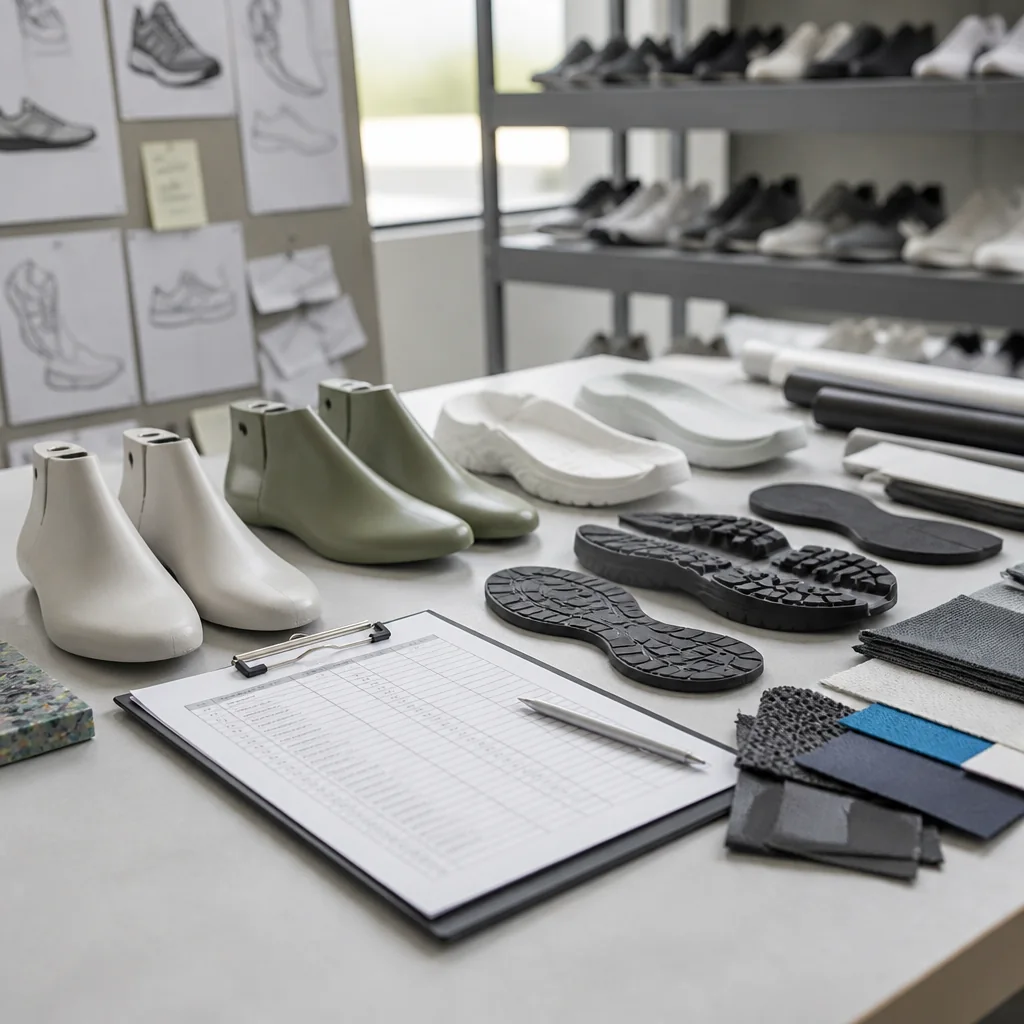
Published OEM language that includes holding the bill of materials and tooling across reorders is a selection filter, not a post-shipment recovery tool. For OEM sports shoes manufacturer reorders, brands that expect more than a one-off athletic program still shortlist on sample look and unit price first. Those two signals leave BOM ownership, tooling custody, and reorder handoff unstated. Continuity drift then shows up after leverage has already moved.
Treat the published hold-BOM-and-tooling clause as a shortlist criterion before award. It is not an assumed factory default. The sections below stay inside published scope: three OEM responsibilities at exact wording, a sport-footwear family list, running-shoe construction descriptors only where they apply, and a first-production example fence. Manufacturability issue flagging during DFM stays on a separate track from asset custody. You leave with a buyer-owned ledger you can attach to the product definition you already have.
What the published OEM custody line actually covers
On Custom Shoe Factory’s OEM and ODM services page, OEM work is described in three bounded responsibilities: manufacture to the buyer’s tech pack and design, flag manufacturability issues during DFM, and hold the bill of materials and tooling across reorders. Score those clauses separately. They support a continuity path for an OEM sports shoes bill of materials and for tooling assets between reorders. On their own they do not define storage length, fee schedule, IP transfer terms, automatic re-run pricing, inventory holding, warranty coverage, or logistics control.
| Published OEM responsibility | What it supports in a buyer scorecard | Scope limit |
|---|---|---|
| Build to tech pack and design | Production intent is buyer-specified construction | Does not make every construction change free or unlimited |
| Flag manufacturability issues during DFM | Development-time review can surface build risks before commitment | Does not establish ongoing engineering ownership after first production |
| Hold BOM and tooling across reorders | A stated path for materials list and tooling assets between reorders | Does not set storage length, fees, or re-tooling triggers |
Use the table as a ceiling. When you press a shortlisted factory on reorders, ask how the third clause will be documented for your program. Do not ask whether the factory “owns” your IP or guarantees identical unit economics forever.
Why first-order quote packages leave continuity open
A typical quote package answers cost under a stated construction and shows what a sample looks like under a stated last and upper. Continuity questions sit outside that package. Who keeps the approved BOM version after first production? Which lasts, molds, or cutting dies remain available for a later season? What material substitution or outsole redesign forces re-tooling rather than a re-run?
Brands, importers, and product-development teams planning repeat athletic seasons often discover those gaps only when a second run no longer matches the first. That is a selection failure, not a production surprise. When multi-season continuity matters, put BOM and tooling custody on the shortlist criteria next to construction fit and sample quality. Waiting until after first shipment turns an award-time filter into a weaker recovery talk.
Category match before multi-season tooling talk
Custody language only helps when the factory’s published product family matches the shoe you intend to reorder. The about page positions Custom Shoe Factory as sport-footwear specialists in one product family done consistently (running, training, walking, and casual sneakers) and states it is not a catch-all factory. Place your program inside that family before you invest negotiation time in tooling hold.
When the program is a running shoe, the products page further describes performance-inspired daily-training builds with breathable uppers and cushioned midsoles, and lists mesh, knit, or PU uppers with EVA and rubber outsoles. Use those descriptors only for running-shoe construction talk. Do not import them as evidence for training, walking, or casual constructions beyond the family-level category list.
- Is the target product running, training, walking, or casual sneakers?
- If running, do mesh/knit/PU upper and EVA-and-rubber outsole options match the construction you plan to freeze?
- Are you asking for multi-season tooling hold on a construction inside the published family, rather than on an unlisted category?
- Have you written category and construction descriptors into the same packet as the custody questions?
DFM issue flags are not reorder custody proof
Sports shoes manufacturer DFM work, as published here, is issue-flagging during development: a review that can catch build risks against the tech pack before tooling is locked. Reorder asset custody is a different question after first production. It asks which approved BOM revision and which physical tools remain available for the next season under the same manufacturer relationship.
Collapsing the two creates false confidence. A thorough first-sample manufacturability conversation does not, by itself, prove that lasts, molds, cutting dies, or BOM version control will stay under the same custody terms months later. Keep DFM flagging on the development track and BOM-and-tooling hold on the multi-season continuity track. Require answers on both before you award a program that must return.
As an editorial recommendation for the buyer, keep the two tracks as separate question blocks in the inquiry packet:
- DFM track: Which construction risks will be reviewed against the tech pack before tooling lock?
- Custody track: Which BOM fields and tooling assets will be retained for reorders, and what change events reopen tooling?
- Handoff track: How will the approved first-production package map to the next season’s order packet?
Common buyer-education tooling illustrations include lasts, molds, dies, and jigs—asset types teams often need to name when they write custody questions. Those illustrations are not a factory-published inventory of retained items. Sports shoes manufacturer tooling custody still needs program-specific documentation. The published OEM sentence alone does not list which assets apply to your construction.
Fence the running-shoe launch example to first production
Custom Shoe Factory’s case studies page presents an example project format titled as a running shoe launch for a new brand. The published framing is structural: how a first running-shoe order is organized from a reference pair through inspected first production. That sequence helps when you want checkpoints for a first build. It is not a reorder playbook, not multi-season volume evidence, and not a completed customer outcome with commercial results.
If your program is a first launch, use the example to list structure from reference pair to inspected first production. If your program is a second or third season, do not treat that page as proof of continuity performance. Keep first-production structure and multi-season custody as two evaluation layers.
Open fields for a buyer-owned custody ledger
Published OEM language gives you a starting claim, not a completed commercial file. Convert unresolved reorder items into a ledger you own. Label each row as a buyer question for the inquiry, not as a documented service deliverable, unless a future reply makes a field explicit.
- Who holds the controlled BOM version after first production approval?
- Which tooling assets stay with the manufacturer across reorders?
- What material substitution, last change, or outsole redesign triggers re-tooling rather than a re-run?
- How are DFM findings from the first development cycle recorded against those assets so they do not silently reopen later?
- What documents travel with a reorder packet so the second season references the same approved package?
- Which sampling, packing, MOQ, or quotation details still need clarification for this project?
As an editorial recommendation for the buyer: freeze the construction fields you already know, mark custody fields as open, and refuse to treat “we will discuss later” as an award-ready answer on multi-season programs. That is a procurement discipline choice, not a claim about any factory’s internal process. Sampling, packing, MOQ, and quotation rows stay buyer-side unknowns until a reply makes a field explicit; do not read them as pre-documented factory services.
Attach the ledger to the product definition you already hold
You do not need a perfect tech pack before asking about continuity. Attach the ledger to the product definition you already hold, even when some construction fields remain provisional.
- State the category (running, training, walking, or casual sneakers) and the construction fields you can already specify.
- For running shoes, note upper and outsole families only where they match published descriptors you intend to use.
- List BOM and tooling custody fields as open questions tied to reorders.
- Keep DFM issue-flagging as a development question, separate from asset-hold questions.
- Submit that packet and ask which development, manufacturability, sampling, or quotation options may apply to the project.
That sequence keeps first-order price and sample quality in view without letting them erase multi-season continuity. Share the current product definition through the site’s request a quote path, mark open custody fields clearly, and evaluate replies against the same ledger you used at shortlist. Continuity for OEM sports shoes manufacturer reorders is decided before award, not after drift appears in season two.
Sources and verification
- OEM / ODM Shoe Development | Custom Footwear Manufacturing First-party site source
- About Custom Shoe Factory | OEM/ODM Athletic Shoes First-party site source
- Athletic Shoe Manufacturer | Custom Product Range First-party site source
- Footwear Manufacturing Case Studies | Example Project Formats First-party site source
Share the current product definition and ask which development, manufacturability, sampling or quotation options may apply to the project.
Send your project brief