OEM Footwear Development
OEM Sneaker Upper Branding Specification
A logo callout on mesh is not an upper definition. Separate engineered-mesh zone intent from artwork placement so the design handoff can be reviewed without guessing which request is structural.
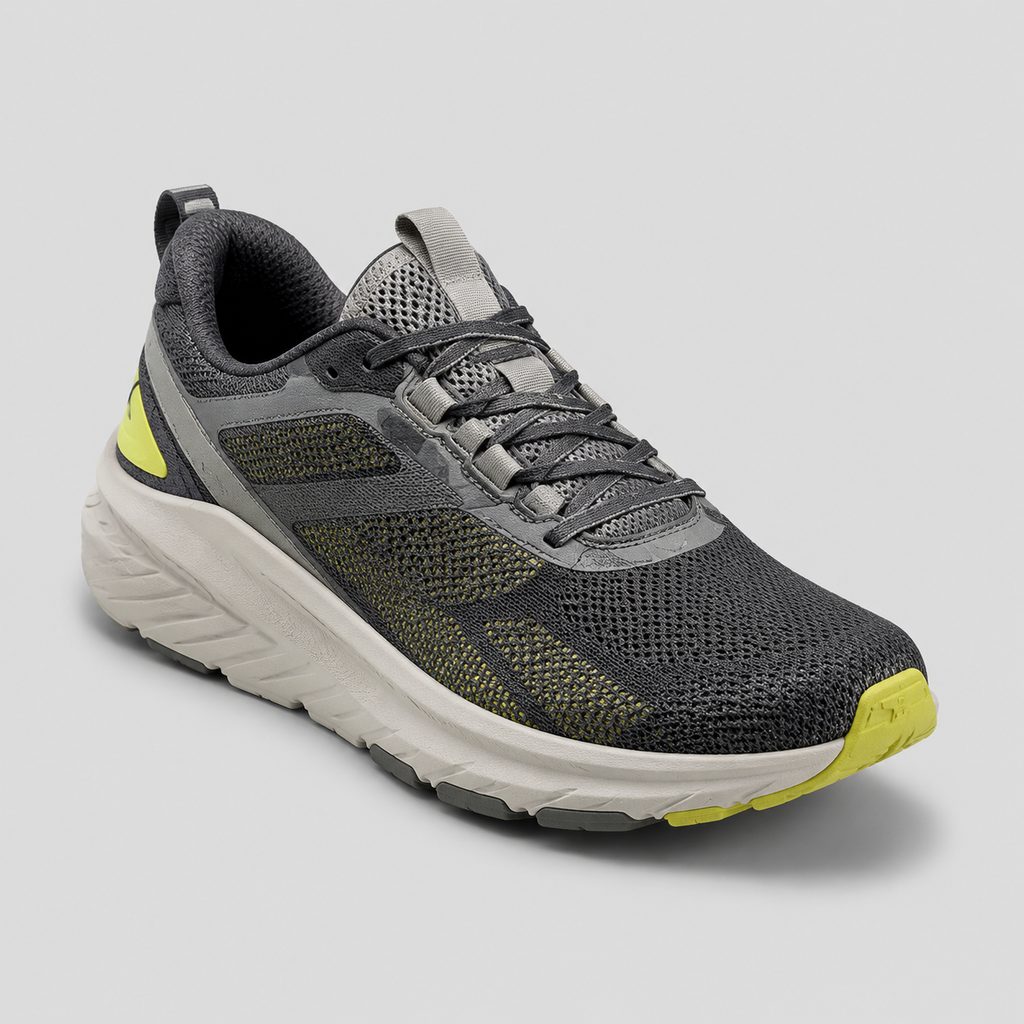
Product teams often attach a logo file, brand colours, and a placement sketch to the same note as “custom mesh upper.” The visual request is clear; the material-zone request is not. Reviewers cannot tell whether a denser area is support, a decoration base, or an unfinished sketch. An OEM sneaker upper branding specification exists to separate those decisions before manufacturability review.
This is a design-handoff guide for buyers, not a supplier-selection checklist. Keep Map One for material and zone intent. Keep Map Two for artwork location and requested application direction. Send both with the current product definition so questions land on something concrete. Company wording below stays inside published first-party language; map field names, decision states, and handoff fields are buyer practice for making the brief reviewable.
Why branding and mesh zoning collide in one note
Branding sits on surfaces. Mesh zoning lives in how the upper is built. When both are written only as “branded engineered mesh,” a density change and a logo move look like the same class of edit. They are not.
On the materials page, engineered mesh is described as a knitted or warp-knit synthetic upper with zoned density for ventilation, light stretch, and support; denser knit at the eyestay and toe; typically 90–250 GSM depending on the zone; and acceptance of screen print, heat-transfer film, and welded TPU overlays cleanly for multi-colour branding. That excerpt gives two lists to complete: zone intent, and visual treatment by location. It does not convert logo placement into finished-shoe breathability, fit, or durability claims.
Map One answers what each region should do as material. Map Two answers which visual element sits where and which application direction is requested for discussion. Only then is “custom mesh upper” reviewable as an engineered mesh upper specification rather than a slogan.
What belongs on the material-zone map?
Start with zones the product team owns before decoration files are debated. Use published engineered-mesh vocabulary as the ceiling: zoned density, ventilation, light stretch, support, denser knit at eyestay and toe, and a typical GSM band of 90–250 by zone. Treat those as design-intent labels in the brief, not lab results for a finished sample or retail claim.
The materials excerpt names denser knit specifically at the eyestay and toe. Other panel names in the table below are buyer-defined fields so your team can locate intent on a drawing. They are not a factory prescription of how every upper must be zoned.
| Zone field (buyer-named) | Intent to state | What belongs in the brief | What not to invent |
|---|---|---|---|
| Eyestay | Denser knit when that matches the product definition (materials language notes denser construction here) | Whether denser eyestay is required for this model | Lace durability or pull-strength guarantees |
| Toe | Denser knit at toe when that is part of the product definition | Toe boundary and density relative to adjacent panels | Abrasion or impact performance claims |
| Other mesh regions (buyer labels, e.g. vamp, medial, lateral, collar interface) | Ventilation, light stretch, or support as your design intends for that region | Region outline, relative density note, reference sample if used | Measured airflow, comfort scores, or unstated comparative stretch ratings |
State GSM only as a zone-level target band when the team has chosen numbers. If not, write “open for discussion” rather than pasting one GSM across the upper. Where the design calls for denser knit at eyestay and toe, record that explicitly. Do not invent reverse layouts the materials excerpt does not describe.
Where does each branding request sit?
Record visual work as location-bound requests, not as a rewrite of mesh density. The materials excerpt states that engineered mesh takes screen print, heat-transfer film, and welded TPU overlays cleanly for multi-colour branding. That is a published material attribute for engineered mesh. It is not a documented Custom Shoe Factory decoration service menu.
| Artwork item | Capture on the map | Application direction (if known) | Keep separate from |
|---|---|---|---|
| Primary logo | Panel, side (medial/lateral), size envelope, file reference | Screen print, heat-transfer film, or welded TPU overlay as a requested direction | Changing zone density only to improve logo placement without a structural decision |
| Secondary marks / wordmarks | Stack order if overlaid, clear space, colour callouts | Same application list, item by item | Assuming one treatment applies to every mark |
| Colour fields / graphic blocks | Boundary relative to mesh zones | Whether the block is print, film, or overlay | Treating a colour block as proof of a denser knit zone |
| Heel or tongue branding | Component callout if not on the main vamp mesh | Requested method if already decided | Folding non-mesh components into “mesh branding” language |
For a custom sneaker branding brief, each row should answer which file, which location, which colour treatment, and which application direction is requested for discussion. If the method is undecided, mark it open. Shoe upper artwork requirements stay on Map Two so they cannot silently redefine the substrate.
Upper names available in the published materials
Name the substrate from the evidence that actually names it. The materials page groups engineered mesh with air mesh and sandwich mesh, and describes engineered mesh as above. Separately, running-shoe product copy lists mesh, knit, or PU uppers with EVA and rubber outsoles for breathable, cushioned running builds. Keep those two excerpts separate; do not merge them into one material taxonomy.
- Engineered mesh (materials page)
- Knitted or warp-knit synthetic with zoned density for ventilation, light stretch, and support; denser knit at eyestay and toe; typically 90–250 GSM by zone; takes screen print, heat-transfer film, and welded TPU overlays cleanly for multi-colour branding. Also noted as best for running, training, and summer styles that need maximum airflow at a sensible cost.
- Air mesh / sandwich mesh (materials page)
- Named alongside engineered mesh. Without further published construction detail, record the exact term you mean and any physical reference. Do not assign unstated comparative properties.
- Mesh / knit / PU (running-shoe product page)
- Upper options listed for running builds with EVA and rubber outsoles. Category context for a running program, not a ranked performance matrix, and not automatic zone or artwork rules for every athletic style.
If the program is not a running shoe, still name the upper honestly and keep running-shoe examples in their published lane.
Keep density decisions separate from artwork changes
Density and zone location are product-definition decisions. Logo size, colourway, and application direction are artwork requests. Mixing them in one comment thread is how a placement tweak rewrites the support map by accident. As a hypothetical example only: a note that only shifts a logo a few millimetres should not rewrite eyestay density unless the buyer explicitly changes Map One.
Under OEM scope on the OEM / ODM page, the company manufactures to the buyer’s tech pack and design, flags manufacturability issues during DFM, and holds the bill of materials and tooling across reorders. That boundary raises the value of buyer decision hygiene: the factory builds to what you define, and DFM surfaces issues rather than finishing unfinished zone ownership. BOM and tooling retention across reorders should not be read as automatic material continuity, price continuity, or free redesign of branding.
Use three decision states for both maps:
- Confirmed by the buyer: zone intent or artwork item is frozen for this definition version.
- Open for DFM discussion: intent is stated, but method, boundary, or manufacturability still needs a question.
- Not yet defined: no buyer decision exists; do not imply one in callouts.
Bump the definition version when either map changes. A colourway revision should not silently clear density notes. A density revision should not inherit old artwork clearances unchecked.
Which DFM questions stay inside the published OEM boundary?
In the published OEM statement, DFM is where manufacturability issues can be flagged against the buyer’s tech pack and design. It is not documented as design approval, redesign authority, validation testing, or a production guarantee. Keep inquiry topics inside that ceiling:
- Can the requested artwork sit on the named mesh zones without an unresolved conflict in the current drawings?
- Where the brief requests screen print, heat-transfer film, or welded TPU overlay on engineered mesh, which items are confirmed requests versus open method choices?
- Are denser eyestay and toe areas defined clearly enough that decoration boundaries do not erase the zone map?
- Which files are controlled references for colour and placement, and which sketches are reference-only?
- Which Map One or Map Two rows remain “not yet defined,” so they are not mistaken for frozen spec?
Product family check before reusing an upper brief
Custom Shoe Factory’s about copy positions the company as sport-footwear specialists within one product family done consistently: running, training, walking, and casual sneakers, not a catch-all factory. Before reusing an upper branding package, reconfirm that the product family and upper direction still match.
Running-shoe product copy describes performance-inspired daily-training builds with breathable uppers and cushioned midsoles, listing mesh, knit, or PU uppers and EVA and rubber outsoles. That context helps a running program. It is not a requirement set for every training, walking, or casual project, and category marketing language is not a substitute for your zone map.
Before copy-forward, reconfirm the family label, the upper direction name, and whether Map One still describes the intended structure. Treat artwork-file reuse and structural-zone reuse as separate buyer decisions, not as one automatic carryover.
Zone record to send with the product definition
When the two maps are ready enough to discuss, send a zone record rather than a slogan. Contents that usually reduce ambiguity:
- Product family within running, training, walking, or casual sneakers
- Upper direction term in use (for example engineered mesh, or air mesh / sandwich mesh if that is the precise callout)
- Map One: zone names, density or intent notes, denser eyestay/toe decisions, GSM band only if chosen
- Map Two: artwork files, locations, colour treatments, requested application directions, decision states
- Confirmed / open / not-yet-defined list for both maps
- Bounded manufacturability questions, without treating sampling, packing, or quotation topics as pre-committed services unless a separate commercial discussion defines them
Share that package as the current product definition and ask which development, manufacturability, sampling, or quotation options may apply through request a quote. For category context while you finalize the family label, use the product range pages without pasting running-shoe examples into unrelated programs.
Two explicit maps, structure and artwork on separate tracks, give DFM something concrete to flag against a design the buyer owns.
Sources and verification
- Shoe Soles, Uppers & Insole Materials | Footwear Specs First-party site source
- OEM / ODM Shoe Development | Custom Footwear Manufacturing First-party site source
- Athletic Shoe Manufacturer | Custom Product Range First-party site source
- About Custom Shoe Factory | OEM/ODM Athletic Shoes First-party site source
Share the current product definition and ask which development, manufacturability, sampling or quotation options may apply to the project.
Send your project brief