Footwear Sourcing
DFM exceptions: how to find an OEM shoe manufacturer for a tech pack
A procurement method for recording DFM exceptions, testing candidate answers and deciding whether unresolved tech pack responsibilities require clarification.
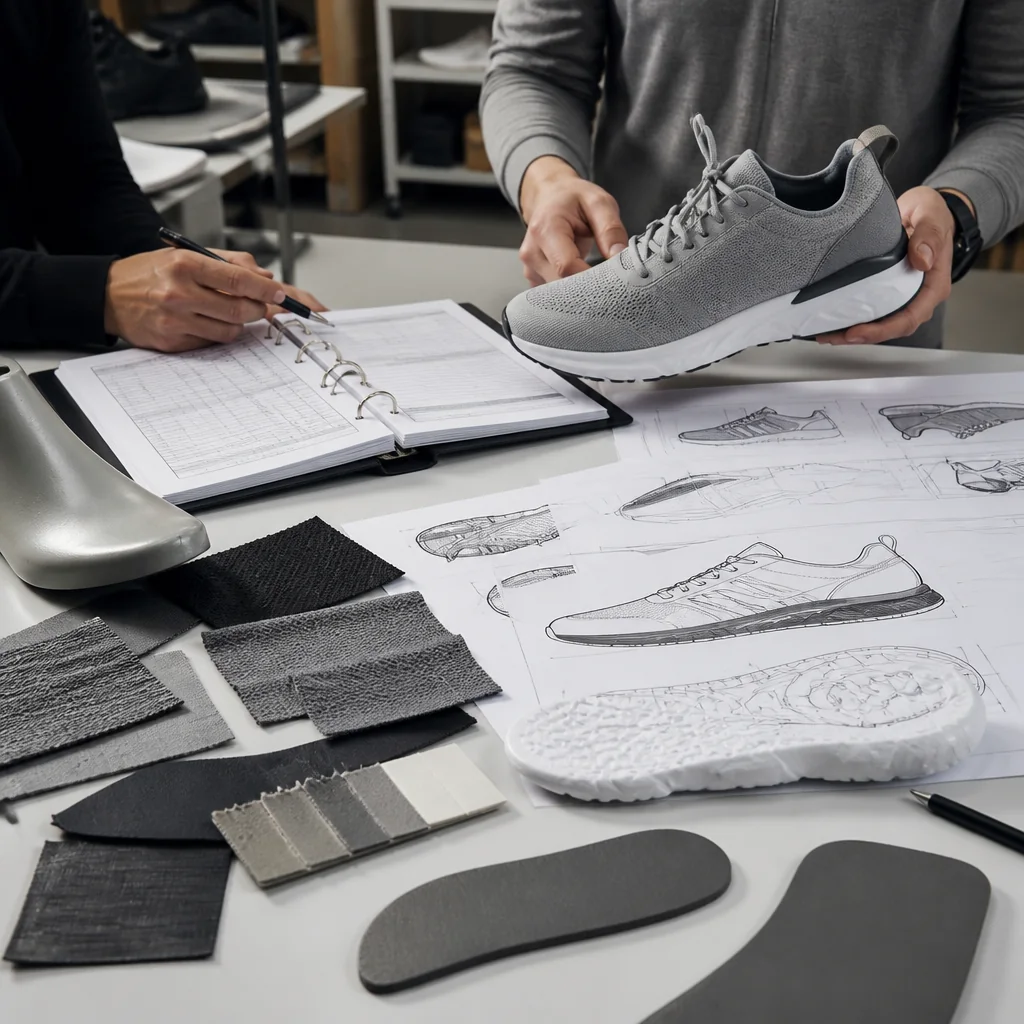
An issued tech pack remains the product baseline while an OEM candidate reviews it for manufacturability. If the candidate proposes a departure, the sourcing team needs to see where the issue occurs, what would change and which decision remains open. The proposed alternative should not silently replace the issued requirement.
That tension defines how to find an OEM shoe manufacturer for a tech pack when the pack already exists. This article recommends a buyer-created DFM exception register as the comparison tool. The register and the assessment method are editorial procurement recommendations, not published Custom Shoe Factory procedures.
Start with the issued requirement
Custom Shoe Factory states on its OEM and ODM development page that it manufactures to the buyer's tech pack and design. The company also says it flags manufacturability issues during DFM.
Those statements establish the limited evidence boundary for this assessment: build-to-spec manufacturing and issue flagging during DFM. The source does not explain who approves a proposed departure, who updates the relevant files or how an accepted change becomes the working specification. Buyers should confirm those responsibilities separately.
For comparison purposes, keep the issued requirement visible until an exception has been considered. A candidate's suggestion can then be evaluated as a proposed departure rather than being mistaken for an approved revision. This approach also allows the buyer to compare candidates that identify different concerns in the same pack.
Use one exception register for every candidate
The recommended register records each concern against the product definition supplied to the candidate. Use consistent fields so that a detailed answer from one factory can be compared with a shorter or more conditional answer from another.
| Register field | Buyer entry | Purpose in the comparison |
|---|---|---|
| Affected requirement | The page, drawing, component, construction note, BOM entry or other reference identified in the tech pack. | Locates the exception instead of leaving it as a general DFM comment. |
| Issued specification | The current wording, dimension, material designation or construction instruction, including the buyer's existing revision reference where applicable. | Preserves the requirement against which the proposed departure is assessed. |
| Issue raised | The concern in the candidate's own words and the location where the candidate expects it to arise. | Keeps the reported concern separate from the suggested remedy. |
| Proposed departure | The alternative material, geometry, construction, tolerance or process stated by the candidate. | Shows what would differ from the issued pack without implying approval. |
| Open decision | The question still requiring an answer and the party the candidate expects to answer it. | Makes assumptions about decision rights visible. |
| Evidence requested | The explanation, annotation, material information, sample observation or other project support the buyer chooses to request. | Records what would help the buyer assess the proposal; the request itself is not evidence. |
| Working reference | The document the candidate expects to follow while the question is open and the reference it would expect to follow after an accepted decision. | Tests whether the operative instruction can be identified at each stage. |
| Evidence status | Documented, candidate-confirmed, conditional or unanswered. | Prevents confidence of presentation from replacing support. |
Do not close the entire entry merely because the technical alternative sounds workable. The technical concern, decision right and document reference may have different statuses. Keep each unresolved field visible until it is sufficient for the buyer's next sourcing decision.
Interrogate one flagged requirement at a time
Useful shoe factory DFM questions refer to a particular requirement. A broad assurance that DFM is performed does not tell the buyer how a proposed departure would be handled.
- Where does the concern appear? Ask for the relevant location in the tech pack, drawing, BOM or construction description. If several references are affected, ask the candidate to identify them separately.
- Why has the concern been raised? Request the candidate's explanation for the proposed construction. Record the reason actually supplied rather than adding an assumed cause.
- What would differ from the issued requirement? Ask the candidate to define the proposed alternative and identify the resulting difference. Terms such as “optimize” or “simplify” are not specific enough to describe an exception.
- What related information may need review? Ask whether the candidate believes the proposal affects another identified component, BOM entry, tooling item, sampling question or quotation assumption. Treat each stated effect as a separate register entry where necessary.
- Who does the candidate expect to decide? Ask whether a buyer decision is being requested or whether another route is assumed. A proposed alternative does not establish authority to approve it.
- Which document would govern the work? Ask what reference the candidate would use while the issue remains open and what it would expect to use if the departure were accepted.
Approval routing, revision history, file updates and distribution of accepted changes are separate inquiry topics. The available source documents issue flagging during DFM; it does not document a broader footwear tech pack change control system.
Classify the answer before judging it
The buyer can use four non-numeric evidence statuses. Apply the status to the exact answer given, not to the candidate as a whole.
- Documented
A specific source available to the buyer supports the answer. Record the source and the limited point it establishes. A document supporting one material designation, for example, does not automatically support the proposed construction or its performance.
- Candidate-confirmed
The candidate has provided a written answer, but no further project evidence has been supplied. Attribute the statement to the candidate and preserve its stated conditions.
- Conditional
The answer depends on another input, decision, material, document update, sample observation or quotation assumption. Place that dependency beside the answer so it remains part of the decision.
- Unanswered
The requested responsibility, reference, explanation or support has not been identified. Leave the field open rather than interpreting silence as agreement.
A fluent DFM response is not evidence that every manufacturability issue has been found. It also does not prove testing, production performance or formal change control. Buyers should seek separate support for any of those conclusions when they matter to the project.
Treat category relevance as an initial screen
Custom Shoe Factory's published product range describes running shoes as performance-inspired daily-training builds with breathable uppers and cushioned midsoles. This gives a buyer a limited basis for identifying category relevance to a related running-shoe brief.
The running-shoe listing names mesh, knit and PU uppers. It separately lists EVA and rubber outsoles.
For screening, buyers can use those listed categories and material families to decide whether to request a project-specific review. The listing does not confirm availability for a particular order, compatibility with the submitted construction, tested performance or feasibility for the buyer's exact tech pack. Ask the candidate to address the actual zones, components and requirements in the pack, then classify each answer by its evidence status.
Separate reorder custody from change control
Custom Shoe Factory also states that it holds the buyer's bill of materials and tooling across reorders. That statement is limited to custody across reorders. For this assessment, do not use it as proof of ownership, exclusivity, maintenance, storage conditions, transfer rights or retention after the reorder relationship ends.
| Inquiry topic | What the published statement establishes | What the buyer should confirm |
|---|---|---|
| BOM continuity | The company says it holds the buyer's BOM across reorders. | Which BOM reference would be associated with a reorder and how a later accepted requirement would be distinguished from an earlier one. |
| Tooling custody | The company says it holds the buyer's tooling across reorders. | Ownership, authorized use, access, storage and maintenance terms. |
| Transfer and retention | The source addresses reorders only. | Transfer conditions and treatment of tooling or records when the reorder relationship ends. |
| Specification revisions | The custody statement does not describe revision control. | How the working specification would be identified after an accepted change. |
These are recommended buyer questions, not documented company services or policies. Keep custody and specification authority as separate register topics: possession of a tool or BOM does not, by itself, identify the instruction authorized for the next order.
Choose a sourcing disposition
Review the open entries against the information the buyer requires for the next stage. The resulting disposition is a buyer-defined procurement judgment.
- Proceed. Move to the next evaluation step when the relevant exceptions are located, the proposed departures are defined well enough for the current decision, and the remaining responsibilities are understood. Proceeding may lead to further development, sampling or commercial discussion; it is not the same as awarding production.
- Clarify. Return specific open fields to the candidate when the proposal may be usable but its condition, decision route, supporting information or working reference remains unclear. Ask for an answer against the named register entry.
- Continue searching. Compare other candidates when requirements important to the buyer cannot be tied to precise exceptions, the expected working reference remains unidentified, or necessary responsibilities stay unanswered after clarification.
For a project-specific discussion, share the current product definition through the request-a-quote page. Ask which development, manufacturability, sampling or quotation options may apply to the project. The answer should be evaluated as project information, not as an assumption that any particular option or process is available.
Sources and verification
- OEM / ODM Shoe Development | Custom Footwear Manufacturing First-party site source
- Athletic Shoe Manufacturer | Custom Product Range First-party site source
Share the current product definition and ask which development, manufacturability, sampling or quotation options may apply to the project.
Send your project brief