Footwear Product Development
Build an engineered mesh upper specification for wholesale sneakers
Turn a broad breathable-mesh note into a buyer-controlled upper map covering location, material terminology, zoned purpose, GSM status, decoration and unresolved review questions.
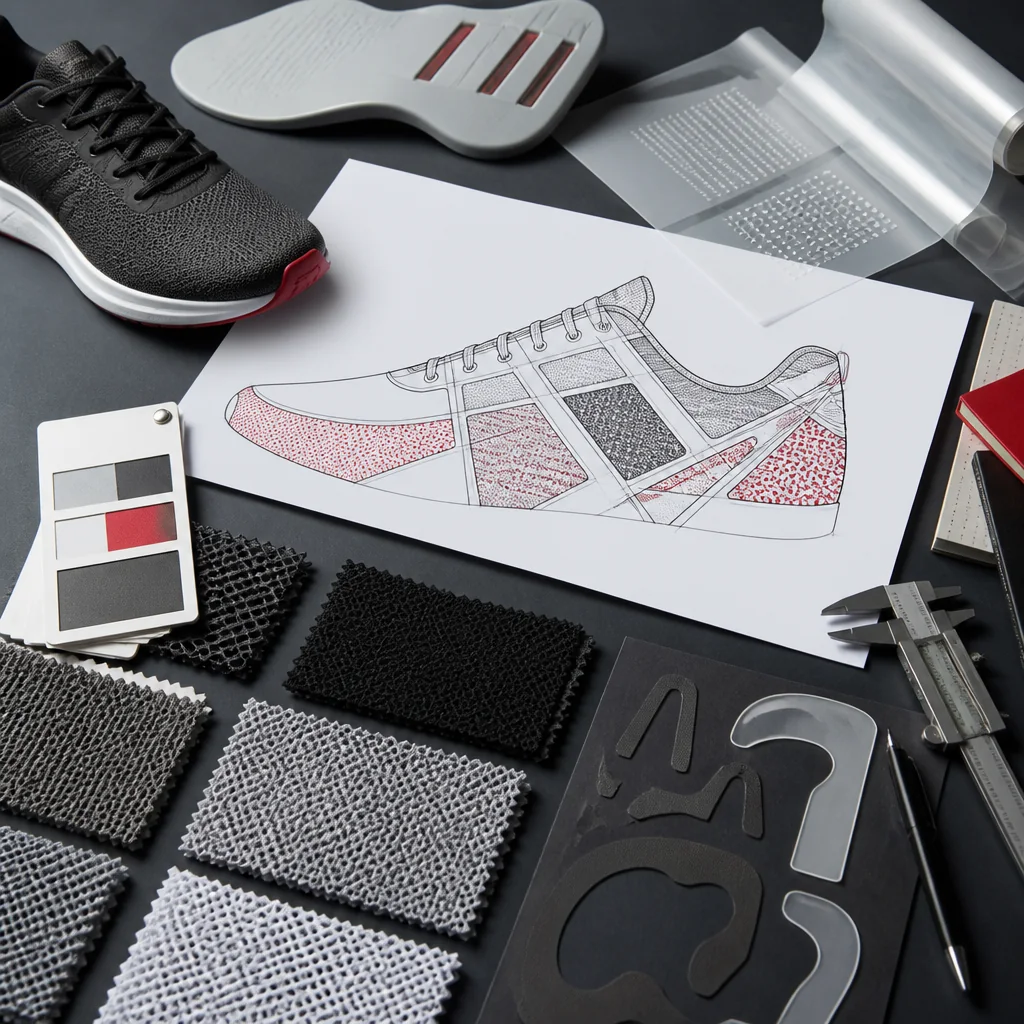
“Breathable mesh” does not define an upper. It leaves the construction, location, density status, intended function and decoration placement unclear. For the buyer, an engineered mesh upper specification for wholesale sneakers should replace that loose note with an upper map. Each map row connects a defined area to a material term, a functional purpose, a GSM status, a decoration reference and any unresolved question.
This is a buyer-side framework, not a company-issued form. The product-focus evidence identifies four sneaker categories. The running-range evidence applies specifically to that listing. The materials evidence supplies mesh terminology, zoned-density context and named decoration processes. The OEM evidence says manufacturability issues are flagged during DFM. Those sources do not select a project-specific construction, GSM value or decoration process.
The category comes before the mesh
Custom Shoe Factory describes its product focus as running, training, walking and casual sneakers. The buyer can select one of those categories for the current design and place it at the top of the upper map. This is an editorial field for organizing the specification, not a documented company classification system.
The running-shoe listing is more specific. It describes performance-inspired daily-training builds with breathable uppers and cushioned midsoles. It also lists mesh, knit and PU as upper categories for that range. Keep those details attached to the running listing rather than carrying the complete description into a training, walking or casual design.
For a clear map header, the buyer should record:
- Product category: the buyer-selected category from the documented running, training, walking and casual product focus.
- Drawing reference: the current upper drawing, file name, date or revision used for the map.
- Location key: the pattern-piece names or marked regions already used in the buyer's drawing.
The location key matters because a material note must point to a defined area. When a pattern-piece name is not precise enough, the buyer can add a marked boundary or anatomical reference without treating the two labels as interchangeable.
Material names are not substitutes
The materials overview names engineered mesh, air mesh and sandwich mesh. It describes engineered mesh as knitted or warp-knit synthetic with zoned density. These terms belong in separate fields because the evidence does not say that they are interchangeable or that every option applies to a submitted design.
| Published wording | Buyer map entry | Status |
|---|---|---|
| Engineered mesh | Place the exact term against the zone where it has been selected or proposed. | Selected, proposed or open. |
| Air mesh | Keep this wording separate and identify the location under consideration. | Selected, proposed or open. |
| Sandwich mesh | Record the specific component or marked region rather than writing it as a whole-upper default. | Selected, proposed or open. |
| Knitted synthetic | Use this construction wording only when it matches the buyer's current reference. | Selected, proposed or unresolved. |
| Warp-knit synthetic | Enter it as its own construction term and retain any open definition question. | Selected, proposed or unresolved. |
An athletic shoe mesh specification becomes misleading when an undecided term is presented as fixed. If the construction has not been selected, write “open for material review” and state the question that needs an answer. That preserves the difference between a buyer requirement and a candidate option.
What job belongs to each zone?
The materials page connects zoned density with ventilation, light stretch and support. These are documented intent categories, not project-specific performance results. The buyer decides where each intent belongs on the current upper.
| Intent category | Recommended map entry | Boundary to preserve |
|---|---|---|
| Ventilation | Mark the zone where ventilation is the primary design intent. | Do not convert the intent into an airflow or test-performance claim. |
| Light stretch | Identify the area where the buyer wants light stretch considered. | Keep the required construction or degree of stretch open unless already defined. |
| Support | Show the zone where support is the primary intent. | Do not treat the word support as a documented performance result. |
A practical editorial rule is to give each zone one primary intent. Additional requirements can remain in a separate constraints field, where they will not obscure the main reason for the zone. A decoration boundary, visible density transition or other buyer-defined condition can be recorded there.
The same source mentions denser knit at the eyestay and toe. Those locations may be retained as source context or adopted as buyer-defined requirements. The source does not make denser construction at either location mandatory for every athletic upper.
GSM belongs to the zone
The published material description gives 90-250 GSM as a typical range depending on the zone. It is not presented as a single whole-upper target. It also does not establish that every value in that range is available or suitable for a particular design.
A wholesale sneaker upper material specification should therefore give each mapped area its own GSM status:
- Requested
- Enter a value when the buyer has already established it, and keep that value attached to the exact zone.
- Open
- Leave the numeric field blank and state what GSM or construction information the buyer wants reviewed.
- Source context
- Record the published 90-250 GSM range as background only, without turning it into a project instruction.
A whole-upper line reading “90-250 GSM mesh” removes the zoned dependency from the published statement. Separate columns for the buyer's request, source context and current status keep that distinction visible.
Decoration needs a coordinate
The materials description associates engineered mesh with screen print, heat-transfer film and welded TPU overlays. For the buyer's map, each proposed process needs a defined location and an artwork reference. Whether the process fits the proposed mesh construction and zone remains a project-specific question.
| Published process | Buyer-controlled input | Question for review |
|---|---|---|
| Screen print | Artwork reference, print boundary and mapped upper location. | What considerations apply to the proposed mesh surface and placement? |
| Heat-transfer film | Film outline, coverage area and the zone receiving the application. | Can the proposed construction and location be evaluated for this application? |
| Welded TPU overlay | Overlay geometry, artwork reference and any material or density boundary it crosses. | What manufacturability issues, if any, apply to the submitted geometry? |
“Logo on mesh” is not enough for this map because it leaves both process and location unresolved. The decoration row should show what the buyer has defined and what still needs review, without presenting the process as approved for every construction or zone.
Fixed inputs, open DFM questions
The documented OEM path says the company manufactures to the buyer's tech pack and design while flagging manufacturability issues during DFM. That statement supports a clear handoff boundary: the buyer provides the current definition, while unresolved manufacturability points remain questions. It does not guarantee approval, pricing, sample acceptance, product performance or production readiness.
| Fixed or proposed by the buyer | Kept open for review |
|---|---|
|
|
An open point should appear as a question, not as an instruction. That status makes later changes easier to trace because a revised proposal will not silently overwrite a fixed location, purpose or decoration requirement.
The upper-map handoff
The finished map can use one consolidated schema:
| Field | Current entry | Required status control |
|---|---|---|
| Product category | One buyer-selected category from the documented running, training, walking and casual product focus. | Selected by buyer. |
| Drawing reference | Current file, date or revision. | Current or superseded. |
| Zone and location | Pattern-piece name, marked boundary or other reference used in the buyer's drawing. | Fixed or proposed. |
| Material term | Exact selected term or a clearly worded material question. | Selected, proposed or open. |
| Intended job | Primary intent plus separately recorded constraints. | Buyer-defined or open. |
| GSM | Buyer-requested value, blank open field or published source context. | Requested, open or context only. |
| Decoration | Named process, artwork reference and mapped location. | Proposed or open for compatibility review. |
| Review question | The specific development, manufacturability, sampling or quotation point that remains unresolved. | Open until addressed. |
Send the current upper map with the relevant tech-pack pages, drawings, artwork and visual references through the quotation request. Ask which development, manufacturability, sampling or quotation options may apply to the package as submitted. The result is a bounded handoff in which selected inputs remain visible and unresolved material, GSM and decoration points remain explicit.
Sources and verification
- About Custom Shoe Factory | OEM/ODM Athletic Shoes First-party site source
- Athletic Shoe Manufacturer | Custom Product Range First-party site source
- OEM / ODM Shoe Development | Custom Footwear Manufacturing First-party site source
- Shoe Soles, Uppers & Insole Materials | Footwear Specs First-party site source
Share the current product definition and ask which development, manufacturability, sampling or quotation options may apply to the project.
Send your project brief