Running Shoes
How to Specify Mesh Zones for Custom Running Sneakers
A procurement worksheet for mapping upper zones, controlling the role of reference pairs and recording material questions for project review.
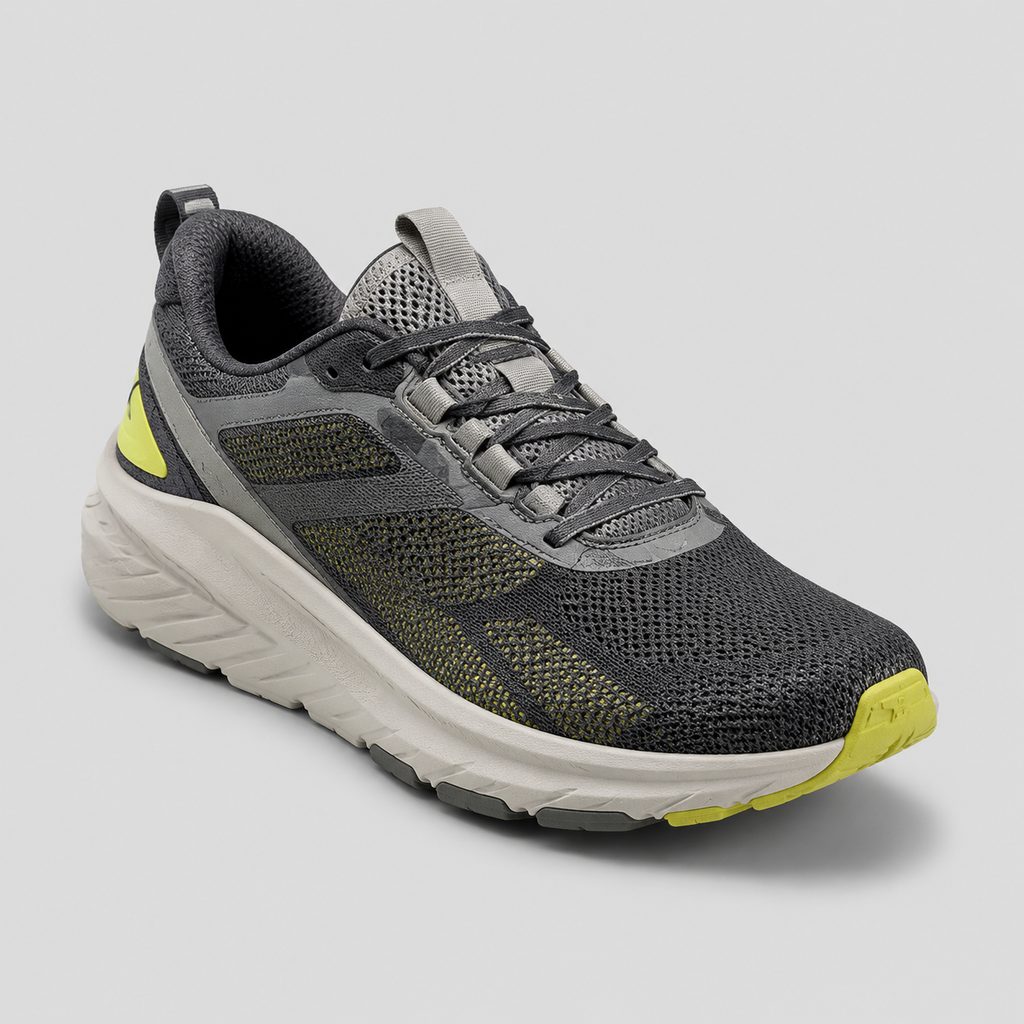
A mesh specification can fail before material selection begins. If a drawing labels the entire upper as "breathable mesh," the artwork may cross an airflow area, the eyestay may have no distinct material direction, and a reference pair may be expected to answer questions it was never assigned. The practical task is to define what each area is intended to do.
For buyers sourcing custom running sneakers, a zone map turns that task into a document that can be reviewed. It shows the intended role of the forefoot, quarters, eyestay, toe and branding areas while keeping unconfirmed materials and constructions visibly open.
Give every decision a status
Before adding material names, mark each entry as a requirement, preference or question. This prevents an attractive detail on a reference shoe from being read as a settled specification.
- Requirement
- A condition the buyer has defined for the proposed product, such as an artwork position, color reference or upper boundary.
- Preference
- A desired characteristic that still depends on material or construction review, such as greater visual openness in the forefoot.
- Question
- An item for which the material, value, method or acceptance criterion has not been selected.
These labels are an editorial documentation method for the buyer, not a stated factory procedure. They are especially useful when preparing information for a custom running shoe manufacturer because one drawing may contain visual requirements, material directions and unresolved technical choices at the same time.
For example, the logo position could be a requirement while the decoration method remains a question. The mesh beneath it could be a preference rather than a selected substrate. Recording those statuses separately keeps the artwork decision from silently approving a material and decoration combination.
Map the upper before naming the mesh
Prepare top, medial and lateral views of the proposed upper, then divide them into functional areas. The worksheet below does not prescribe where ventilation, stretch or support must be placed. It gives the buyer a consistent way to state the intended function and identify what remains to be assessed.
| Upper area | What the buyer should define | What to mark or attach | Question to retain |
|---|---|---|---|
| Forefoot | Intended ventilation, coverage and degree of stretch | Boundaries on each relevant view and any visual reference | Which material direction may be considered for this area? |
| Medial and lateral quarters | Areas intended for ventilation, less stretch, more coverage or overlays | Panel lines, seams and overlay boundaries | Should the material or density direction vary across the quarters? |
| Eyestay | Appearance around the lacing area and the proposed eyelet or loop arrangement | A close view of the lacing concept | What material and construction information is needed for review? |
| Toe | Ventilation intent, toe shape, coverage and visible overlay lines | Proposed seams, films and material boundaries | Which construction directions may be considered for the geometry? |
| Branding area | Artwork dimensions, position, colors and finish intent | Placement drawing and available vector artwork | Which substrate and decoration combination may apply? |
The map should preserve the buyer's actual level of certainty. If "high airflow" is only an objective and no acceptance method has been established, record it as an objective rather than presenting it as a verified result.
Use the material page as a boundary
Custom Shoe Factory's materials page identifies air mesh and sandwich mesh under engineered mesh. It also describes knitted or warp-knit synthetic material with zoned density for ventilation, light stretch and support. Those statements provide possible vocabulary for a brief about engineered mesh running shoes; they do not select a material for a submitted design.
| Documented detail | How it can inform the inquiry | What remains undecided |
|---|---|---|
| Air mesh and sandwich mesh are identified under engineered mesh. | Name either direction if it is genuinely under consideration. | Whether it applies to the proposed shoe or to a particular zone. |
| Knitted or warp-knit synthetic is described with zoned density. | Ask whether density zoning may be considered against the upper map. | Zone geometry, construction and the result for the project. |
| The typical published range is 90-250 GSM depending on the zone. | Keep GSM as a zone-level review topic. | The value, range or suitability for any area of the proposed upper. |
| Denser knit is identified at the eyestay and toe. | Use those locations as discussion prompts when relevant to the concept. | Whether denser knit applies and what density should be assessed. |
The 90-250 GSM statement is zone-dependent. It is not a required range for every project, and it does not show that every value inside the range is suitable for a particular shoe. A buyer's brief should therefore avoid assigning one nominal weight to the whole upper unless that value has been established separately for the project.
Do not let artwork select the construction
Ventilation, stretch or coverage, and branding can overlap on the drawing without becoming one decision. Record them in separate fields: first the intended material function, then any overlay or reinforcement concept, and then the artwork itself.
The materials page states generally that engineered mesh takes screen print, heat-transfer film and welded TPU overlays. This documents broad compatibility only. It does not approve a particular mesh, artwork, color count, placement or assembly for the buyer's design.
- Material function: mark the intended airflow, visual openness, stretch or coverage.
- Construction direction: identify proposed backing, seams, reinforcement or overlay boundaries without treating them as approved.
- Artwork: provide dimensions, placement, colors, files and finish intent independently of the base-material request.
This separation has a direct purchasing consequence: changing a logo size does not automatically change the ventilation requirement, and choosing a mesh direction does not automatically confirm a decoration method.
Limit what a reference pair is allowed to answer
The case-studies page presents an example first running-shoe order from a reference pair through inspected first production. The source supports the presence of a reference pair in that example. It does not establish a universal sequence for every order, promise replication or resolve the submitted project's fit, tooling, construction or intellectual-property questions.
Annotate each reference with one or more limited purposes. A pair might be supplied to discuss silhouette, visible zone boundaries, material hand or branding position. Photographs can be marked in the same way. Features outside the stated purpose should remain separate decisions.
Reference purpose: discuss the forefoot boundary and the relative visual openness of the adjoining zones. Keep fit, tooling, cushioning, outsole, branding and construction open for separate review.
That wording is a suggested entry for the buyer's document. It is not a company instruction or a reported result from the published example.
Carry unanswered items into the inquiry
A zone map is useful partly because it exposes what the available evidence cannot decide. Collect those items in a register instead of filling the gaps with assumed values or methods:
- Exact mesh selection for each relevant zone
- Project-specific GSM or density values
- Color references and color feasibility
- Backing, lining, reinforcement, seam and overlay construction
- Artwork method, dimensions, placement, colors and finish
- Last, fit objectives, size range and fit references
- Cushioning targets, midsole construction and outsole choice
- Testing criteria, acceptance methods and approval responsibilities
- Possible stages of running shoe sample development and the intended evaluation at each stage
- Minimum order quantity, quotation basis, packing and other commercial terms
- Production inspection requirements, acceptance criteria and reporting expectations
These are inquiry topics, not documented services, terms or promises for a particular project. Neither the product description nor the materials description resolves them.
Connect the map to the documented product scope
The company page describes a specialist product family covering running, training, walking and casual sneakers. Separately, the product range describes performance-inspired daily-training running shoes with breathable uppers and cushioned midsoles. It lists mesh, knit and PU as upper categories.
Those statements place a custom running sneaker inquiry within the published range, but the current model still needs its own definition. The submission should identify the product and intended use, attach the annotated upper views, list only the material directions actually under consideration, and include artwork files and scoped references. Add the decision register so requirements, preferences and questions cannot be confused.
Send the resulting package through the project inquiry page and ask which development, manufacturability, sampling or quotation options may apply to the submitted definition. The zone map provides a concrete basis for that conversation while leaving material selection, construction, testing, commercial terms and production requirements subject to project review.
Sources and verification
- About Custom Shoe Factory | OEM/ODM Athletic Shoes First-party site source
- Athletic Shoe Manufacturer | Custom Product Range First-party site source
- Footwear Manufacturing Case Studies | Example Project Formats First-party site source
- Shoe Soles, Uppers & Insole Materials | Footwear Specs First-party site source
Share the current product definition and ask which development, manufacturability, sampling or quotation options may apply to the project.
Send your project brief