Running Shoe Development
OEM BOM matrix: custom running shoe material specification checklist
A buyer-side method for separating current running-shoe material callouts, published range labels, acceptable alternatives, open questions, recorded DFM flags and approval status.
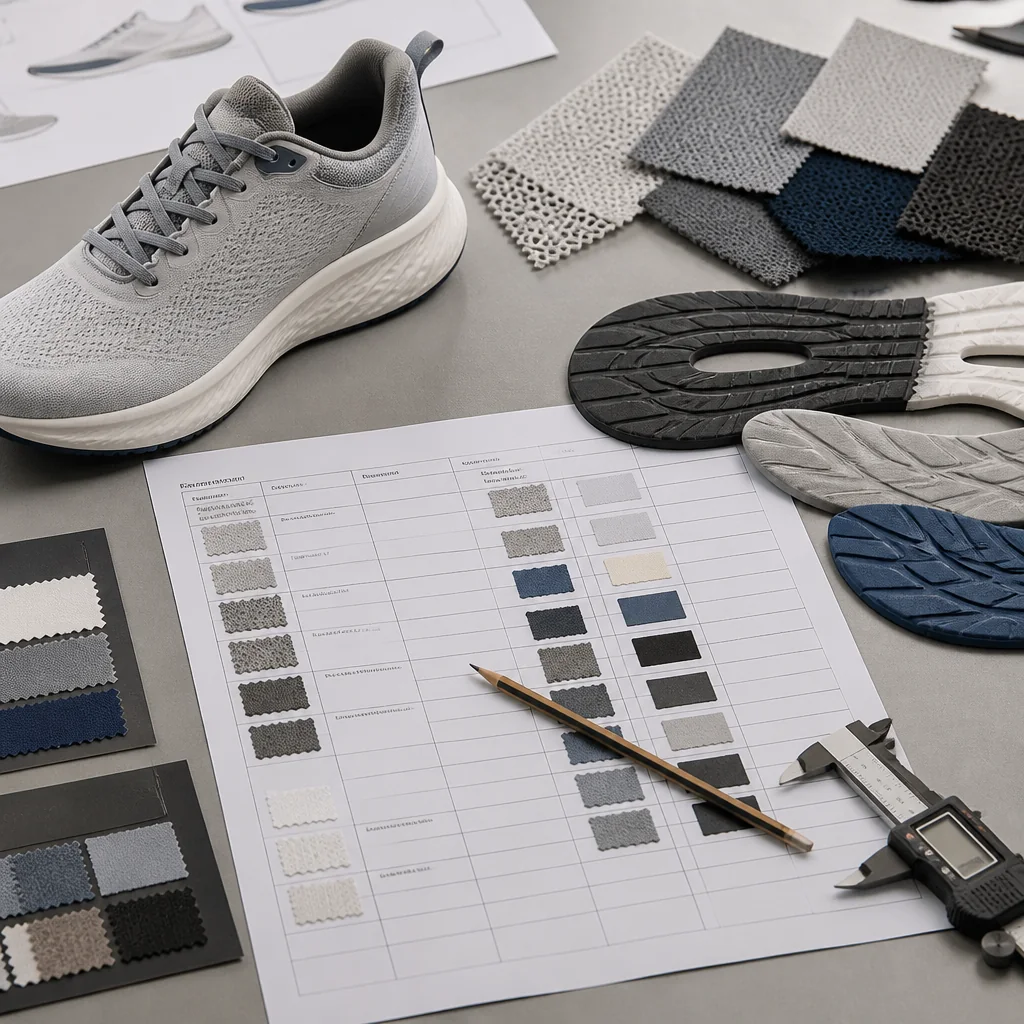
A material label copied from a product-range page can look settled once it appears in a project BOM, even though its exact specification, placement and availability for the design may remain unconfirmed. For buyer-side document control, this article recommends a custom running shoe material specification checklist: a matrix that separates the buyer's current requirement, published category references, permitted alternatives, open questions, manufacturability flags and buyer decisions. The matrix is not a documented Custom Shoe Factory form or service. The cited OEM excerpt supports only that the manufacturer flags manufacturability issues during DFM; it does not establish a standard written note, dated response or return procedure.
What belongs in the buyer's matrix?
For each component or construction zone, the buyer should record the active callout and the document that controls it. Published product language belongs in a separate reference field. Alternatives, questions, DFM flags and decisions also need distinct fields so that one type of information cannot silently replace another.
Suggested buyer-owned material confirmation matrix
| Component or zone | Current tech-pack callout | Authority for callout | Buyer-permitted alternative | Published category reference | OEM confirmation question | Buyer DFM log | Buyer decision or status |
|---|---|---|---|---|---|---|---|
| Upper zone | Enter the exact material, construction and placement currently required | Identify the active tech-pack revision or buyer decision record | Enter an alternative only if the buyer is willing to review it | Mesh, knit and PU are named as upper labels | Is the exact callout available and workable for this design and placement? | Record an issue here only if the manufacturer flags one | Mark open, accepted, rejected or superseded under the buyer's rules |
| Midsole | Enter the buyer's current material and construction requirement | Identify the controlling buyer document | Define the permitted scope of change or enter none | The range describes cushioned midsoles but names no midsole material in the supplied excerpt | Which details need confirmation before this callout can be reviewed? | Keep any recorded flag separate from the original requirement | Record the buyer's decision without treating a proposal as approval |
| Outsole component | Enter the exact callout and placement for each identified part | Identify the active tech-pack revision | List only alternatives the buyer has chosen to consider | EVA and rubber are named as outsole labels | Can the proposed material and construction be evaluated for this design? | Buyer records a manufacturability issue if one is flagged | Keep the item open until the buyer records a decision |
| Other component or finish | Enter the buyer's current definition | Identify the relevant file, sample reference or buyer decision | State the allowed change boundary | No relevant statement appears in the supplied excerpts | What project-specific information is needed to consider this callout? | Do not infer a DFM result where none has been communicated | Use the buyer's document-control status |
Teams reviewing OEM running shoe tech pack materials can adapt these fields to their own document-control rules. If an answer is received, the buyer should record its content, source and date in the inquiry record. If the manufacturer flags a manufacturability issue, the buyer can add that issue to the buyer DFM log. Approval remains a separate buyer-controlled status because the supplied evidence does not say that the manufacturer approves substitutions or final specifications.
Published labels have a narrow use
Custom Shoe Factory's product range describes running shoes as performance-inspired daily-training builds with breathable uppers and cushioned midsoles. It names mesh, knit and PU as upper labels. It separately names EVA and rubber as outsole labels.
On its about page, the company describes its product focus as running, training, walking and casual sneakers. That statement identifies the published product-family scope. It does not provide a project BOM or confirm a material for a particular running-shoe design.
The editorial recommendation for the buyer is to copy a published label only into the matrix's reference column. The current-callout field should contain the buyer's exact project requirement, including whatever construction and placement details the buyer has defined. The supplied range excerpt does not disclose exact material grades, finishes, suppliers or approved combinations.
For an upper, the mesh, knit and PU labels are not evidence that every label is available for the project, suitable for each zone or usable together. For the bottom unit, the EVA and rubber outsole labels do not establish a particular midsole material or a combined EVA-and-rubber construction. Availability, placement and compatibility therefore remain project questions unless they are confirmed for the submitted design.
When does a performance word become a requirement?
Breathable and cushioned are qualitative descriptors in the published running-shoe range. The supplied excerpt gives no test method, measured result, acceptance threshold or project-specific performance approval for either term. A buyer should not use those words as evidence that a selected material will produce a defined outcome.
For buyer-side specification control, the editorial recommendation is to break the intended outcome into separate entries:
- Describe the intended product outcome in buyer language without presenting it as a tested result.
- Identify the component or zone to which the outcome applies. Keep upper and midsole requirements separate.
- Record the evidence, comparison or acceptance basis the buyer intends to use. Mark it unresolved if the basis has not been chosen.
- Ask which development or verification options, if any, may apply to the submitted specification. The question should not presume that a particular method or result is available.
- Identify the buyer-side person or team authorized to accept, reject or request a change.
This structure keeps a performance intention separate from the material label and from approval status. Until the buyer has defined an acceptance basis and reviewed the relevant project information, the matrix should show the item as open.
Who controls each OEM handoff decision?
On its OEM development page, Custom Shoe Factory states that it manufactures to the buyer's tech pack and design. The company also states that it flags manufacturability issues during DFM. Separately, it says that it holds the buyer's bill of materials and tooling across reorders.
Documented OEM scope and recommended buyer records
| Topic | Documented company statement | Recommended buyer record |
|---|---|---|
| Build input | The manufacturer says it builds to the buyer's tech pack and design | Identify the submitted revision, fixed requirements, open items and buyer approval authority |
| DFM | The manufacturer says it flags manufacturability issues during DFM | Log any issue that is flagged, its source and the buyer's status; record a proposal only if one is communicated |
| BOM and tooling | The manufacturer says it holds the buyer's BOM and tooling across reorders | Record relevant identifiers and ask which custody terms apply to the project |
The excerpt does not assign material selection, substitution approval or final specification approval to the manufacturer. It also does not define ownership, exclusivity, storage conditions, fees, duration, access rights or end-of-project disposition for the BOM or tooling. Buyers should address those subjects in project and commercial documentation rather than infer them from the statement about reorders.
Questions that stay open until answered
The supplied pages do not answer the following project-specific running shoe BOM questions. They belong in the inquiry column rather than in the confirmed-specification field:
- Is the exact material callout available for the identified component and placement?
- If the callout cannot be used as submitted, what alternative, if any, may be proposed for buyer review?
- Can the proposed materials and construction be evaluated together for the current design?
- Which changes require buyer approval, and where will each decision be recorded?
- If sampling is available for the project, which steps and timing would apply?
- What MOQ, packing, cost and quotation terms, if any, apply to the submitted definition?
- Which performance criteria will the buyer provide, and which development or verification options may apply?
- Which terms govern the identification, custody, access and disposition of the BOM or tooling referenced for reorders?
For the buyer's own control, any answer received can be classified as a confirmation, proposal, manufacturability flag, commercial condition or unresolved item. That classification is a recommended buyer practice, not a documented factory workflow. It keeps technical decisions, commercial terms and open questions from being recorded as though they carried the same status.
The package sent for review
The buyer should send one active project definition and preserve superseded information outside that active package. The following sequence is an editorial recommendation for a bounded OEM inquiry:
- Identify the current tech pack and design revision. Keep older callouts in the buyer's revision history rather than mixing them into the active specification.
- Include the material confirmation matrix with the current requirement and its controlling source completed for each component or zone.
- Distinguish fixed requirements from alternatives the buyer is willing to review. Enter none when no substitution is currently permitted.
- List unresolved questions about availability, compatibility, performance criteria, approvals, sampling, timing, MOQ, packing, quotation terms and BOM or tooling custody.
- Ask which development, manufacturability, sampling or quotation options may apply to the submitted project definition.
When the package is ready, use the project inquiry page to share the current definition and its open questions. Published range terms can remain visible as references, while project requirements, DFM flags and buyer decisions stay in their designated fields.
Sources and verification
- Athletic Shoe Manufacturer | Custom Product Range First-party site source
- OEM / ODM Shoe Development | Custom Footwear Manufacturing First-party site source
- About Custom Shoe Factory | OEM/ODM Athletic Shoes First-party site source
Share the current product definition and ask which development, manufacturability, sampling or quotation options may apply to the project.
Send your project brief