Product Development
Buyer Brief: Sole Specifications for a Custom Sneaker Manufacturer
A source-labeled method for keeping published sole wording, buyer decisions and unresolved construction questions separate in a running-shoe inquiry.
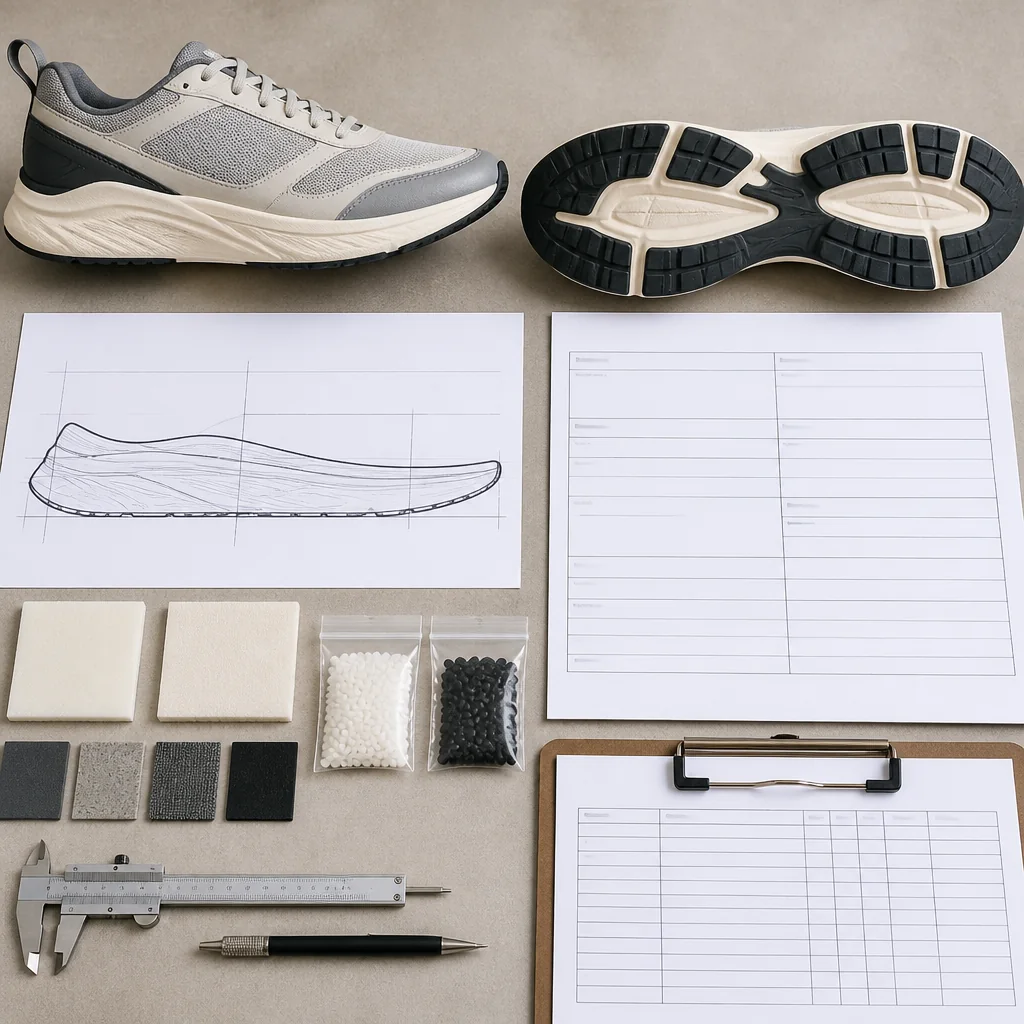
The product page uses the phrases "cushioned midsoles" and "EVA & rubber outsoles." A buyer can quote those phrases, but they do not establish a sole construction for a particular project. When drafting sole specifications for a custom sneaker manufacturer, this article recommends tagging both phrases as reference wording before completing any project-specific material, arrangement or acceptance field. The first phrase describes a midsole characteristic. The second places two material names beside an outsole label without explaining their relationship.
Evidence boundary: Company statements below are limited to the supplied product, About and OEM excerpts. Every worksheet field, status label and suggested question is an editorial recommendation for the buyer, not a description of a documented company practice, capability or promise.
Build a source-and-status register
Start by separating published category language from the buyer's design. The product page provides the running-shoe descriptions. The About page supplies broader product-family context. Neither excerpt is a substitute for the buyer's project files.
| Published wording | What it establishes | What remains unresolved | Recommended buyer status |
|---|---|---|---|
| Running, training, walking and casual sneakers | The About excerpt lists these categories within one sport-footwear product family. | It does not identify the category, use or requirements of the buyer's proposed shoe. | Use as category context. Record the project category separately. |
| Performance-inspired daily-training builds | This is the published description for the running-shoe entry. | The excerpt gives no project-specific use statement, test method or result. | Mark as reference wording unless the buyer independently adopts and defines a related requirement. |
| Cushioned midsoles | The running-shoe entry applies this wording to midsoles. | No midsole material, geometry, measurable requirement, acceptance method or result appears in the excerpt. | Keep as reference wording. Enter buyer-defined midsole information on a separate line. |
| EVA & rubber outsoles | The published outsole line contains the terms EVA and rubber. | The excerpt does not define placement, coverage, compound, configuration or the relationship between the terms. | Mark the full phrase as reference wording and leave the project arrangement open. |
The purpose of the register is to show provenance. A status such as reference only identifies language that came from a company page. Fixed by buyer can identify a decision already stated in the project files, while open can identify a question that still needs an answer.
Keep the ampersand in the question
The punctuation in "EVA & rubber outsoles" connects two terms grammatically, but it does not approve a technical interpretation. Treat the possible readings as inquiry questions rather than available constructions.
| Interpretation to ask about | Evidence limit | Recommended project question |
|---|---|---|
| Are EVA and rubber alternatives? | The excerpt does not confirm separate outsole options. | Are these terms alternatives for the submitted design, or does neither term apply as currently written? |
| Are both terms part of one arrangement? | No combined construction, placement or coverage is described. | Does the submitted design use both terms, and where would that arrangement need to be defined? |
| Does the phrase summarize multiple configurations? | The excerpt does not explain the punctuation or identify a number of configurations. | Which, if either, of the published terms is relevant to this project? |
A custom sneaker outsole inquiry should not select one of these readings solely from the ampersand. Quote the full source phrase, state the project's current material status and ask what project-specific definition is needed. That approach leaves the answer open without implying that any listed interpretation is offered or manufacturable.
Write one record for each component
Within a running shoe sole specification, use separate records for the midsole and outsole. Add another component or interface only when it is identified in the buyer's current design. The following editorial sequence keeps material language from being transferred between components.
- Name the component and status. Identify the record as midsole, outsole or another buyer-defined part. Mark it fixed by buyer, open or reference only.
- Cite the project source. Point to the relevant tech-pack page, drawing, model, BOM line or other current design reference. If no project source exists, mark the field open.
- Record the geometry reference. Cite buyer-defined dimensions, profiles or drawings where available. Do not create dimensions from the general product wording.
- Record material language exactly. Enter a buyer-selected material or compound only when it appears in the project files. Keep website wording in a distinct reference field.
- Separate requirements from descriptions. Link any buyer-defined measurable requirement and acceptance method to its project source. Do not use "cushioned" by itself as a measurable threshold.
- Ask one focused question. Tie the question to the named component, file reference and open decision instead of requesting a general review of the entire sole.
EVA should not be moved into the midsole record merely because the product page also mentions a cushioned midsole. In the supplied excerpt, EVA appears in the outsole wording. That placement still does not establish how EVA relates to the outsole in the buyer's design. The same restraint applies to rubber: retain the source wording until a project-specific definition is confirmed.
Use DFM within the published OEM scope
On the OEM development page, Custom Shoe Factory says, "We manufacture to your tech pack and design" and says it flags manufacturability issues during DFM. The excerpt establishes manufacturing to those named inputs and manufacturability flagging. It does not allocate authorship of the sole specification, material selection or performance validation to the company.
| Topic | Published scope | Recommended treatment |
|---|---|---|
| Design baseline | The OEM statement refers to "your tech pack and design." | List the current project files and identify which sole decisions appear in each one. |
| Manufacturing | The company says it manufactures to the tech pack and design. | Distinguish buyer-approved inputs from website references and unresolved questions. |
| DFM | The company says it flags manufacturability issues during DFM. | Name the proposed feature, component or interface for which comments are requested. |
| Specification authorship, material choice and performance validation | The supplied OEM excerpt does not assign these responsibilities to the company. | Keep each item buyer-defined or explicitly open until its project-specific scope is confirmed. |
Recommended OEM running shoe DFM questions should point to a specific entry: Does the feature identified on the cited drawing present a manufacturability issue? Would a flagged issue affect a named drawing or BOM line? Which buyer decision or file revision would need clarification? These questions request comments within the published DFM boundary without presuming a broader development service.
The page title mentions OEM and ODM, but the supplied excerpt describes only the OEM build-to-spec path. It does not document a separate allocation of sole-development responsibilities for ODM.
Move BOM and tooling to a separate track
The same OEM excerpt says Custom Shoe Factory holds "your bill of materials and tooling across reorders." Keep that statement intact and narrow. The excerpt gives no ownership, storage-duration, cost, replacement, revision-control or availability terms. It also does not say that any tooling is associated with the sole unit.
As an editorial recommendation, place these topics in a commercial or project-administration section of the inquiry:
- Which BOM identifier and revision correspond to the submitted design?
- Does the proposed project involve project-specific tooling?
- If tooling is relevant, which item and component are being discussed?
- What custody, storage, cost, replacement and change terms would apply?
- Which confirmed BOM and tooling terms would apply to a later reorder?
These are questions for the project. They should not be presented as documented services, agreed commercial terms or evidence that particular tooling will be required.
Assemble the buyer brief
Place the following source-labeled block near the front of the inquiry:
- Footwear family
- Name the buyer's project category. Identify any company product-family wording as reference context.
- Buyer-stated use
- Describe the proposed use in the buyer's own project language, separate from the published daily-training description.
- Design baseline
- List the current tech pack, design, drawing and BOM references that are relevant to the inquiry.
- Midsole record
- Enter its source, geometry reference, buyer-stated material, requirement reference, acceptance method and decision status. Mark unresolved entries open.
- Outsole record
- Use the same fields for the outsole. If quoted, label "EVA & rubber outsoles" as product-page reference wording.
- Arrangement question
- Ask whether either published material term is relevant to the submitted design and what definition is still required.
- DFM questions
- Identify the proposed features, components or interfaces for which manufacturability comments are requested.
- BOM and tooling questions
- Ask separately whether relevant tooling is involved and which project-specific commercial or custody terms would apply.
- Requested next step
- Ask which development, manufacturability, sampling or quotation options may apply. Do not presume that a particular option is available.
Share the current definition in a project inquiry. Keep each component, material term, requirement and tooling topic attached to a named source and decision status. The resulting brief will show which wording came from the website, which decisions belong to the buyer's current files and which points remain open for a project-specific response.
Sources and verification
- Athletic Shoe Manufacturer | Custom Product Range First-party site source
- About Custom Shoe Factory | OEM/ODM Athletic Shoes First-party site source
- OEM / ODM Shoe Development | Custom Footwear Manufacturing First-party site source
Share the current product definition and ask which development, manufacturability, sampling or quotation options may apply to the project.
Send your project brief